
What Does the Future Hold for Private-Market Investing?
How the convergence of public and private markets could affect investors and managers.


What’s the better investment: a mutual fund or the stock of the mutual fund manager? Morningstar analysts tackled this question several times in the 1990s and 2000s, comparing fund returns with the share price performance of publicly traded fund managers. Back then, the data typically favored the latter.
But times have changed. In “New Era for US Asset Managers” Morningstar senior equity analyst Greggory Warren cited fee compression, the shift to passive investing, regulatory changes, distribution costs, and an aging population as headwinds facing traditional asset managers. It’s not surprising that the Morningstar industry index of publicly traded asset managers has lagged the broad equity market over the past decade.
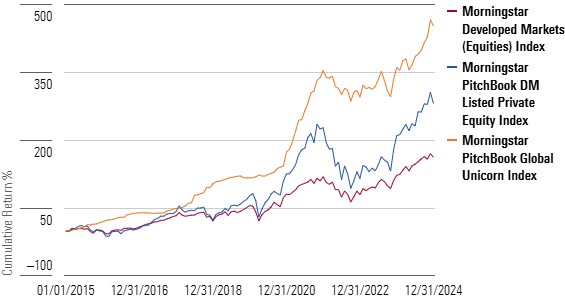
The picture is very different, though, for asset managers specializing in private markets. The Morningstar PitchBook Developed Markets Listed Private Equity Index has gained 281% in cumulative terms for the 10 years through 2024 compared with a 163% advance for the broad market for developed equities. Companies like Blackstone BX, KKR KKR, Partners Group PGHN, and ICG ICG have seen their share prices surge, reflecting a boom in private markets.
Private-market growth leads me to ask two big questions:
- Are the shares of publicly traded private market managers outperforming actual private-market investments?
- Will the good times for private markets keep on rolling?
The answers aren’t clear, but they are worth contemplating.
The Rise and Rise of Private Markets
Beyond the soaring share prices of private-market managers, many statistics tell the dramatic growth story of private markets. There’s the roughly $15 trillion sitting in private equity, venture capital, real estate, real assets, and private-debt-focused funds, according to data from PitchBook, Morningstar’s private-market research arm. That’s up nearly threefold in a decade’s time. Then there are the 1,336 constituents of the Morningstar PitchBook Global Unicorn Index of private companies worth more than $1 billion, up from fewer than 100 a decade ago and rendering the “unicorn” term no longer appropriate. On the debt side, there’s the $1.6 trillion private credit market, of similar size to high-yield bond and leveraged loan markets.
Ask Your Advisor These Questions Before Investing in Private Credit
Why has this happened? Policy and regulation are a big part of the reason more capital is being raised in private markets than public. The SEC has blamed itself for measures that allowed private companies to raise capital with fewer burdens. The 2012 JOBS Act in the US increased the maximum number of shareholders in private companies. Jamie Dimon, CEO of JPMorgan Chase, blames the reporting burden on public companies, which is not only costly but also competitively compromising. Another common theory is that managers want to grow their businesses without the pressure of quarterly earnings.
Low interest rates in the many years following the 2007-09 global financial crisis also helped fuel the boom. “Leveraged buyout” was a popular term in the 1980s “before some marketing genius fastened on ‘private equity’ as a way to disguise the fact that the business still rests on a mountain of debt,” in the words of venture capitalist Michael Moritz. It’s no coincidence that sharp rate hikes starting in 2022 acted as a speed bump on private-market deal activity.
Are Private Markets Really All That?
How does the performance of publicly traded private-market investors compare to actual private-market funds and the assets they target? There are a few ways of answering this question. None of them are perfect.
First, we can compare the returns of the Morningstar PitchBook Developed Markets Listed Private Equity Index, which measures the performance of publicly traded companies with significant private-markets exposure, to private-markets funds. The listed private equity index has recorded an average annual gain of 14.4% for the past decade in gross return dollar terms. But the performance of PitchBook Benchmarks, which are peer group averages, is displayed in terms of internal rate of return, which, “is not appropriately compared with the time-weighted return of a public index,” write PitchBook analysts in a recent note called Numbers Mean Nothing Without Benchmarking. For what it’s worth, the average internal IRR for all funds with a 2014 vintage is 11.8% net of fees through 2024’s third quarter. Of the different categories of funds, private equity performed best, recording an IRR of 17.5%, followed by funds of funds (15.7% IRR) and venture capital (16.2% IRR). Real estate, real assets, and private debt were all in the 8%-10% range. Another important caveat: This fund data is self-reported. Dispersion between top- and bottom-performing funds can be large.
What about the Morningstar PitchBook Global Unicorn Index’s track record? That benchmark tracks private companies backed by venture capital that are worth more than $1 billion. It was launched in 2022 with performance back-cast to late December 2014 based on a pricing methodology that estimates daily valuations, an inexact science for companies that aren’t marked to market. Pricing factors in funding rounds, deals for comparable private companies, and changes in comparable public company valuations. Annualized returns for the index approached 19%. The big year was 2021, when the index rose 66%.
Private Market Investments vs. Private Market Investors
Another attempt to measure the performance of private company investments was made by Morningstar manager researcher Jack Shannon. Shannon studied mutual funds’ ownership stakes in private companies and concluded that “mutual funds would have been better off allocating their private stakes to public markets over the last 10 years.” In Shannon’s analysis, removing funds’ ownership in a single unicorn—SpaceX—would have left their private investments in net negative territory. It’s a sobering conclusion. Clearly the jury is still out.
What Does the Future Hold?
When envisioning the path forward for private markets, it’s key to remember their relationship to public markets. Morningstar’s unicorn pricing model considers public market comparables for good reason. After the down year of 2022, venture capital activity slowed considerably, 2023 being the worst year for unicorn creation since 2017. Down markets discourage IPOs as an “exit route” and lower private company valuations. The Morningstar PitchBook Developed Markets Listed Private Equity Index fell nearly twice as far as the broad equity market in 2022.
Despite inevitable cyclicality, though, the long-term secular growth story for private markets looks strong. “There is plenty of room for private fund AUM to expand further,” concluded PitchBook in a May 2024 report modeling the growth trajectory of private equity, venture capital, real estate, real assets, and private-debt-focused funds. The authors project private capital reaching nearly $20 trillion by 2028, with an upside scenario of nearly $24 trillion and downside of $16 trillion.
“Private-market allocations have become a cornerstone of institutional investors’ portfolios,” write the authors of the PitchBook report. The “Yale Model,” heavily reliant on “alternative” investments, has been widely adopted. “Asset owners” like pensions, endowments, foundations, and sovereign wealth funds don’t mind the long lockup periods and lack of daily pricing that comes with private-market investing.
Meanwhile, efforts are underway to bring private markets to the masses. The term “access class” is jokingly used to describe private equity, because it’s available only to “qualified” or “accredited” investors. In addition to mutual funds holding a small portion of their portfolios in private companies, interval funds, closed-end funds, ETFs holding private credit, and “secondaries” platforms all aim to provide a piece of the action. For investors, private-market exposure without high fees, illiquidity, and opacity is a positive. For the asset manager, it’s an opportunity to “diversify its capital pool,” in the words of PitchBook research director Nizar Tarhuni.
Will the “alternative asset managers” included in the listed private equity index see the same margin compression that has undermined the returns of their public counterparts? Morningstar’s Warren sees most as benefiting from narrow moats around their businesses, noting competition, “continued pressure on fees, and a general maturation of the segment.” Firms like BlackRock, which have traditionally focused on public securities, are upping their involvement in private assets.
Mass market accessibility would bring fees down. The aim for the managers is to compensate through higher volumes. Clearly, public and private markets are converging. How this convergence will affect investment managers focused on private markets is an open question.
The author or authors do not own shares in any securities mentioned in this article. Find out about Morningstar’s editorial policies.
Morningstar, Inc., licenses indexes to financial institutions as the tracking indexes for investable products, such as exchange-traded funds, sponsored by the financial institution. The license fee for such use is paid by the sponsoring financial institution based mainly on the total assets of the investable product. A list of ETFs that track a Morningstar index is available via the Capabilities section at indexes.morningstar.com. A list of other investable products linked to a Morningstar index is available upon request. Morningstar, Inc., does not market, sell, or make any representations regarding the advisability of investing in any investable product that tracks a Morningstar index.

 United States