
Why Private Direct Lending Is an Attractive Alternative to Public Securities
A different way to gain access to the corporate debt risk premium.


This article mentions funds that have an issuer-initiated rating and/or track a Morningstar Index. For full disclosure information, please refer to the specific funds, which are demarcated with a * symbol, listed below.
Over the past three decades, regulatory reform and industry consolidation have driven banks away from corporate lending activity. To fill the gap, private direct lending emerged with independent asset managers funded by capital from institutional investors, replacing banks as providers of secured first-lien commercial loans. By 2024, according to the International Monetary Fund, the private credit market has grown to more than $2 trillion globally, about three-fourths of which is in the United States, where its market share is nearing that of syndicated loans and high-yield bonds.
Private Debt Markets Have Grown Rapidly in Size
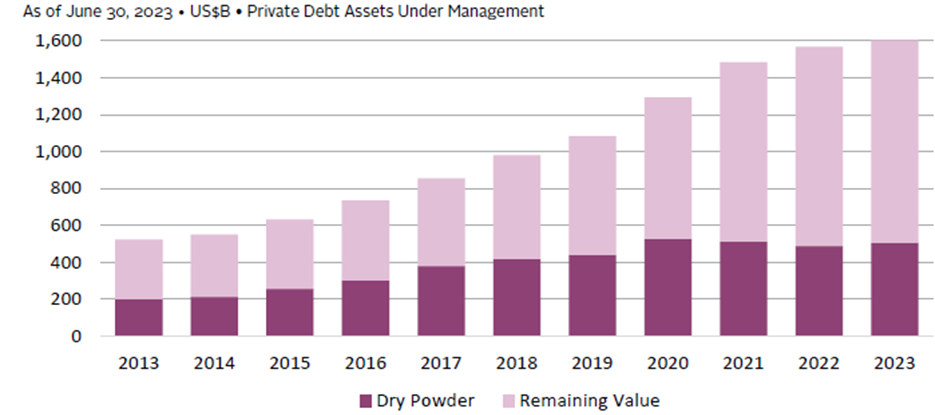
The market has grown rapidly, and the speed, flexibility, and certainty of execution that direct lenders provide have proved valuable to borrowers and their private equity sponsors. Although private credit is illiquid, institutional investors such as pension funds and insurance companies are attracted by the higher returns and reduced volatility.
Characteristics of Middle Market Loans
Commercial loans made by asset managers or other nonbank lenders typically have a five- to seven-year maturity (though effective maturities have been roughly three years because of early repayments) and charge floating interest rates based on a reference rate, such as the one- or three-month secured overnight financing rate, plus an interest-rate spread to compensate for the risk of loss from borrower default. The interest spread varies depending on many factors, including the perceived riskiness of the borrower, industry, loan/value ratio, seniority, covenants, and other factors. In addition to interest income, lenders receive an “original issue discount” for originating and underwriting the loan. Original issue discount is received when the loan is issued in the form of lender proceeds that are 1% to 3% less than the final principal. This upfront price discount is generally considered additional interest income and is amortized over the life of the loan. In addition, middle-market loans receive fees for loan prepayments, which can total a one-time 1% to 2%.
Middle-market loans are generally not rated, are considered non-investment-grade, and are not traded in the secondary market. As a result, yields are generally greater than traditional broadly syndicated bank loans and publicly traded high-yield bonds.
The growth in direct middle-market loans originated by asset managers is partly explained by the growth in middle-market private equity. These loans are referred to as “sponsor-backed.” Private equity sponsors often prefer to borrow from asset managers rather than traditional banks because asset managers offer speed, certainty of execution, and greater financing flexibility.
Investors in middle-market loans can preselect the types of risks they want to take. For example, many investors, particularly first-time investors, choose the least risky senior secured loans, with yields currently averaging about 11%. More-experienced investors, or those seeking further diversification, may be comfortable investing in second-lien or mezzanine loans, with yields currently in the 13% to 15% range. Investors may also choose middle-market loan funds that use some leverage. Portfolio financing is readily available to managers with strong track records and performing loan collateral, and private funds focused on senior secured loans often use one to two turns of leverage to enhance returns.
Middle-market loan performance is the combined outcome of (1) interest income, (2) realized losses through impairments, (3) unrealized net gains or losses from periodic valuations, and (4) fees and expenses.
Gaining Access to the Asset Class
One way to access the corporate debt risk premium in a highly diversified way is with the Cliffwater Corporate Lending CCLFX. The fund, with more than $20 billion in assets, is highly diversified across 12 industries and more than 20 private lenders, with more than 3,700 underlying credits, with an average loan size of only about $5 million, representing a small fraction of the underlying loan size. The fund’s investments are almost exclusively in senior secured loans to companies backed by private equity sponsors, with 95% first-lien exposure as of May 31, 2024.
Cliffwater does use modest leverage within the fund (the regulatory maximum is 0.5 times net assets for interval funds). However, fees are applied only to net assets, not gross assets; fees are not applied to the leveraged assets. Cliffwater has set maximum leverage at $130 of gross assets for each $100 of investor assets. Assuming 30% leverage, the 1.63% expense ratio becomes 1.25% on investor assets (investors are paying $1.63 per $100 of their assets, but the fund would have $130 of assets, and $1.63 on $130 of assets is 1.25%). Thus, the effective expense ratio is 1.25%, not 1.63%. (Note: The effective fee would be higher if the fund does not use its full leverage ability.) And importantly, in contrast with many other direct lenders, the fund does not charge a performance fee.
In the 2024 edition of its annual fee survey of 66 of the largest middle-market direct lenders, managing $1.1 trillion in direct lending assets, Cliffwater found that the average total fees and administrative expenses for private debt funds was 4.12%. At an effective fee of 1.25%, Cliffwater Corporate Lending’s expense ratio is less than one third the average fee.
A concern, or objection, to the use of this fund is that its “posted” expense ratio is much higher compared with other passive/systematic investment strategies and compared with daily liquid corporate credit funds. Compared with Invesco Senior Loan ETF
BKLN
Passively managed funds, like index funds, buy and hold publicly traded, liquid investments. And they are systematically managed in a transparent and replicable manner, resulting in low expense ratios, though typically higher than for similar index funds. An investor should be willing to pay a higher fee for funds that can add additional value through providing deeper exposure to factors (such as size, value, probability, and momentum). Systematically managed funds also can add value through intelligent design (screening out securities that similar index funds would hold because they have historically earned lower returns) and patient trading. In other words, one shouldn’t consider only the expense ratio but also the value added relative to the expense ratio. Cliffwater Corporate Lending is a very different type of fund from either Invesco Senior Loan ETF or Vanguard High-Yield Corporate.
Cliffwater Corporate Lending doesn’t invest in publicly traded, highly liquid securities. Instead, in effect, it is running a bank that makes loans to private companies—the fund reviews and approves every loan submitted to it prior to investing. And it seeks to be very conservative in its lending, noted by the average loan/value of only about 40% as of June 2024 (that low loan/value ratio allows the fund to borrow for leverage at very low costs). With that in mind, investors should ask: Is this a good alternative to Invesco Senior Loan ETF and Vanguard High-Yield Corporate? To make that determination, we will analyze the yields and expected net returns to investors seeking corporate credit risk exposure, comparing Cliffwater Corporate Lending to Invesco Senior Loan ETF (which also makes floating-rate senior secured loans) and Vanguard High-Yield Corporate (which invests in publicly traded high-yield bonds).
Invesco Senior Loan ETF
The following analysis will demonstrate why, despite the relatively high expense ratio, Cliffwater Corporate Lending is a good alternative, which also explains why investors are receiving value for the fee paid. I will begin my analysis with the expected returns to that of Invesco Senior Loan ETF and Cliffwater Corporate Lending. For educational purposes, the following example is hypothetical but is based on current market yields and historical realization of gains and credit losses.
Comparing Cliffwater Corporate Lending to Invesco Senior Loan ETF
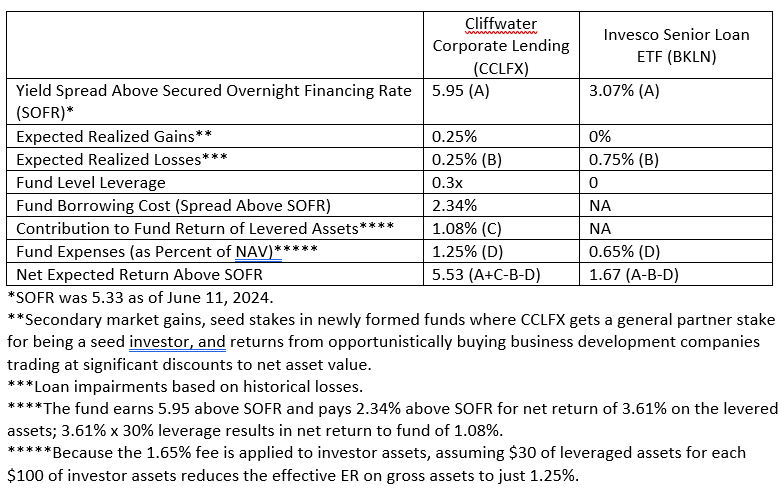
From the above table, despite having an expense ratio that on the surface is 0.98% higher than that of Invesco Senior Loan ETF, Cliffwater Corporate Lending has a higher expected return of close to 4 percentage points without even including the 83 basis points expected from origination discounts. In addition, Cliffwater Corporate Lending’s conservative lending policies have resulted in significantly lower default losses—higher expected net returns with less economic cycle risk and less inflation risk.
Cliffwater has a very strong due-diligence process in its manager selection and has high credit standards (focusing on senior secured loans backed by private equity firms) and broad diversification across managers with long track records in specific industries.
Vanguard High-Yield Corporate
The other alternative, Vanguard High-Yield Corporate, has an expense ratio of just 0.22%. Vanguard High-Yield Corporate’s option-adjusted yield as of June 11, 2024, was 6.8%. It also had a duration of about 3.3 versus less than 0.25 for the Cliffwater Corporate Lending. Subtracting the 0.22% expense ratio brings the yield down to 6.6%. That’s just 1.3% above SOFR while taking three more years of interest-rate risk. However, we need to also consider credit risk.
Using 20-year default rates by rating from JPMorgan and applying Vanguard High-Yield Corporate’s rating weights as shown by Morningstar, the estimated weighted-average default rate is 1.25%. Using the same historical information from JPMorgan, a 40% recovery weight (60% loss rate) applied to the 1.25% default rate results in a 0.75% credit loss rate (1.25% x 60%). Subtracting 0.75% (expected losses due to loan impairments) from 6.6 (yield minus the expense ratio) provides an estimated return of 5.85%—only 52 basis points above the current SOFR yield (versus more than 5% for Cliffwater Corporate Lending). Once again, one can see that by considering only a fund’s expense ratio, investors can make very poor choices, as Cliffwater Corporate Lending has significantly higher expected returns, lower duration/inflation risk, and also less credit risk. (Note that Vanguard shows a default history for Vanguard High-Yield Corporate of just 0.27%. However, funds like Vanguard High-Yield Corporate can sell bonds that have fallen in rating before default occurs. Thus, they incur losses while not reporting defaults. For example, currently Vanguard High-Yield Corporate holds only about 5% of its assets in bonds rated below B. Using actual historical defaults by rating is a more appropriate methodology for estimating the impact of credit risks.)
Performance of Cliffwater Corporate Lending Versus Daily Liquid Funds
From inception in July 2019 through May 2024, Cliffwater Corporate Lending returned 9.5% per year. By comparison, liquid loans, as represented by the SPDR Blackstone Senior Loan ETF SRLN, the largest fund of its kind with assets under management of $6.6 billion, returned 4.2% per year; the index fund focusing on senior secured floating-rate bank loans, Invesco Senior Loan ETF, with $8.3 billion in AUM, returned 4.0%; investment-grade bonds, as represented by the iShares Core US Aggregate Bond ETF AGG, with $108 billion in AUM, returned negative 0.4% per year; and Vanguard High-Yield Corporate returned 3.2%.
Investor Takeaway
Investors seeking higher yields and relatively low risk, and who are willing to sacrifice liquidity, will find attractive opportunities in interval funds that invest in senior secured, sponsored middle-market loans.
The analysis shows that once the expected returns from origination discounts are included, Cliffwater Corporate Lending has an expected return above SOFR of 5.53 or 3.86 percentage points higher than that of the 1.67% for Invesco Senior Loan ETF and 5 percentage points higher than that of the 0.52% for Vanguard High-Yield Corporate. Since inception, Cliffwater Corporate Lending has outperformed those estimates, providing a 5.3% higher return than Invesco Senior Loan ETF and a 6.3% higher return than Vanguard High-Yield Corporate.
The bottom line is that while bank loans (leveraged loans) are useful in creating investment-grade tranches of structured vehicles, attractive to insurance companies and other regulated entities (for regulatory capital purposes), they are unattractive within other investor portfolios when private credit (debt) is an alternative.
There’s a cliché about individuals who know the price of everything and the value of nothing. That applies to investors who focus solely on the expense ratio to judge the worthiness of an investment. The right way to think about the expense ratio is whether the expected return after all costs compensates the investor for the risks taken, and how the addition of that investment impacts the overall risk and return of the portfolio.
Hopefully the above examples demonstrate that, when viewed through the proper lens, investors are receiving good value for their investment in gaining exposure to corporate credit risk through a fund like Cliffwater Corporate Lending. The “equitylike” expected returns are compensation for the risks of occasional significant losses (caused by economic cycle risks) as well as the illiquidity of the interval structure, which requires the fund to provide at least 5% per quarter (20% per year) but may need to prorate if redemptions exceed that amount. For those investors who don’t need daily liquidity for at least some significant portion of their portfolio (likely true for almost all investors), the illiquidity premium—while not a free lunch—can be viewed as a “free stop at the dessert tray!” For example, consider the retiree who is taking no more than their required minimum distribution from their IRA account. Even at age 90, the RMD is not even 10%, and interval funds are required to meet liquidity demands of at least 5% every quarter.
Larry Swedroe is the author or co-author of 18 books on investing, including his latest, Enrich Your Future: The Keys to Successful Investing.
The author or authors own shares in one or more securities mentioned in this article. Find out about Morningstar’s editorial policies.
Larry Swedroe is a freelance writer. The opinions expressed here are the author’s. Morningstar values diversity of thought and publishes a broad range of viewpoints.

 United States