
3 Recommendations for Fund Companies Not Named Vanguard
How the rest of the industry can compete against the Vanguard juggernaut.
Breakfast, Lunch, and Dinner Earlier this week, I was asked to give my 2017 outlook for the fund industry. My reply: "It will be like 2016, but more so." Just as 2016 was 2015 writ large, and 2015 expanded on 2014. The fund industry has become like the film Source Code, where each scene repeats and intensifies the previous one, except that in the movie, repetition leads to progress, whereas for fund companies not named Vanguard, each year brings the bomb closer to detonation.
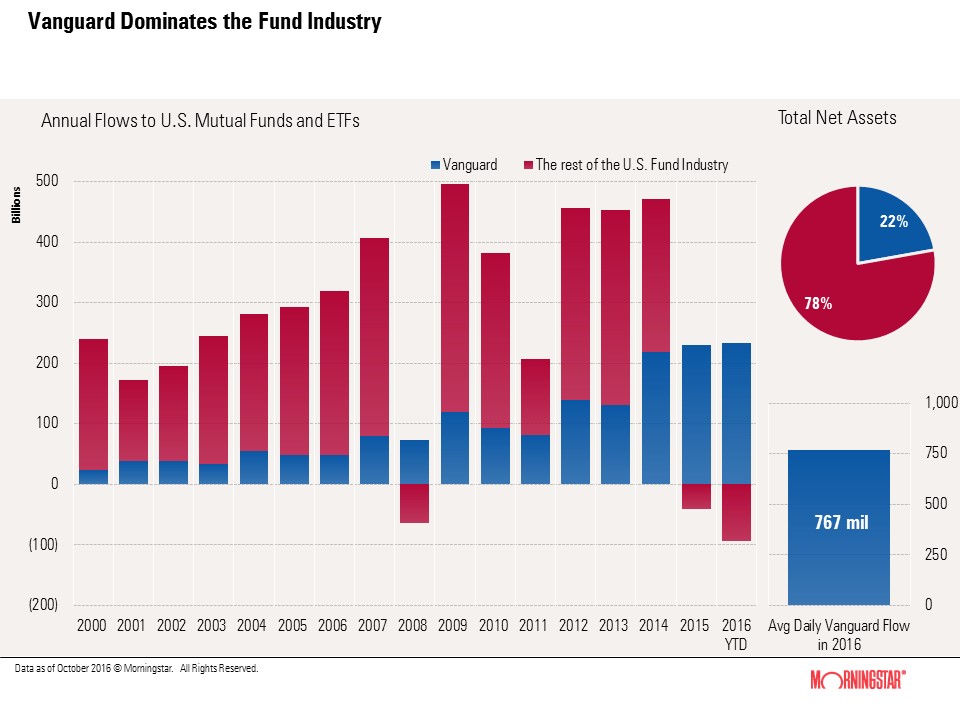
In the words of a Morningstar colleague, "Vanguard is eating the rest of the industry." That's one way of putting the matter. Devouring, gobbling, ingesting, inhaling, swallowing, and absorbing are other ways. To switch metaphors, Vanguard is
That's right: Vanguard enjoyed the largest sales ever by a fund company in 2014, outdid that record in 2015, and beat it again in 2016. In the process, Vanguard not only snatched the leftovers from the rest of the fund industry, but also stole food from their larders. Over the past two years, Vanguard has attracted more than 100% of the industry's new assets. It has turned the volume up to 11.
Unsolicited Advice Into the breach has stepped Ritholtz Wealth Management's Josh Brown, who offers seven suggestions for Vanguard's would-be competitors. (The article lists six ideas, but number five has two items.) Three are very much on track. Vanguard's rivals would do well to heed--assuming, of course, that they value their survival.
First, briefly, Brown's four discards: 1) Fund companies should not try to beat indexers at their own game by offering actively managed core U.S. stock funds; 2) Benchmarks aren't "neutral" investments; 3) Performance fees might help; and 4) The industry should consolidate.
My responses: 1) These days, fund companies rarely launch such funds. Their actively run "closet index" funds are legacy investments, established many years back; 2) While it is true that benchmarks are created by investment committees rather than The Lord, index-fund shareholders care not about provenance; 3) Performance fees won't help (I will leave it at that; this subject needs rather more discussion, or none at all); and 4) The industry has begun to consolidate, albeit slowly.
On that final item, Brown is correct that fund companies should show more haste, but the reality is that investment management is an outstanding business. Even fourth-tier fund companies are profitable, after paying their employees distinctly above-average wages. Change comes slowly in such environments.
On to the three winners:
Only for You Mutual funds (and exchange-traded funds) are a democracy, and Vanguard has captured the masses. So, why play that game? Why be a democracy? As Brown recognizes, many people continue to love the aristocracy. So, give the people what they want. Offer them funds that are only available for a limited time, until they reach a certain size, at which point they will be closed.
Writes Brown, "When I started in the retail brokerage business, one of the first things I taught was how to take 'indications of interest' from clients for new issues coming to market. The key to a good pitch was to explain to clients that the initial public offering shares were 'first come, first served' and that we couldn't guarantee that any client would get the full amount of stock that they were requesting--or any at all, in some cases. It worked."
Yes, it does work. Implying scarcity sells stock IPOs, and closed-end funds, and concert tickets, and pretty much everything else as well. True, for fund companies pursuing such an approach, it means conceding volume. It means being a secondary provider. Selling scarcity is niche strategy, not the market leader's strategy. Well, competitors, guess what--we have a market leader already, and it's not you. Time for Plan B.
Although Brown, correctly, frames this suggestion as being about fund-company positioning--"good funds should be marketed like luxury products"--it's not entirely cynical. Niche companies that offer small, closed funds can pursue investment approaches that Vanguard cannot. Possessing enormous scale is helpful for mainstream, low-turnover investing. It is not necessarily a boon elsewhere.
Going Boldly The second idea also turns Vanguard's strategy on its head.
Vanguard built its brand on avoiding surprises--in particular, on minimizing the tracking error between its funds and their benchmarks. Its actively run stock funds are highly diverse, usually with multiple managers, and its fixed-income funds are, as Jack Bogle long ago conceded, passive in all but name. Then there are its official index funds. If you know how the markets have performed, you know how Vanguard's funds have performed.
The savvy competitor will do the opposite. It will use its niche position to deliver funds that are capable of very large surprises. Brown writes, "Tracking error is seen as a dirty word among consultants and advisors and uninformed journalists." (So, informed journalists are not prey to the mistakes made by all consultants and advisors? I wish that were so.) "It's not. It's a positive. It means that you're actually getting something for your money."
Not if it's negative, it's not. But the point is well taken. Other companies can offer funds that Vanguard would never launch, because of its size and brand. Funds that have concentrated portfolios; or buy into small, illiquid corners of the market; or follow investment strategies that can only succeed through high turnover. Vanguard's value-style funds, whether actively or passively run, will have hundreds of positions. Come at Vanguard with a fund that holds 25 stocks. (But keep costs at least somewhat in line; previous incarnations of concentrated funds have erred, in part, by being too expensive.)
Better Owners
Brown's final idea, I believe, is the most profound--and by far the least understood. He advises, "Ask more of your investors." He cites as an example Dimensional Fund Advisors, which (in)famously requires financial advisors who wish to use its funds to
attend
education seminars on DFA's investment principles. Brown writes, "Advisors using DFA funds are better informed, the thinking goes, and so they themselves (along with their clients) aren't panicking or switching money in and out of volatile markets."
This has largely been true. Which has redounded to DFA's benefit, as advisors and investors who have had good market experiences tend to bring more business to the investment firms that have served them. Educated investors make for better investors; better investors tend to have happier investment experiences; and those with happier investment experiences tend to come back for more. Win, win.
To be sure, Vanguard deserves similar credit. Its communications task has been eased by the simplicity of its message; extolling the virtues of low cost, while avoiding investment surprises, is not the most complex of tales. Nonetheless, Vanguard has been exceedingly clear and consistent in explaining what its funds can and cannot do, including warning prospective buyers about funds that appear to becoming faddishly popular.
Rivals can and should do more. Brown's advice: "Skip the full page ads in Kiplinger's and focus some attention on the behavior of the end users of your product. Behavior, after all, is the single biggest determinant of investor success--not manager tenure or how many analysts you have or how many Morningstar stars you accumulate."
True that.
John Rekenthaler has been researching the fund industry since 1988. He is now a columnist for Morningstar.com and a member of Morningstar's investment research department. John is quick to point out that while Morningstar typically agrees with the views of the Rekenthaler Report, his views are his own.
The opinions expressed here are the author’s. Morningstar values diversity of thought and publishes a broad range of viewpoints.

 United States