
Does Adding Dividend Stocks Improve Portfolio Performance?
Dividend stock investing for total return.


This article mentions funds that have an issuer-initiated rating and/or track a Morningstar Index. For full disclosure information, please refer to the specific funds, which are demarcated with a * symbol, listed below.
Today’s Goal
There are two reasons to invest in stocks that pay dividends. One is to improve the portfolio’s total returns, accomplished by reinvesting their payouts. The other is to generate retirement income. Rather than reinvest dividends, retirees could spend them. In effect, dividend stocks would substitute for cash or bonds.
Today’s article addresses the first issue: Does adding dividend stocks improve portfolio returns? (The second potential use for dividend stocks, as fixed-income replacements, is a matter for another day.) Stock market indexes already include many dividend-paying securities. The issue then becomes whether investors should own even more. If so, dividend stocks must deliver at least one of three benefits: 1) higher total returns, 2) lower volatility, or 3) better diversification.
Here I will address those three possibilities, following up on two articles I devoted to this topic when the year began: “Are Dividend Funds All That?” and “Which Type of Dividend Fund Do You Prefer?”
Total Returns
Ask whether U.S. stocks have beaten their international rivals, or whether short-term Treasury notes have outgained high-yield bonds, and the response will quickly be forthcoming. The indexes that track those investments each perform similarly. Whether the benchmark is supplied by Morningstar, Dow Jones, or Standard & Poor’s, the answer does not change.
Not so for dividend stocks. While all indexes take essentially the same approach when cloning the conventional stock and bond markets, they diverge with dividend stocks. Some use a very broad benchmark, while others shrink the field by incorporating quality screens. Or they may whittle down the portfolio not by seeking the sturdiest companies, but instead the highest available yields.
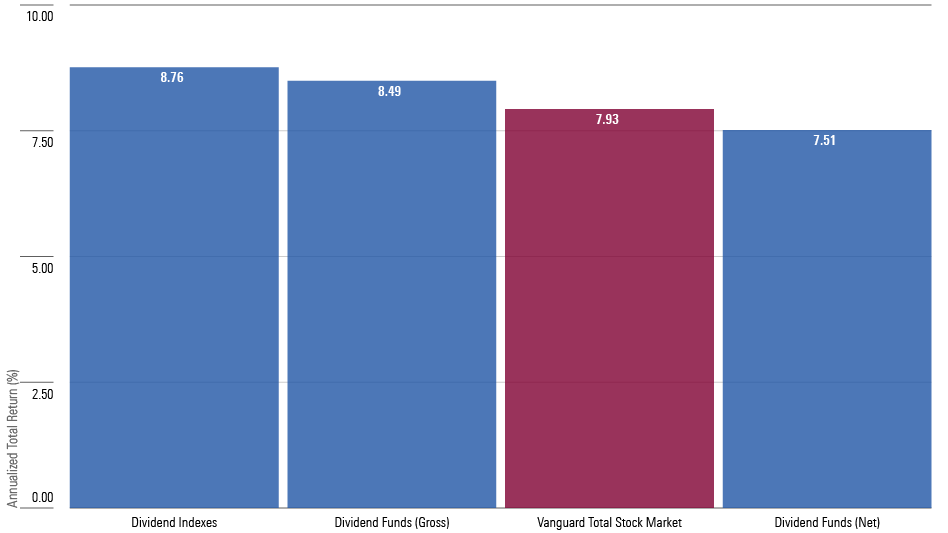
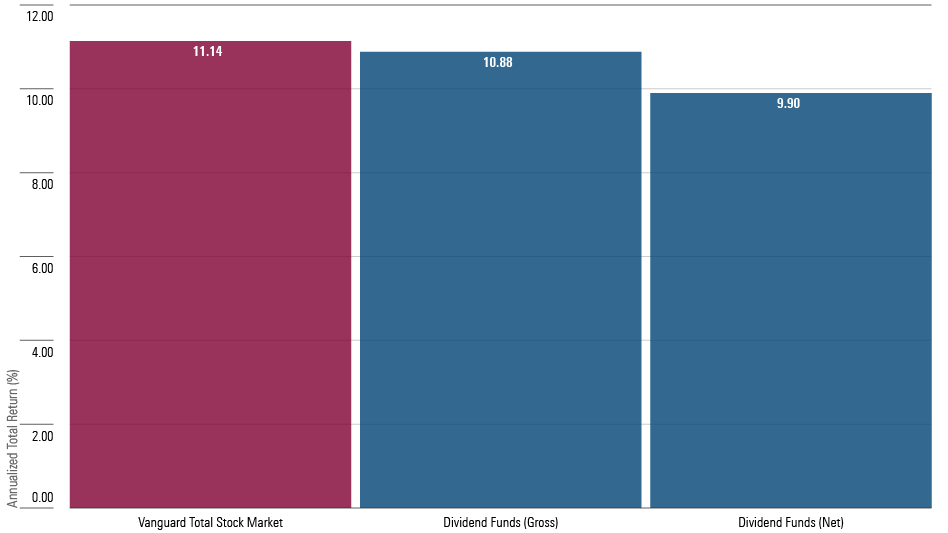
Consequently, I cast a wide net. My study group for dividend stock investments includes two sets of averages: 1) all domestic dividend stock indexes with 25-year track records and 2) all domestic dividend mutual funds with similarly long histories. Here are their results.
The 25-Year Returns
Dividend Stocks’ Triumph
An impressive showing! Of the 945 large-company U.S. equity funds that existed in 1998, only 137 have since outgained Vanguard Total Stock Market Index VTSMX. (More than half failed even to complete the journey.) Yet the average return for both the dividend stock indexes and the precost version of the funds managed that feat.
It is perhaps not surprising that the dividend stock indexes shone, as all were launched after the 25-year period began. Consequently, they benefited from hindsight analysis, as their creators could craft investment rules that made for strong back-tested performance. However, the funds enjoyed no such privilege.
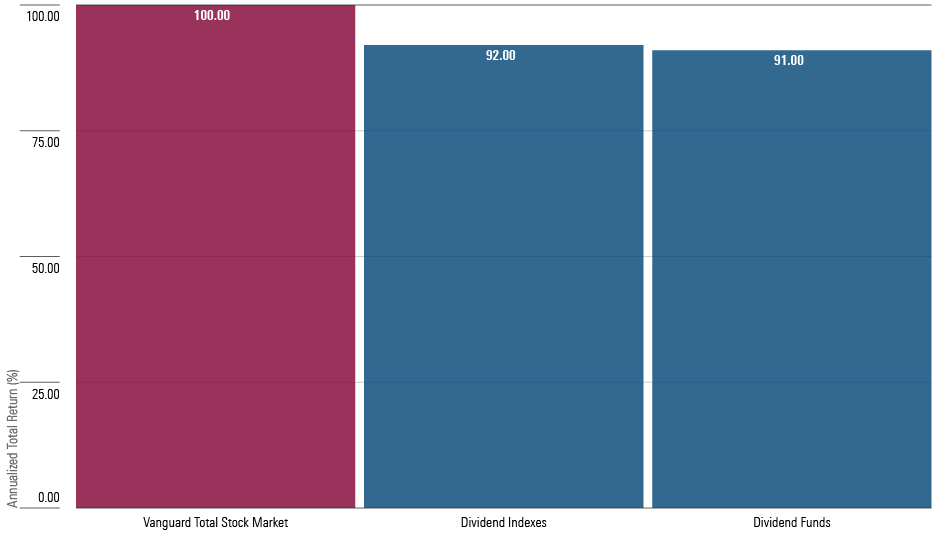
Enticingly, the returns from the dividend stock indexes and funds were accompanied by lower volatility. The next chart shows the average standard deviation for each set of investments, again compared with that of Vanguard Total Stock Market Index. (In this instance, I scaled the totals instead of showing the raw amounts.) Once again, the dividend stock strategies prevailed.
Along with Lower Risk
The Caveats
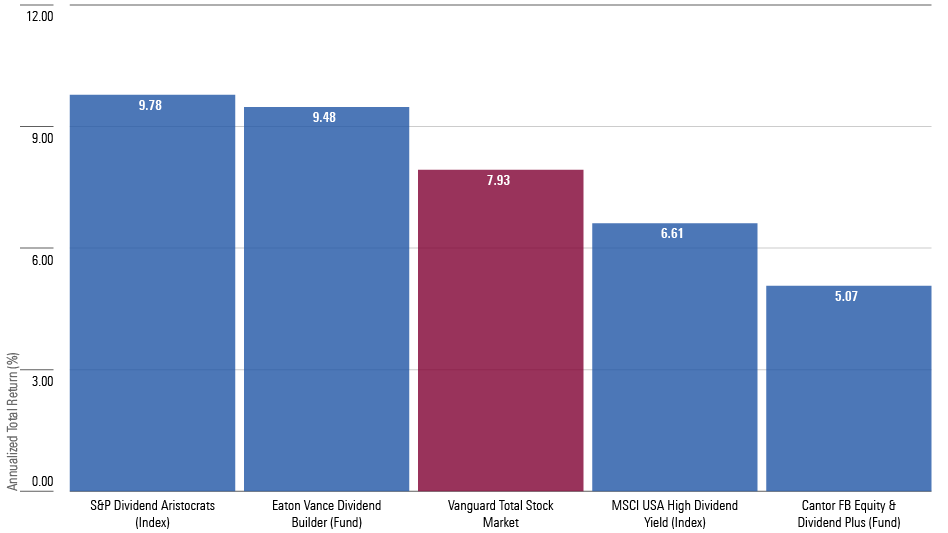
So far, so good. However, as suggested earlier, these victories do come with a catch. Because the performances of dividend stock strategies vary so greatly, their investors have not necessarily beaten the market, even while the overall strategy thrived. The category has contained losers as well as winners. Below were the period’s top and bottom returners, among both indexes and practicing funds.
The Best and Worst
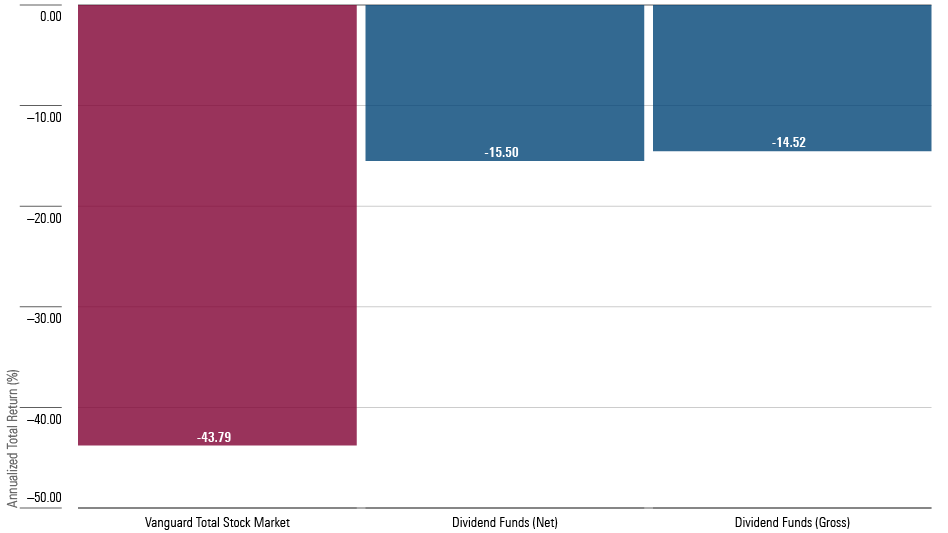
A second drawback concerns the timing of the results. (To simplify the discussion, I have omitted the dividend stock indexes, addressing only the funds’ returns. But the argument applies to both.) Dividend-stock funds were ideally positioned to weather the technology stock crash that occurred from 2000 through 2002, as they were only lightly exposed to the sector. While Vanguard Total Stock Market Index lost nearly 44% cumulatively, owing to calamitous losses from its growth stocks, dividend stock funds dropped only one third as far.
The Technology-Stock Crash
That was a terrific result! However, from 2002 until 2022, when they once again resisted a downturn, dividend-stock funds performed unremarkably. Even including 2022′s relative success, when most dividend funds kept their losses to the single digits, the total returns for such funds since the technology-stock crash have trailed those of the overall market. (For additional discussion on the recent performance of dividend stocks, see Friday’s “Markets Brief: What’s Wrong With Dividend Stocks?”)
Since Then
Additional Diversification?
We have now addressed the first two potential benefits of adding dividend stocks to a portfolio: higher returns and lower risk. When evaluated over the full 25 years, dividend stock strategies have been moderately superior on both accounts. However, that success owes to two brief periods that occurred almost 20 years apart. In other words, while dividend stock strategies have made a case for themselves, investor patience very much has been required.
The third potential benefit, as previously mentioned, is portfolio diversification. After all, as Dr. Harry Markowitz taught us, investment contributions should be measured in context, not isolation. If dividend stocks behaved differently from other securities, thereby providing the portfolio with what other investments cannot, they would deserve inclusion.
To an extent, they do possess that feature—but so do value stocks. For example, Vanguard alone offers three value-style mutual funds—Vanguard Selected Value VASVX, Vanguard Windsor VWNDX, and Vanguard Windsor II VWNFX—that collectively lost less money than the average dividend fund from April 2000 through September 2002 and fell the same distance in 2022. Over the entire 25-year period, each of those funds also outgained the dividend fund average, Thus, it’s difficult to recommend dividend stocks for their diversification advantages when mainstream blue-chip values funds can accomplish much the same.
Wrapping Up
These comments should not be mistaken for criticism. Dividend funds have earned their keep. The only question is whether they deserve an above-market weighting for investors who seek superior total returns. I do not believe they do, but I can certainly understand if others dissent. Friday’s column will be for those investors, as it will discuss the details of dividend stock strategies.
The author or authors own shares in one or more securities mentioned in this article. Find out about Morningstar’s editorial policies.
The opinions expressed here are the author’s. Morningstar values diversity of thought and publishes a broad range of viewpoints.

 United States