
Don’t Believe the Retirement Defeatists
Vanguard’s report brings additional hope.

Spend Less? A couple of years back, I wrote several columns on in-retirement issues. It wasn't a subject that I had previously considered, but time marches onward, and the topic was beginning to feel relevant.
Upon looking through the conventional wisdom, my immediate reaction was that it was too gloomy. The numbers that people carried around in the television commercials (remember them?) were overstated. Those figures assumed unrealistically high spending needs and unrealistically low withdrawal rates. To be sure, Americans were--and are--saving less than they should, but the gap between actual and best practices is less than advertised.
Morningstar's David Blanchett has amply addressed the issue of spending needs. In "Estimating the True Cost of Retirement," David scrapped the convenient heuristic of assuming a 30-year time horizon and an 80% replacement rate for income, and he looked instead at how long people actually live, what their needs are during retirement, and how these needs change over time. David's conclusion:
"While a replacement rate between 70% and 80% may be a reasonable starting place for many households, when we modeled actual spending patterns over a couple’s life expectancy, rather than a fixed 30-year period, the data shows that many retirees may need approximately 20% less in savings than the common assumptions would indicate."
Well, that’s a nice start--particularly for this column’s relatively wealthy audience, because David’s calculated replacement rates decline for higher incomes.
Withdraw More? David has also studied withdrawal rates, but I won't cite him for that, because you'll stop believing me if I use only Morningstar sources. Also, Vanguard has issued a new white paper on the topic, with some handy-dandy calculations on appropriate withdrawal rates.
Mind you, Vanguard doesn't bill its report as being about withdrawal rates. The paper bears the generic title of "From assets to income: A goals-based approach to retirement spending." Nor will you find any sense of victory in its findings--that perspective is all mine. Vanguard--being Vanguard--presents "just the facts, ma'am." (If Vanguard were asked to select an ice cream flavor, it would refuse the assignment, finding vanilla to be too daring.)
But victory for investors it is.
The customary rule of thumb is that a retiree can withdraw 4% of a portfolio’s value per year. (This figure is expressed in real terms, meaning that it is adjusted by the rate of inflation.) In recent years, many have suggested that 4% is too optimistic. That figure was promoted when bond yields were higher than they are today, stock-price ratios were lower, and expected asset returns brighter. Is it not irresponsible to continue to use 4%, when the world has changed?
Conservative Input, Conservative Output All true--if the 4% rule were not founded on three highly conservative, and constraining, assumptions.
One is that the withdrawal rate be required to last 30 years. In pitching for assets, financial-services firms wave their arms and talk about how much longer people live today than in the past. That is so, but it is also so that only about 1.5% of the population now survives to age 95. That number will increase as medical science improves, and the amount needed doubles for couples, but no matter how much waving is done, there’s no way to get that figure near 50%. For the large majority of retirees, 30 years is too long.
A second constraint is the requirement that the withdrawal rate never fail. The 4% rule was derived by putting portfolios through the historical wringer, looking for any time when the 4% approach would have depleted the investments before the full 30 years. Never is a very strong word, and 100% a very high degree of certainty. We can all elude dying from an automobile accident by avoiding cars entirely. Few of us make that choice.
Finally, the withdrawal rate is foolishly inflexible. It means that every year, no matter what, the retiree requires the same amount as the previous year, adjusted for inflation. There’s no need for anybody who is above subsistence level to behave like that. Most people have at least a modicum of discretionary income. And as it turns out, not much more than a modicum is required.
By the Numbers Let's see how this all plays out, by Vanguard's reckoning.
First, the calculated withdrawal rates using forecasts from Vanguard’s Capital Markets Model, and a projected 85% success rate for the simulations.
These numbers contain three of the four adjustments to the traditional 4% rule. They incorporate VCMM’s lower projections of the future, rather than the higher results of the past; they show the effects of shortening the time horizon; and they target an 85% probability of portfolio success, rather than 100%. However, the numbers in this chart do retain the assumption of inflexible spending.
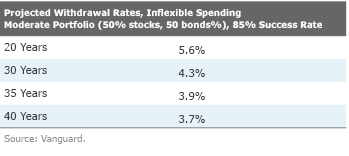
Using a 30-year time horizon and taking into consideration today’s steep financial-asset prices (sure, Vanguard’s market outlook might be mistaken, but the company is as reliable a source as can be found), investors can withdraw at 4.3% annually for a balanced portfolio, with 85% confidence. Dropping the time horizon to 20 years bumps the withdrawal rate by more than a percentage point, to 5.6%. That’s better than advertised, right there.
Better yet, by adjusting discretionary spending.
Even a small adaptation can lead to a big improvement. Consider, for example, Vanguard’s results for a spending strategy that changes modestly along with a portfolio’s balance. If the portfolio shrinks during the year, then the retiree cuts spending accordingly, but only up to 2.5% of the previous spending amount. That is, if the investor withdrew $40,000 in the previous year, when the financial markets sold off, then he would spend $39,000 the following year. Similarly, spending would rise during bull markets, by a maximum of 5% per year (plus, once again, an adjustment for inflation).
As hardships go, an occasional 2.5% spending cut isn’t exactly atop the list. However, the benefits from showing even that amount of flexibility are substantial:
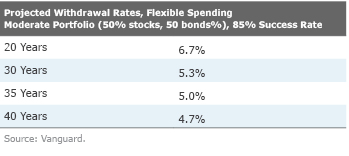
By implementing only a modicum of common sense, the retiree raises the 30-year withdrawal rate (as before, at the 85% forecast probability) for a balanced portfolio to 5.3% from 4.3% and the 20-year probability all the way to 6.7%. Or, for those with very early retirement dates, fantastic genetics, or a severe case of overconfidence, a withdrawal rate of 4.7% for a 40-year horizon.
(The percentages are higher yet if the floor is lowered, so that the investor is willing to cut more than 2.5% from the following year’s spending if the current year’s financial markets are poor.)
Less Is More The back of the envelope yields the upshot. By traditional retirement math, a worker making $75,000 would require an annual income of $60,000 (80% replacement ratio) during retirement. If $20,000 of that is covered by Social Security, then a $1 million portfolio would be required to generate the remaining $40,000. By new math, the worker might require a retirement income of $50,000 (67% replacement ratio), leaving $30,000 uncovered after Social Security, which could be generated with a 5% withdrawal rate on a portfolio of $600,000.
It might be just me, but accumulating $600,000 seems to me a significantly easier task than coming up with a million bucks.
Of course, this analysis cannot be considered anything more than illustrative. Costs, taxes, and investment mistakes can push the nest egg's retired size right back up to where it started. I do not claim retirement planning is easy or that complications cannot arise. I only claim that the news is better than is commonly believed.
John Rekenthaler has been researching the fund industry since 1988. He is now a columnist for Morningstar.com and a member of Morningstar's investment research department. John is quick to point out that while Morningstar typically agrees with the views of the Rekenthaler Report, his views are his own.
The opinions expressed here are the author’s. Morningstar values diversity of thought and publishes a broad range of viewpoints.

 United States