
Good Selection, Bad Timing for Fund Investors
Investors buy the right funds, but at the wrong times, says John Rekenthaler.

Good Selection We'll start with the good news: People are better at selecting mutual funds than are monkeys armed with darts. (Besting an octopus at predicting soccer matches is another matter.) It is true that if the experiment contains more monkeys than darts, several apparent geniuses will be discovered. But make the test large enough, so that the results reflect the monkeys' actual abilities, and the humans will come out ahead.
That's because people, unlike monkeys, have skill.
Consider the aggregate returns for mutual funds, calculated in two different ways. One is the standard method of measuring fund averages: treating each fund equally, regardless of size. The other is to weight funds according to their assets, so that giant funds count for proportionately more than the small funds. The first approach is the Senate, the second the House. A Senate victory means that investors collectively chose poorly, while a House victory means the opposite.
During the past decade, the House has won. Below are the trailing 10-year returns for mutual funds, generated in each fashion. The calculations are thorough, as they use monthly data, considering all funds that were in existence at the time, even if those funds have since been merged or liquidated. The pattern is clear: Across the board, the asset-weighted pools beat the equal-weighted pools. The selection gap, as I have termed the difference, is positive for all fund types.
(Note: As discussed in last week's column, investment math sometimes must sum to zero. For example, the pool of all investors cannot time the U.S. stock market well or poorly, because for every winning trade, there lies on the other side a losing trade of equal value. However, mutual fund performance does not follow that logic. There's no reason why every large fund couldn't surpass every small fund, or vice versa.)
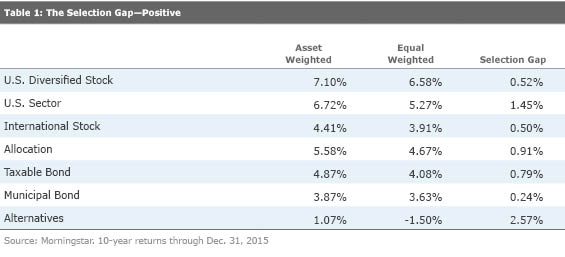
It would be a mistake to credit investors for the entire selection gap. Rolling up several hundred (or thousand) funds into a single figure inevitably creates unintended consequences. For example, the asset-weighted U.S. diversified stock group is dominated by giant large-company stock funds, which gives it an advantage over its equal-weighted rival when blue chips outperform and harms it when they lag. Similar effects occur for each of the investment groups; the comparisons are not pure.
However, seven victories in seven tries suggest there's something more to the positive selection gap than fortunate circumstances. So, too, does the knowledge that previous Morningstar studies reveal a similar pattern. Across time periods and investment types, asset-weighted returns almost always are higher than equal-weighted returns. The people are doing something right.
Cost Matters Most of which consists of holding cheaper funds. Expense ratios explain the bulk the difference in performance between the asset- and equal-weighted averages. Table 2 shows the selection gap, the difference in expense ratio between the asset- and equal-weighted averages (the asset-weighted pool is cheaper in all cases), and the remainder after the second is subtracted from the first.
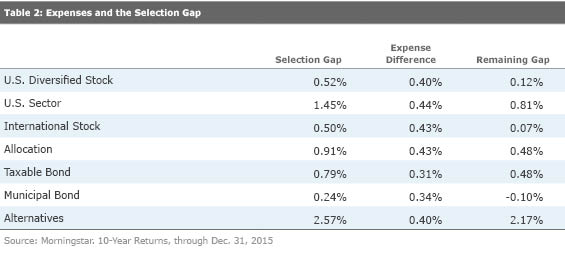
Of course, that investors own lower-cost funds is not a strike against their decision-making. It's the easy path to outperformance, but it nonetheless surpasses what the monkeys can manage. It's also worth noting that, whereas two decades ago fund investors owned cheaper funds mostly by accident, as they placed cost well down on their priority list, they now aggressively seek lower expenses. Most new inflows go into funds with annual expense ratios of less than 0.50%.
There has been some additional benefit even after the cost difference; the sign for the remaining gap is positive for six out of seven groups. I wouldn't make too much of that, though. The two biggest positives, alternatives and sector funds, occur with the smallest, most-idiosyncratic groups; the accidental effects in those areas are large indeed. The remaining positives are relatively minor and could also occur because of the fortune of darts, so to speak.
Bad Timing That was the win. Now for the loss: asset timing. This is a familiar story, told each year by Russ Kinnel in his Mind the Gap series, and related on occasion in this column as well. Fund investors do well enough with their fund selection, but when it comes to deciding which asset classes to buy and sell, they have been far less successful. This can be seen anecdotally, in observing the tendency of fund buyers to chase their tails by redeeming poor-performing investment categories and purchasing performance-leading assets, or it can be measured--albeit indirectly--by comparing the paper returns on funds with the profits they actually made for their owners. The latter is termed "investor return."
I won't delve into the details of those calculations here, as they are covered in Russ' series. Suffice it to say that every gain humans make over monkeys with fund selection, they give back with their investment timing--and then some. Table 3 shows the investor return, the equal-weighted fund return (that is, the return earned by the monkeys), and what Russ calls the return gap, the difference between what investors theoretically would have earned if they had put equal amounts of money in all funds and what they actually received from the monies that they put to work.
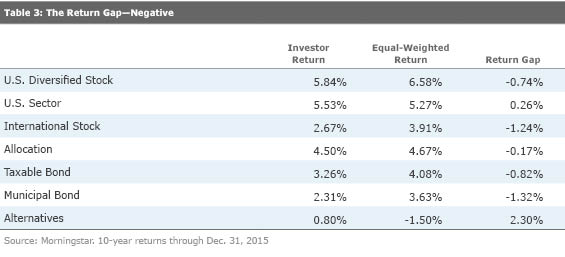
Not good. Once again, the puny alternatives and sector-fund groups are the exceptions, but that's scant consolation. Allocation funds fare better than the rest, because target-date funds have positive return gaps, but they are still negative. The other groups are even worse off.
These results are even noisier than those leading to the selection gap. Investor returns are affected by many factors besides timing decisions. As skeptics of the measure have pointed out, shareholders who dollar-cost average into funds by investing the same amount each month will show a return gap (perhaps positive, perhaps negative). That's a fair criticism. On the other hand, Morningstar has generated its Mind the Gap research for a decade now, and the pattern is always the same. The result is unlikely to have occurred by accident.
Less Is More Experienced investors and financial advisors, I believe, can improve their results by judiciously picking up bargain assets and trimming those that appear to have overheated. This column suggested energy pipeline stocks earlier this year, and I'm currently considering whether emerging-markets stocks and European banks might be timely. So I am not a purist for strategic asset allocation. But it must be granted that most investors don't do well with their asset timing. They would be better off doing what they're already doing with their fund selection and keeping their asset allocation rigorously, strictly strategic.
John Rekenthaler has been researching the fund industry since 1988. He is now a columnist for Morningstar.com and a member of Morningstar's investment research department. John is quick to point out that while Morningstar typically agrees with the views of the Rekenthaler Report, his views are his own.
The opinions expressed here are the author’s. Morningstar values diversity of thought and publishes a broad range of viewpoints.

 United States