
Making 401(k)s for Everybody
Small changes, big improvements.

Reaching Across the Aisle The great irony of 401(k) plans is that they suffer from the same problem of the system that they replaced, defined benefits. (This fact has escaped many 401(k) critics, who pine for a return from today's frying pan to the earlier generations' fire.) Both 401(k)s and their defined-benefit predecessors serve those who least need the help: higher-paid employees at larger companies. Those further down the workplace ladder are, for the most part, left behind.
Those who seek to reform the 401(k) system are aware of this; it would be hard to study the subject objectively without reaching that conclusion. Typically, their proposals address some of this inequality. A new paper by a group called the Bipartisan Policy Center--a think tank founded by four former senators, two Democrat and two Republican--pushes the issue further. The key points of "Securing Our Financial Future: Report of the Commission on Retirement Security and Personal Savings" aim squarely at extending 401(k)s' reach, so that the program becomes truly national.
Three comments before outlining the group’s two main suggestions.
Far from Perfect First, to support this column's opening paragraph, consider the chart below, supplied in the paper. More than 80% of workers who are in the top quartile of wages have access to a 401(k), as do those who work at companies that employ more than 100 people. (I use the term "401(k)" generically; it could be another flavor of defined-contribution plan, such as a 403(b) or 457.) The percentages drop dramatically from there--
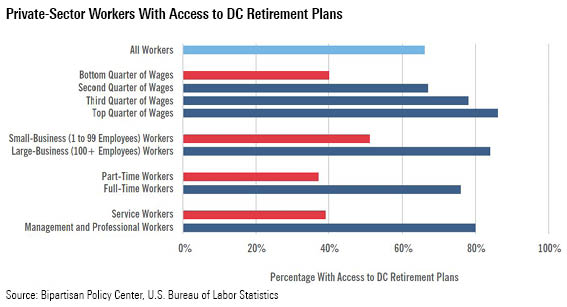
Second, 401(k) reform efforts often receive the response, "The last thing we need is more federal rules." Well, perhaps--but government rules are what we now have. The 401(k) system is built from a 1970s' provision in the IRS tax code. That code, perhaps, should not be etched into stone tablets. Several of the paper's proposals seek to eliminate requirements that currently exist. To oppose legal efforts to remove laws, on the principle of resisting new laws, is a difficult position to defend.
Third, the paper addresses more than 401(k)s. It is a comprehensive, 152-page attempt at addressing all policy issues related to retirement planning. Among its topics are Social Security reform, facilitating the use of home equity for retirement income, and offering lifetime-income (that is, annuity) investment options to employees. The first two items lie outside the scope of this column (at least until your author knows enough about those subjects to comment usefully). Lifetime-income options do not--but they are of second-order importance.
Two Recommendations 1) Create "Retirement Security Plans" for businesses that have fewer than 500 employees.
(Yes, I know, that proposition creates something new instead of abolishing something old. However, its overall effect would be to ease paperwork--and legal liability--for small to midsize businesses. They are unlikely to object.)
Retirement Security Plans would be created at a national level. The government would not decide among financial-services providers that wish to offer RSPs, except to require that each provider pass a certification process. (The report does not give details on what would constitute that process except to suggest that it would be designed to screen “bad or unscrupulous actors.”)
Employers could then select any certified RSP without concern for legal liability. ERISA's existing selection and monitoring requirements, which have led to multiple recent lawsuits and even a Supreme Court decision, would be waived for employers who use RSPs. In contrast, the current small-company solution of multiemployer plans does not eliminate the sponsor's fiduciary obligations (and also places restrictions on which other employers can share in its plan).
2) Simplify “safe harbor” rules, so as to eliminate discrimination testing.
Cleaning up an old mess. Originally, 401(k)s required discrimination testing to ensure that a plan wasn’t a tax dodge that was created to benefit only the firm’s executives while claiming to be a companywide benefit. This was perhaps a necessary evil, but an evil it certainly was. Nobody could possibly wish for continued discrimination testing if a better solution is available, unless one’s job is to harass company managements and create paperwork.
Later regulations permitted companies to qualify for safe-harbor status so that they would not be required to conduct discrimination testing. However, these safe-harbor provisions can be onerous; for example, one stipulation is that the company provide some level of matching contributions.
The paper's proposal eases the safe-harbor barrier by limiting the requirements to items that directly address the discrimination issue while being costless to the company sponsor. Any plan that has automatic enrollment of at least a 3% contribution rate initially, with automatic escalation of the savings rate by at least 1 percentage point per year until an 8% rate is achieved, is granted safe harbor. Participants, as always, can opt out. But they were all put into the plan and all with increasing contributions. The plan did not discriminate.
(The report contains several other suggestions for cutting existing red tape, from replacing a patchwork of often-conflicting state laws for “minimum coverage” with a single, consistent standard, to developing a private-sector-managed clearinghouse that would permit the easy consolidation of the many small 401(k) and IRA accounts that people frequently accumulate. These recommendations also seem sensible, if not critical.)
Easier Said Than Done These two items, I believe, would go a long way to extending the benefits of 401(k) plans across the broad workplace. They would make 401(k) plans essentially costless for smaller employers that cannot afford to make cash contributions, conduct tests, hire consultants, and/or document their fiduciary decisions. The plans would also be riskless-- the employees, not the company, are on the hook for the market's behavior, and the government, not the company, bears the legal responsibility for provider selection.
Will they become law? That, of course, is another question entirely. The report's key suggestions should be enacted. They benefit those who run smaller companies and those who work at such firms. Republicans loudly claim to advocate for the former and Democrats for the latter. So, in theory, these proposals will quickly be fashioned into a new bill, which will pass without much of a fuss.
In practice ... perhaps not. But that is past what the Bipartisan Policy Center can accomplish. It can only lead the horse to water, not force the beast to drink.
John Rekenthaler has been researching the fund industry since 1988. He is now a columnist for Morningstar.com and a member of Morningstar's investment research department. John is quick to point out that while Morningstar typically agrees with the views of the Rekenthaler Report, his views are his own.
The opinions expressed here are the author’s. Morningstar values diversity of thought and publishes a broad range of viewpoints.

 United States