
Rekenthaler's Sunday Reader Mailbag
Morningstar columnist John Rekenthaler tackles strategic beta, choosing a MLP fund and math for 7 year olds.

Bad Example: Part 1
In response to “Why Strategic Beta Makes Sense,” Tom Granata asks, “Other than
Now, there’s an awkward question.
The definition of “strategic beta” is fluid; the field is so new that all parties do not yet agree on the boundaries. Morningstar uses the term to mean:
1) Index funds that 2) Invest in a market segment, rather than the entire market, unless 3) The market segment is defined by size
Thus, Morningstar would classify a value index fund as strategic beta and a small-value index fund as strategic beta but not a small-company index fund.
Got that?
There is a catch, though, with that DFA example. DFA states that its funds are actively run, because its portfolio managers are permitted to deviate from the indexes that the funds emulate. Morningstar accepts DFA’s taxonomy. So, per Morningstar, DFA’s funds are not strategic-beta funds, because they are not index funds.
Meaning that the sole example that I gave in my article was incorrect.
(Morningstar's definition also excludes AQR's funds, as they, too, are not based on indexes. The irony is palpable, as AQR founder Cliff Asness was a leader in the development of strategic-beta funds. His firm's 2008 article, "Is Alpha Just Beta Waiting to be Discovered?", outlines the case for replacing the higher-cost "alphas" of active management with lower-cost "betas" that replicate those investment strategies.)
Time for my protective cloak--the disclaimer at the bottom of each column: John is quick to point out that while Morningstar typically agrees with the views of the Rekenthaler Report, his views are his own. The reverse holds true as well. While John typically agrees with the views of Morningstar, he differs here. That DFA tinkers with the fringes of its portfolios is a technicality. DFA's funds are mechanically constructed to participate in the gains of investment factors--betas, in the lingo. That makes them strategic-beta funds in my book.
To use Morningstar's book, here are the 10 largest strategic-beta funds, counting both traditional mutual funds and exchange-traded funds, as defined in the company's database. (Vanguard’s totals include the share classes of both its mutual funds and ETFs because they are officially all members of the same fund.)
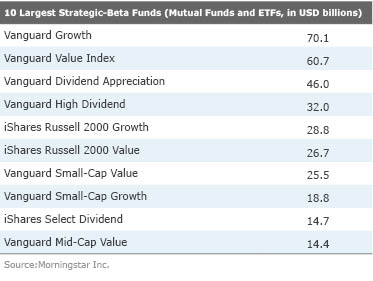
Basic stuff--value and growth funds and dividend-index funds. Some of the newer, more-exotic strategic betas are gaining in popularity. For example, iShares has a low-volatility ETF
Bad Example: Part 2
Of my recent purchase of two energy-pipeline funds, mentioned in May 3’s column, Rich Bachmann wonders why I selected
Another awkward question.
I would love to detail my painstaking, security-by-security research and the subtle differences between the chosen fund and its siblings. But the truth is, I have not a clue. I wanted to invest in energy pipelines while they were down; I sought a diversified portfolio, rather than an individual stock; and a friend who knows this sector--and who owns this fund himself--recommended the security. That, pretty much, was my research.
It is not the proudest admission for a former mutual fund analyst. There was a time when I would have scorned such a purchase. The security that was not thoroughly researched would not have been the security for me. However, I have learned that it’s far easier to have such a motto when working as an analyst, living and breathing in that space, than when working as an investment columnist, addressing more general issues. Distinguishing between those similar funds and deciding on the best for my portfolio would require significant work.
And one thing I have learned, from previous missed opportunities, is not to let the perfect stand in the way of the good. If there is a contrarian prospect--that is, a company (or collection of companies, as with a fund) that is severely out of favor, but which has a solid, profitable business--better to take some action than none at all. Too often I have fussed over the details until the stock has rebounded. That is penny-wise, pound-foolish. Don't worry about a nickel here, a dime there, when there are dollars to be made.
Mind you, that comment only applies to play money--the assets that one devotes to speculative, timing-based trades. I care very much about nickels and dimes with my long-term, core holdings. They are low-cost and tax-efficient. And I know those securities well indeed.
Shortcuts Here's a quick lesson in investment math posted on Yahoo.
[Spoiler below.]
The Yahoo article suggests subtracting by 19 and adding 17. That is the wrong way to do investment math. In the vast majority of cases, even back-of-the-envelope is too much effort. Investment math means looking at the problem from many perspectives--company fundamentals, valuation, market conditions, management issues, and so forth--with each perspective being measured in various ways. Warren Buffett is not putting all those items to pencil and paper (never mind Excel). He is sorting them out in his head.
Which is what one should do with the Yahoo problem. Nineteen off, 17 on, that means two more got off than on, so if there are 63 now, there were 65 at the beginning.
That’s it. The work should be no greater than that. And yes, a 7 year old with a head for numbers could do that. Perhaps two decades from now she will become an active manager. The fund industry could use the help.
John Rekenthaler has been researching the fund industry since 1988. He is now a columnist for Morningstar.com and a member of Morningstar's investment research department. John is quick to point out that while Morningstar typically agrees with the views of the Rekenthaler Report, his views are his own.
The opinions expressed here are the author’s. Morningstar values diversity of thought and publishes a broad range of viewpoints.

 United States