
Today’s Fund Industry, in 1 Chart
Why the winners will keep winning.

Performance Consistency The chart below shows the average performance of Vanguard's large-blend index funds, versus those of the competition. The comparison is for 15 rolling 10-year periods, with the y-axis showing the annual outperformance (positive) or underperformance (negative) for Vanguard's funds. The study uses only a fund's oldest share class to prevent overcounting funds that use the full share-class alphabet, and it resuscitates dead funds to eliminate survivorship bias.
Vanguard won the contest 14 times out of 15. While the victory margins were modest, typically about 20 basis points, they were nothing if not consistent. And, as Jack Bogle never grows tired of reminding us, a small annual difference that becomes compounded over many years eventually becomes a large cumulative difference. Every little bit does matter.
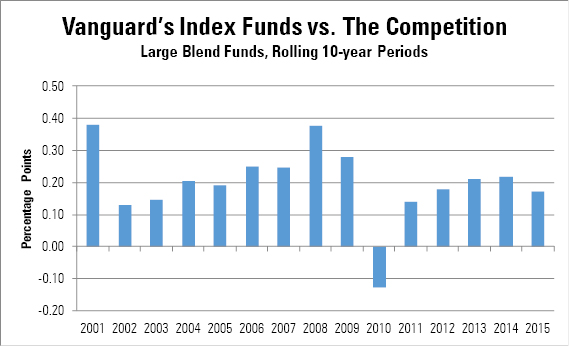
- source: Morningstar Analysts
What’s new about this apparently familiar picture is that the Washington Generals are not actively managed funds. Instead, “the competition” consists of other index funds. The chart graphs the difference between the results for Vanguard’s stable of large-blend stock index funds and those large-blend index funds offered by the rest of the U.S. fund industry.
Lessons--
No. 1: Index Funds Differ An index fund is not an index fund is not an index fund. Different fund companies offer different index funds that are based on different indexes, with different amounts of tracking error, and with different expense ratios.
You knew that already. What you might not have known, however, is that the walk is not always random. Sometimes, it is true, one index fund wins this year, another wins that year, so that it doesn’t matter which of the two funds an investor owns. Over time, those funds end up in the same place. However, sometimes--as with Vanguard’s large-blend funds--one fund (or series of funds) will show persistence. It is clearly the better fund.
No. 2: Costs Matter Most For large-cap index funds, such success comes from an expense advantage. Index construction is not of primary importance. While one can argue the merits of various smaller-company stock indexes and perhaps arrive at the conclusion that Small Company Index A is superior to Small Company Index B such that A can be expected to outperform in the long run, it is pretty difficult to make such a claim of the major large-company indexes. Their performances are highly correlated. Moreover, when deviations do occur, they tend to be in the form of noise, rather than as a repeatable pattern.
Nor is tracking error an issue. Again, this generalization does not apply to all index-fund asset classes. Emerging stock market index funds, for example, must balance the twin desires of achieving a low tracking error and a high total return. Those goals pull in opposite directions. The best way to cut tracking error is to own the entire set of securities in the index, rather than sampling some and excluding others. The best way to manage trading costs, however, is to do the opposite.
Vanguard’s large-cap index funds are better than the industry average because they are cheaper. Sure, the company does its research in deciding which indexes to offer, and it has almost entirely eliminated tracking error--but, in today’s index fund marketplaces, those abilities are door tickets. Cost is what separates the also-rans from the champions.
No. 3: Today's Investors Know Gone are the days when new, actively managed funds dominated the sales charts. Possessing only limited track records, yesteryear's best-sellers were long on hopes and short on hard data. They were the canvas onto which shareholders could paint their investment dreams. For that privilege, investors paid a pretty penny, with expense ratios often exceeding 1.5% annually--sometimes even for bond funds.
Today’s fund investors are a different breed. They haven’t just dropped actively managed funds for cheaper, better-performing, and more-transparent index funds. They have also sifted among the index funds, showering the champions with new assets while largely avoiding the also-rans. Vanguard, of course, has not been the only victor among index-fund (or exchange-traded fund) providers. BlackRock, State Street, Schwab, and Fidelity have also fared well. But all the winners share the same trait: unusually low costs, which enable their index funds to outgain the industry averages.
Fund investors were fooled for many, many years. They won’t be fooled again.
No. 4: Bigger Is Now Better For most of the fund industry's history, a ballooning asset base spelled trouble for a fund company. Yes, it meant great things for that company's current profits, but it threatened fund performance. Incoming assets drove portfolio managers to put the money to work, whether they wished to or not, in stocks that were not their best ideas. Trading costs rose as the newly expanded fund exerted a greater influence on the market. Opportunities shrunk as the fund was pushed higher up the stock market capitalization food chain and as it could no longer "flip" stocks via short-term trading strategies.
The problems accruing from asset bloat would frequently reverse the course of the leading fund companies. They would enjoy a stretch of strong fund returns; investors would reward them with assets; those new assets would gum up the investment-management wheels; the funds would begin to lag; and investors would begin to redeem. Continue the wash cycle until the item is fully cleaned, then rinse and repeat. Success led to failure; failure created the possibility of success.
Not anymore. Index-fund providers are helped, not hurt, by strong sales. Their new assets don't cause them investment problems. Quite the contrary--by increasing the company's revenue base, the assets give the firm additional scale with which it may further decrease its cost, thus improving its funds' returns. More once led to less. These days, it leads to more. The very biggest fund companies get bigger--and the rest are left behind.
John Rekenthaler has been researching the fund industry since 1988. He is now a columnist for Morningstar.com and a member of Morningstar's investment research department. John is quick to point out that while Morningstar typically agrees with the views of the Rekenthaler Report, his views are his own.
The opinions expressed here are the author’s. Morningstar values diversity of thought and publishes a broad range of viewpoints.

 United States