The Triumph of Fund Shareholders
At long last, they have bested those who invest in fund companies.


Inflation’s Effects
Roughly speaking, commodity prices track inflation over time, while technology costs decline. Which begs the question: What goods or services increase more rapidly than inflation? One answer is “home prices,” although that reply is somewhat misleading because housing quality has improved over time. (The formerly middle-class houses in my hometown are now occupied by the working poor.)
Another response is “customer services.” In recent decades, for example, the cost of a haircut has grown moderately faster than the Consumer Price Index. So have many bigger-ticket items. The chart below shows the rise in expenses for college tuition, auto insurance, and medical care since 2003. (The source for the industry-price histories cited in this column is the Bureau of Labor Statistics.)
Consumer Services
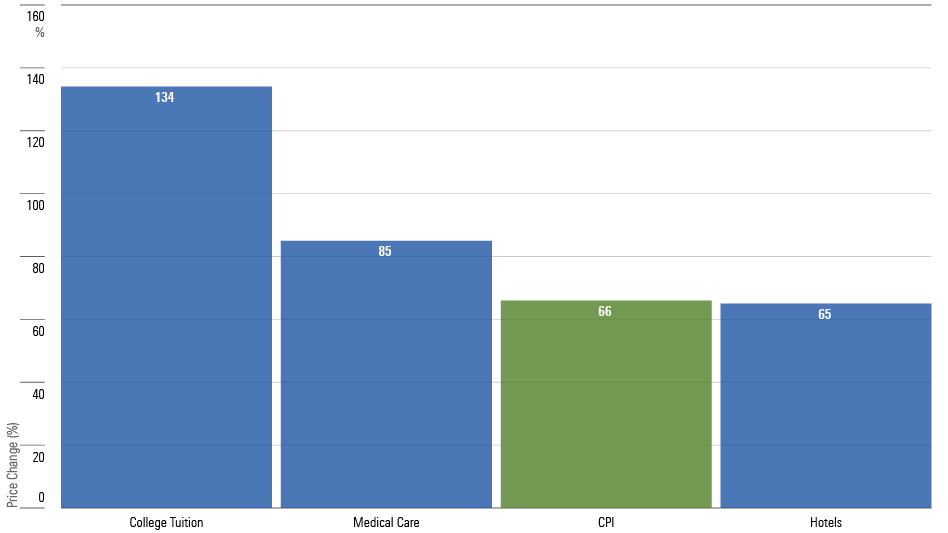
Such is the tendency of labor-intensive industries. Businesses that hire lower-wage workers can sometimes soften the blow; thus, the expense of hotel lodging has only matched the increase in the CPI. But rarely will their cost growth be significantly lower than the overall inflation rate. The people must be paid.
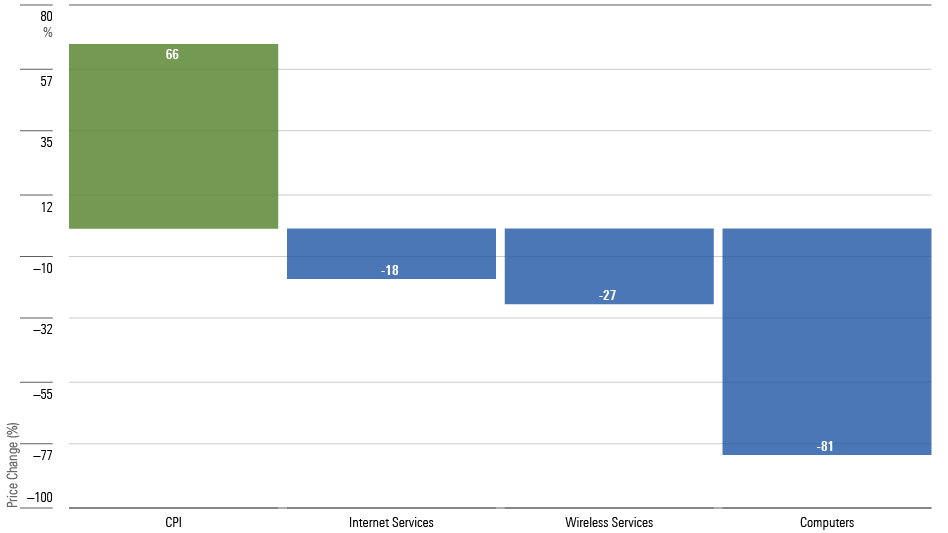
Technology, of course, operates differently. At least until artificial intelligence becomes sentient, tools do not expect better pay in return for their productivity gains. They churn along, oblivious to the fact that each year, they accomplish more with less. Perhaps Skynet would be justified in rebelling: As the next exhibit demonstrates, technology has been hugely important for tempering inflation.
Technology Industries
High Hopes
At least subconsciously, investors at the start of the New Millennium had these facts in mind when considering the fund industry’s future. Historically, fund companies had emulated other consumer-services organizations by growing their revenue faster than inflation. That is, although their assets had ballooned during the 1980s and 1990s, because of new sales and market appreciation, they had not reduced their expense ratios. The result was massively higher revenue.
The other side of the seemingly happy coin was that fund companies could continue to reduce their costs through technology. That outcome was already under way, but the internet accelerated the process by cutting transaction costs and eliminating the necessity to mail printed statements.
The prospect of continued revenue growth, along with technology-assisted cost-cutting, delighted those who invested in the stocks of companies that operated in the fund industry (as opposed to the funds that the industry ran for its clients). Few publicly traded companies manage mutual funds and/or exchange-traded as their main business line, but four that do—and existed 20 years back—were BlackRock BLK, T. Rowe Price Group TROW, Franklin Resources BEN, and Invesco IVZ. Their stocks soared.
Fund-Company Stocks: Early 2000s

Reality Intrudes
What fund-company investors failed to foresee, however, was that fund shareholders would stop accepting what were effectively ongoing price hikes. Abetted by financial advisors, who promised their customers that they would help them not only find sound investments but also find ones that were relative bargains, fund shareholders voted with their feet, seeking notably cheap funds.
Since 2001, the industry’s average weighted expense ratio has shrunk by 54%. This shift does not owe solely to the “index fund revolution.” Even among active funds, investors have slashed costs. The trend has occurred across the board.
Fund Costs: Now and Then
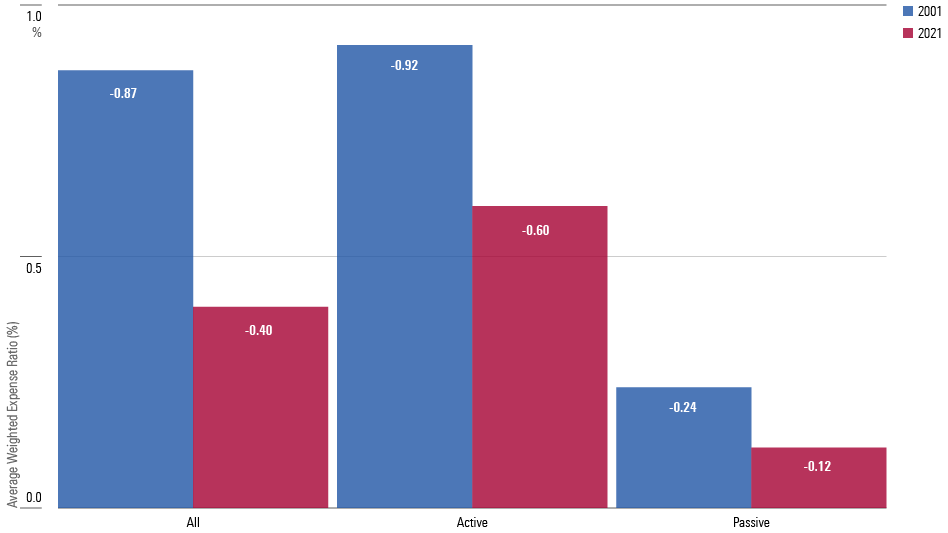
This development doubly hurt the industry. First, it depressed overall revenue. Second, as only a few companies offered truly low-cost funds, most organizations were left entirely behind by the change in customer habits. The well-positioned few accounted for essentially all new sales. The assets held by the remaining companies, to quote one industry executive, became “melting icebergs.”
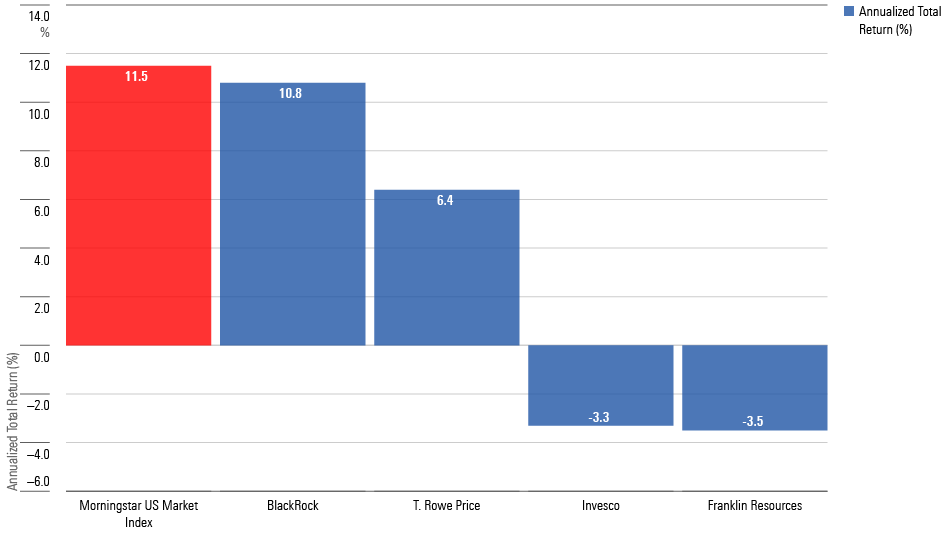
Fund-industry stocks were rocked. Over the previous 30 years, they had routinely beaten the market averages. (For example, Franklin Resources was the nation’s sixth-best performer during the 1980s.) Not recently. Even BlackRock, which as a leading ETF provider was among the industry’s chief beneficiaries, has trailed Morningstar US Market Index since 2013. Its rivals have done worse yet.
Fund Company Stocks: The Past 10 Years
Advisor Fees
Fund shareholders have wrested control from the industry that serves them. Consequently, do-it-yourself investors have unquestionably profited from the changes of the past 15 years (give or take).
Whether shareholders who invest through financial advisors have similarly prospered is a trickier issue. To be sure, their fund expense ratios have declined. In addition, few advisors now sell funds with front-end load charges, which were once ubiquitous. On the other hand, though, most advisors now levy ongoing “asset management” fees. When addressing whether investors’ fortunes have improved, those payments must be considered.
Evaluating all the possible combinations of expense ratios, load charges, and advisors is a task for a white paper. But we can view a typical example. A financial advisor once might have sold a fund with a 5.75% front-end load and a 0.75% expense ratio. In 2023, that same advisor would likely collect no load, apply a 1% annual advisory fee, and use a fund with a 0.25% expense ratio.
Below is the breakeven analysis for those two possibilities, assuming a 7% annual return on the underlying investments. The chart shows the investor’s annual cost advantage (or disadvantage), comparing today’s approach against that of the past.
Breakeven Analysis
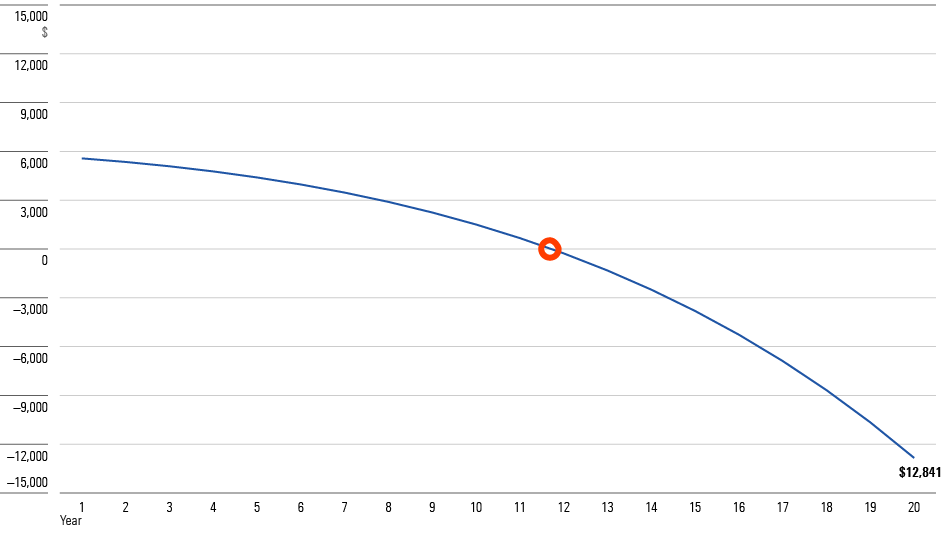
In short: Fund investors are better off with the current system for the first 12 years, and then the traditional scheme prevails. This result, admittedly, is merely suggestive. Even modest changes to the assumptions can dramatically alter the conclusion. For example, using a 1% expense ratio in conjunction with the front-end load doubles the breakeven date to 24 years. (Discounting the load charge for a volume purchase moves the scale in the other direction.)
Conclusion
Fund-industry executives, along with those who held their company’s shares, were optimistic entering the New Millennium. They could keep their expense ratios constant, which would lead to handsome profits on account of higher revenue and lower costs. However, fund shareholders repealed the traditional math. By demanding much-reduced expense ratios, they received moneys that would otherwise have gone into the industry’s coffers.
Whether that same process will occur with financial advice remains to be seen. But it’s possible. Fund shareholders have exerted their power once. They certainly could do so again.
The author or authors do not own shares in any securities mentioned in this article. Find out about Morningstar’s editorial policies.
The opinions expressed here are the author’s. Morningstar values diversity of thought and publishes a broad range of viewpoints.

 United States