
What to Know About Small-Value Funds
Should investors just index?


This article mentions funds that have an issuer-initiated rating and/or track a Morningstar Index. For full disclosure information, please refer to the specific funds, which are demarcated with a * symbol, listed below.
Small Value’s Victory
Last week’s column, “All-Weather Stock Funds Do Exist,” discussed five U.S. equity funds that have combined downside protection with high overall returns. Each fund fell less than 70% as far as Vanguard Total Market Stock Index VGTSX during the three down years of 2002, 2008, and 2022, while also outgaining Vanguard Total Market Stock Index for the 21 years from 2002 through 2022. Nice work if you can get it.
As all five of the all-weather winners hold small-value stocks, one might wonder how much of their accomplishment has owed to managerial insight, as opposed to being in the right place. (When asked about his investment secret after his fund topped 1990′s charts, Michael Gordon replied, “I run the only biotechnology fund.”) Perhaps owning a small-value index fund would have sufficed.
Indeed, it would have. On average, small-value index funds gained half a percentage point more per year than did the overall stock market. What’s more, although their bear-market performances were not quite as spectacular as those of the all-weather funds, small-value index funds also fared much better than the mainstream index funds when the bears arrived.
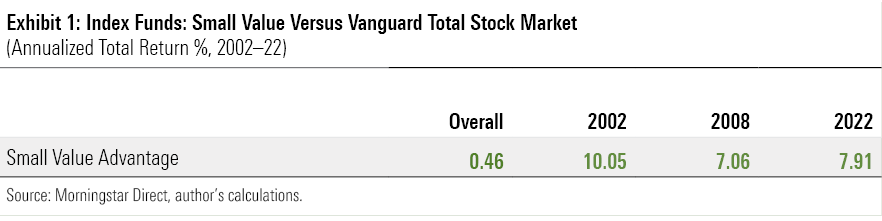
Two Caveats
While heartening for small-value devotees, this outcome does require two caveats.
First, the selected period could be accused of favoring small-value stocks. After all, they thrashed blue chips both in 2002 and 2022. While correct in spirit—cherry-picking time periods is an unscrupulous analyst’s best ally—the argument is dubious, because small-value stocks also excelled before the study began, in 2000 and 2001. Also, the stock market’s after inflation return over those 21 years resembled its long-term average. In that sense, the period was representative.
The other objection is stronger. Over the full period, small-value index funds were more volatile than their blue-chip rivals. That argument is not entirely convincing, because small-value index funds better protected shareholders during the worst of times, but the math cannot be disputed. According to customary financial theory, small-value index funds provided no free lunch because they paid for their higher returns with extra volatility.
Nevertheless, by any reasonable standard, small-value index funds thrived. Even as growth stocks sparkled—along with the late ‘90s, the five-year period from 2017 through 2021 was the strongest growth-stock climate of the past half century—small-value index funds persevered. Small-value stocks entered this century with the best track record among U.S. equities. Quietly, they continued their success. In this instance, at least, past performance was indeed indicative of future results.
Considering Active Funds
For investors, however, the performance of active funds is what matters. Even today, index funds claim only about half of small-value assets. In 2002, they accounted for almost none. Thus, most of the gains enjoyed by small-value index funds exist only on paper. Shareholder profits have depended on the fortunes of the group’s actively managed funds.
The following table evaluates three groups of actively run small-value funds. The first basket contains all funds that existed from 2002 until 2022; the second holds only lower-cost funds, defined as those that carried expense ratios of 1.00% or less throughout the period; and the third consists of the five all-weather funds that were identified in last week’s column.
The format resembles that of the previous table. The results are relative. Positive figures indicate that the active-fund average bested the index-fund average, with negative outcome depicting the reverse. The table also displays the difference in expense ratios. Predictably, the index funds hold a comfortable advantage.
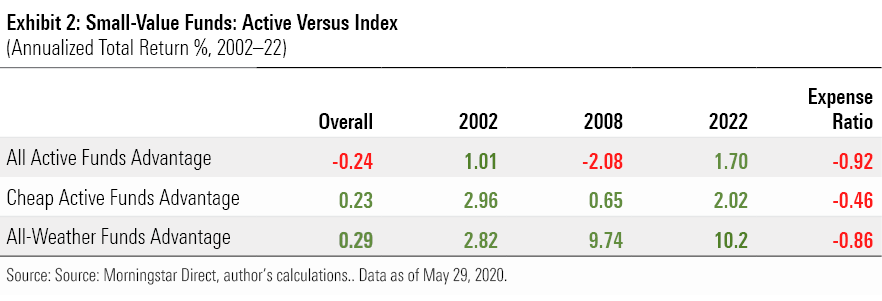
In aggregate, actively run small-value funds kept pace with their indexed rivals. However, they did so with a significant dropout rate. Forty percent of the active funds that existed in 2002 have since disappeared. In addition, of those funds that persisted, one fourth returned less than the worst index fund. In other words, only half of the active funds managed the simultaneous feat of surviving the 21-year period and outgaining the last-place index fund.
Thus, although the summary figures for the active funds look equal, investors should likely have indexed. Unless they had selected the sole index fund that folded its tent (which almost no investors did, as that fund was tiny), doing so would have brought them an annualized return of at least 7.77%. Half the active funds failed to achieve that outcome.
The second basket of cheap active funds, on the other hand, were a plausible alternative. Eleven of the 15 funds survived, with overall results that closely matched the index funds’, along with modestly better bear-market performances. As Jack Bogle often said, low-cost index funds succeed not because they index but because they are low-cost. With small-value stocks, actively managed funds are competitive when they are offered at the right price.
The all-weather funds, of course, were easily the best of the three investment baskets. Unfortunately, it would have been challenging to identify those funds in advance. Only three of the five funds had existed for even five years before 2002, and none of them boasted particularly impressive track records. Investors would therefore have needed to anticipate that those funds would shine, although their past performances offered no such clues. That would be a tricky assignment.
Last week’s column was largely theoretical. It demonstrated that true all-weather funds do exist, but it left open the difficult question of how to find such funds before the fact. Today’s article, in contrast, aims to be practical. It shows that, despite unfavorable publicity, small-value U.S. stock funds have continued to deliver attractive investment performance by posting competitive gains that are accompanied by bear-market resistance. Investors who wish to participate can do so either by indexing or by buying an established, low-cost actively run fund.
The author or authors do not own shares in any securities mentioned in this article. Find out about Morningstar’s editorial policies.
The opinions expressed here are the author’s. Morningstar values diversity of thought and publishes a broad range of viewpoints.

 United States
