
Navigating the Risks Associated With Technology Investments in 2025
Threatened and imposed tariffs have increased uncertainty about technology companies selling physical goods with Chinese supply chains.


Key Takeaways
- The potential for a dramatic shift in supply chains away from China presents material risk to portfolios.
- The hardware companies most exposed to Chinese supply chains are the most at risk.
- The software and cybersecurity sectors are less at risk and benefit from long-term spending trends, which will not be materially affected by tariffs.
The intrinsic value of many technology stocks is now inextricably linked with geopolitics. Technology stocks, particularly hardware and semiconductor companies, operate in the context of a globalized supply chain, and the outcomes for that supply chain are now entering a phase where they will be determined by geopolitical policy more than ever before. How long tariffs are held in place, at what level, and the responses of other nations around the world will determine fair value outcomes. This increases risks and uncertainty levels and alters the type of analysis needed for proper due diligence.
The Environment Will Likely Remain Volatile
Investors need to seriously consider the medium-term costs of dramatically shifting the current global supply chain.
If good news comes out of US President Donald Trump’s deals with foreign countries, the market could experience some relief rallies. Additional measures, like lower taxes or other reinvestment mechanisms aimed specifically at encouraging domestic investment, could also have an impact.
However, we think investors should not be fooled by any shortsighted optimism in this phase, because if the administration is trying to change supply chains dramatically, there would still be a long road ahead. Further, even if supply chains do not change materially, the actions being taken today could still cause a recession.
The Investment Implications of Proposed and Imposed Tariffs
While there may be some level of pain that could cause the Trump administration to reverse course, tariff-related risks are far from over. Despite initially escaping Trump’s crosshairs, we believe we’re likely to see new tariffs targeted specifically at semiconductors. Those would have significant implications both at home and abroad.
Supply Chains
Supply chain issues will primarily affect hardware and semiconductor manufacturers. We estimate that close to 60% of PCs and smartphones are imported from China and therefore are likely to be the most hurt product categories (and all of their downstream supply chain partners). We estimate that servers, networking gear, and storage have a much lower percentage of final products imported from China and are likely to be more insulated. Goods considered discretionary are more likely to see the highest demand destruction.
Financials
Costs of goods sold are likely to increase, and price hikes to offset such increases are likely to hurt demand on some level. Companies also often absorb some of the cost increases, not fully offsetting the cost increases with price increases, pressuring margins. We see a higher likelihood of negative earnings revisions, particularly for names with the key risk factors we outline below. We see a higher likelihood of negative fair value revisions as we incorporate updated outlooks over the upcoming earnings season.
Companies that do not need to rework their supply chains, those whose goods are not tariffed, and those with more stable revenue streams are likely to be more insulated. Our base case is no retaliation on the services revenue of US companies (most importantly, by the EU), but this is a risk that would primarily affect Big Tech.
The more the relationship between the US and China deteriorates, the more it could encourage other tail risks, such as China/Taiwan issues, or more aggressive retaliation by China or the US, which could put any China-based revenue at risk in a worst-case scenario. We are already seeing some of this with Nvidia’s NVDA China-related revenue now expected to drop effectively to zero.
Mapping Supply Chains of Common Goods
Smartphones
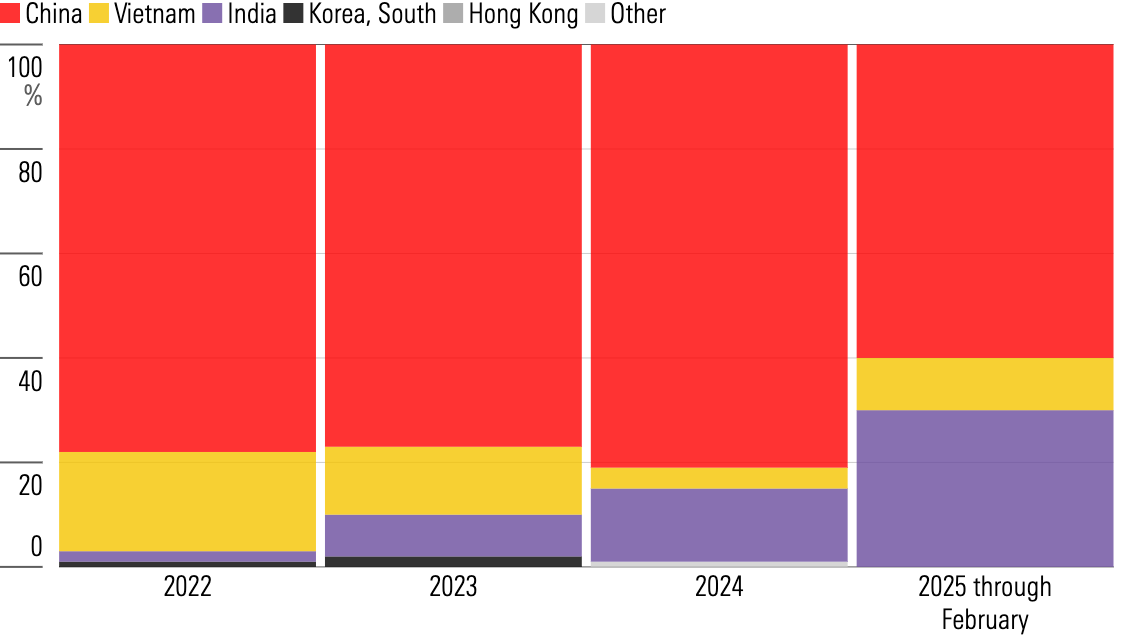
We estimate that one of the hardest-hit supply chains will be for smartphones. Under our coverage, this primarily affects Apple AAPL, which still has most of its iPhones assembled in China before being shipped to the United States. We estimate that roughly 80% of imported smartphones were from China in 2024, although the amount coming from India has been increasing gradually as Apple shifts more production to India. Recently, it has been estimated that Apple now makes 20% of its phones in India, and we expect this percentage will continue to go up.
Value of Imports of Smartphones Into the US
Personal Computers
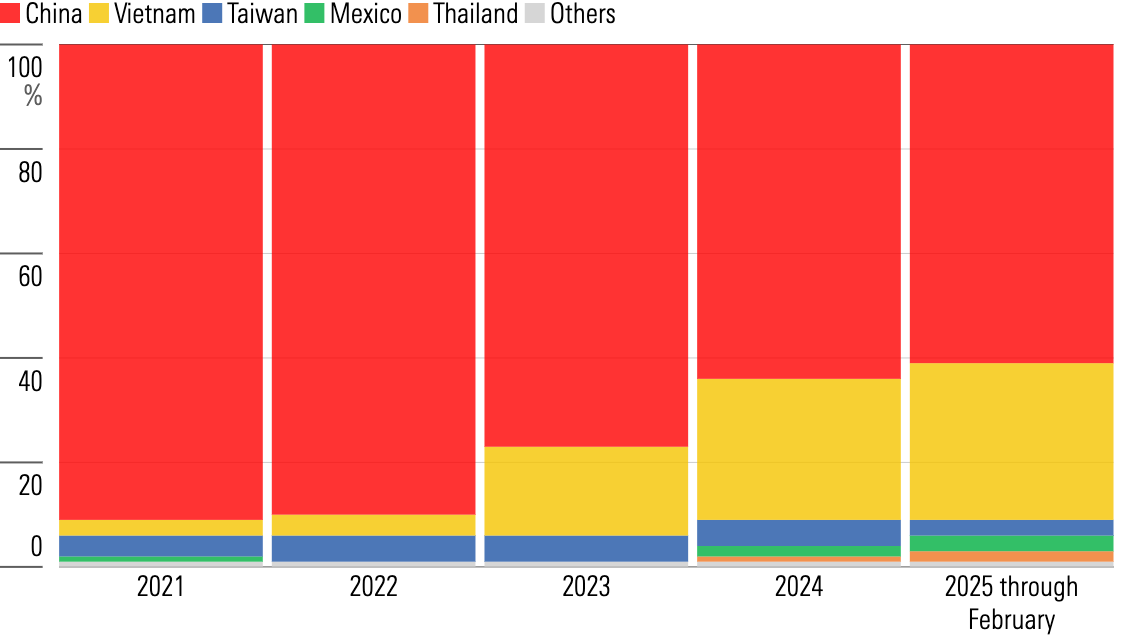
We think the PC supply chain will also be affected materially. We estimate that just over 60% of imported PCs come from China, with Vietnam being the second-largest source of PC imports. We think PC supply chains would be a little easier to move than that of the iPhone, as PCs are a bit less technical and there is an emerging base in Vietnam, although it would still require a material amount of pain to make any dramatic changes.
Value of Imports of PCs Into the US
Servers
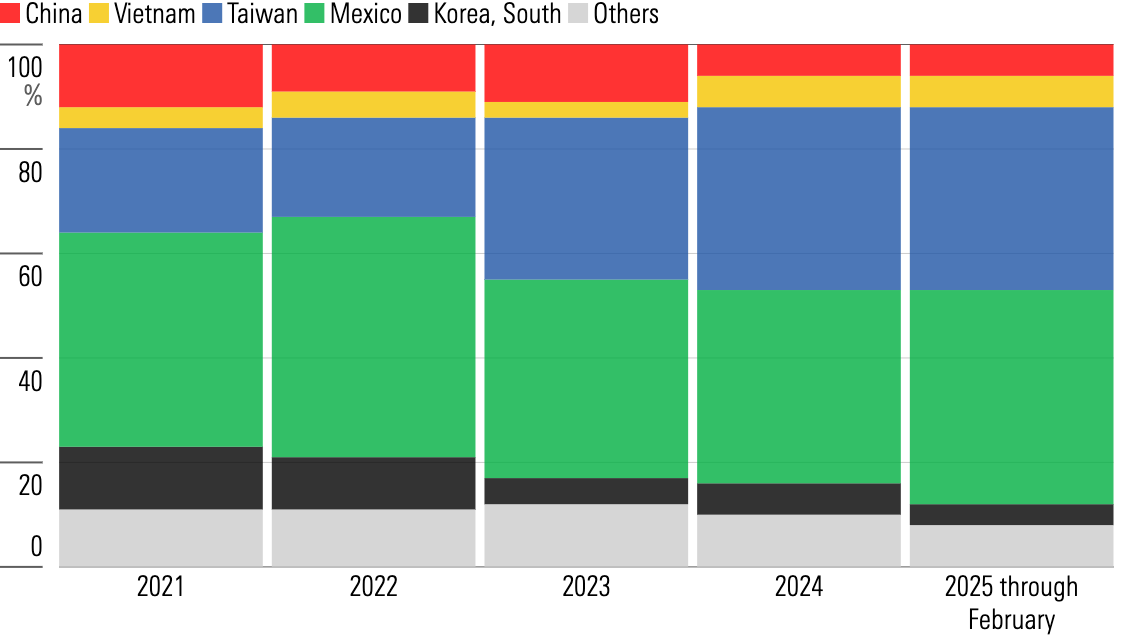
We think that servers would be more insulated than most would expect. We estimate that a minority of servers are shipped from China, and instead, Mexico is the dominant import hub for servers, followed by Taiwan. We also believe this supply chain would be easier to shift, given the only moderately technical nature of final assembly, and the fact that Mexico is primed to take on greater volumes.
Value of Imports of Servers Into the US
A High Probability of Tariffs in the Future
While PCs, smartphones, networking gear, servers, and storage are technically exempt from tariffs for the time being, we still see a high probability of tariffs coming in the future. This is because these items have simply been repositioned as being within the broader “semiconductor” sphere, and the administration has been clear that it is exploring options for tariffs and the rerouting of supply chains for semiconductors in general, most notably with the recent launch of an official government investigation into these specific supply chains.
As we survey the hardware sellers under our coverage, we think roughly 60% of smartphones and PC supplies would be subject to tariffs on China. We think servers would be much less disrupted, with most shipments coming from Mexico (tariff-free under the United States-Mexico-Canada Agreement) and Taiwan (we’ll see where tariffs end up).
We think the smartphone supply chain would be the most difficult to alter, and hard disk drives (storage) would also be difficult, while servers and networking have built up scale in multiple areas outside of China, which could give them more flexibility. Motorola MSI is one of the few names where we see minimal exposure to China (both in the supply chain for assembly and in the final bill of materials), even though it is a hardware vendor.
The author or authors do not own shares in any securities mentioned in this article. Find out about Morningstar’s editorial policies.

 United States