
Why the Bond Market Is Fertile Ground for Active Management
Its structure poses inherent challenges for passive investing.


The case for indexing the bond market isn’t nearly as straightforward as it is for the stock market.
Passive investing can be effective in liquid, higher-quality, and homogeneous parts of the bond market. Yet, limitations of index coverage and real-world distortions make it hard to index major parts of the global bond market.
In our latest report, we discuss why active management in the bond market still makes sense. Here are some of our key findings.
Why It’s Difficult to Index the Bond Market: Concentrated Ownership and Infrequent Trading
The bond market isn’t as inefficient as it used to be. Innovations such as credit default swap baskets, index-tracking exchange-traded funds, and block-style trading have improved efficiency in some bond market segments. But inefficiency still lingers, and this creates opportunity for skilled active managers to add value.
One cause of the bond market’s inefficiency is the fact that most bonds are owned by a relatively small number of large investors, which can limit the number of buyers and sellers willing to transact. In turn, this small number of bond investors means relatively little trading outside of the largest, most liquid bonds. These factors can create challenges in pricing consistency and discovery.
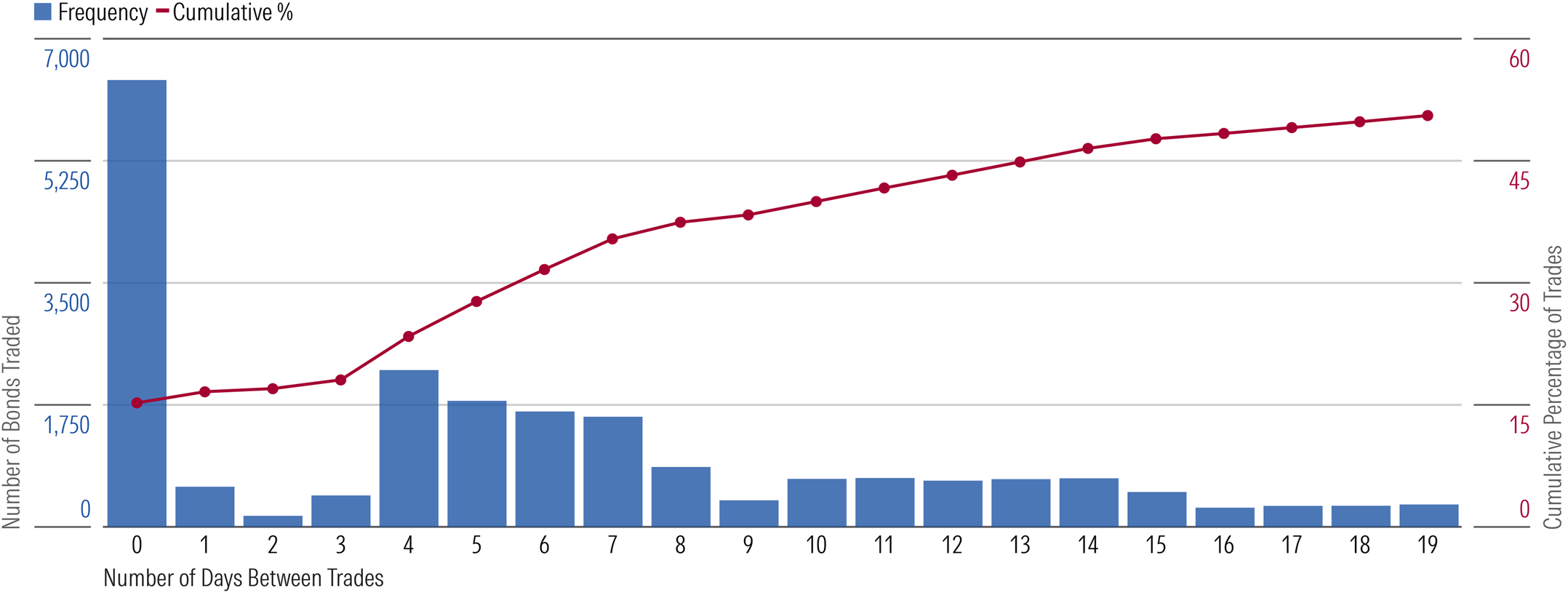
One way to gauge the frequency of trading is to measure the average time between trades for the same corporate bond. A Morningstar study conducted several years ago found that of the 35,000 bonds in the sample, fewer than half traded at least once in three days.
This inefficiency is one reason that active managers can add value to bond investing.
Concentrated Ownership and Infrequent Trading
Specific Borrowing Needs Create Complexity
The complexity of the bond market is another feature that active managers can exploit to add value. Indeed, the range of bonds and combinations of features are potentially infinite. Even bonds from the same issuers may have distinguishing features, including differences in maturity, coupon, seniority, optionality, and covenants.
Complexity is also a theme across bond sectors.
Government Debt
Regular Treasury bonds in the US are among the simplest of all. They have fixed coupons, fixed maturities, no calls or puts, and no odd structural elements.
Things can get messier, though, even among government bond markets.
For example, the US issues Treasury Inflation-Protected Securities, whose face values adjust semiannually in line with changes to the Consumer Price Index. TIPS investors receive no less than par, which means TIPS held to maturity guard against inflation and have backstop protection against disinflation.
Other countries also issue inflation-linked bonds, including the United Kingdom, Israel, France, Germany, Canada, and Japan. Their structures and mechanics differ from country to country, though.
Corporate Debt
Beyond Treasuries, the corporate bond universe is arguably less complicated than others. Yet, a dizzying array of features can still distinguish one corporate bond from another.
One example is the differences between bonds issued by subsidiaries and parent companies. It’s common for corporations to shuffle assets into or out of related companies with legally distinct identities. The bond’s structure and terms matter. If the parent company defaults, parent company bondholders may not have a legal claim to valuable assets held by a subsidiary.
Investors holding bonds issued by a subsidiary, meanwhile, may find that a company isn’t willing to back those bonds if things go sour.
Securitized Debt
Securitized debt is a financial instrument created by pooling various types of debt into one package and selling them as bonds. The process has exploded in recent decades. In most cases, securitized debt is carved up into tranches with different features that can be sold to investors with different appetites for their risks.
The vast market for securitized debt includes a broad variety of types and styles. The more differentiated they are, the more likely it is that inefficiencies will exist. They can range from asset-backed securities supported by credit card receivables to collateralized loan obligations backed by loans to companies with lower credit ratings, and much more.
Real-World Distortions Can Make Indexing Unattractive
It isn’t just that lingering inefficiencies and the complexities of the bond market provide opportunities for skilled active managers. It is also the case that passively replicating isn’t always a good idea.
In fact, in the real world of bond investing, meaningful market distortions have happened across all its major sectors, including government, corporate, and securitized debt. So, indexing during those times means moving in the opposite direction of the overall market.
Some examples include the Greek eurozone crisis of 2011, the proliferation of automobile debt in the early 2000s, and fundamental changes to the mortgage market.
Greece and the Euro
Take the case of Greece, which had the hardest time of the countries that faced trouble following the 2008 financial crisis. It had already been building up debt before the crisis and ramped it up even more as things got worse.
By 2010 and 2011, investors began to worry about scenarios that could lead to default. Either Europe might equivocate on supporting the country, or Greece might leave the monetary union and reissue its own currency at a drastically lower value.
So, even though much of Greece’s debt was denominated in euros, investors began demanding higher yields, and the spread of Greek bonds over the EU’s stalwart countries’ bonds shot up dramatically as their prices plummeted.
Greece Government Debt Market Capitalization and Yield Spread
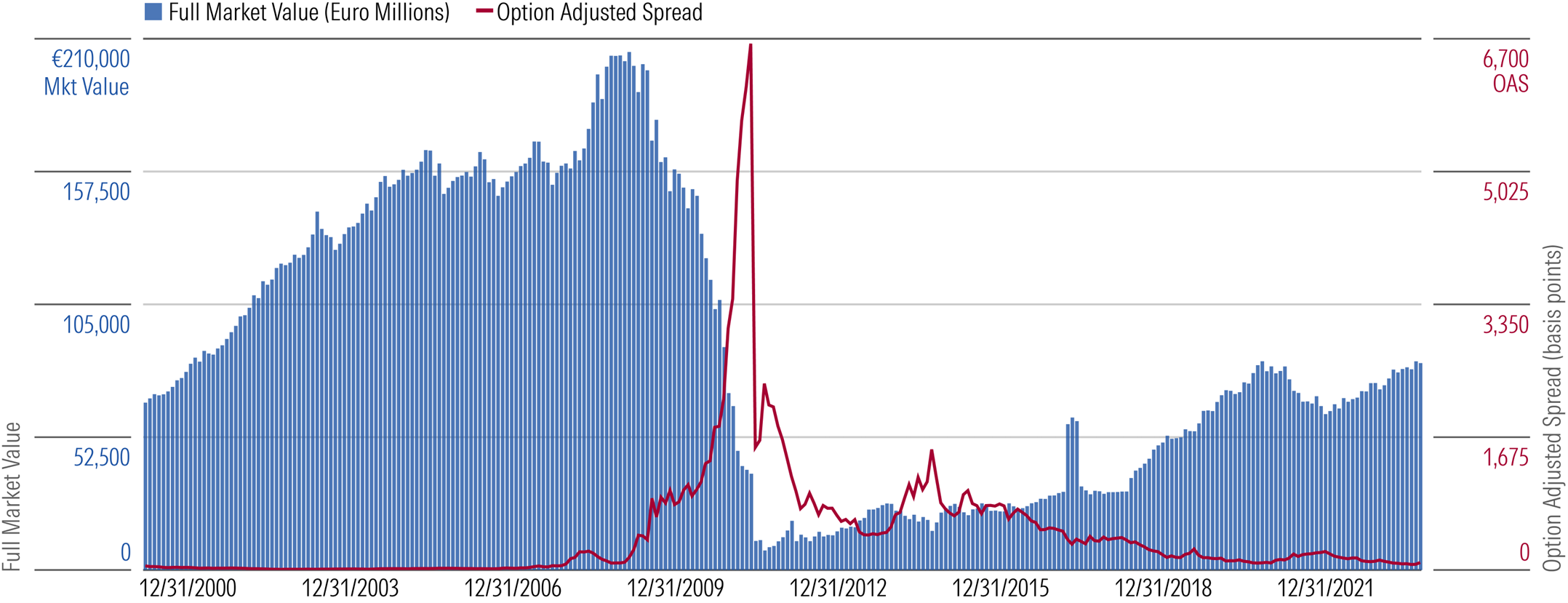
Just as things looked to be their most dire, the head of the European Central Bank announced that he would do whatever it took to effectively save Greece and keep the euro together. The country’s debt costs improved nearly overnight, but they remained higher than those of the continent’s strongest economies in early 2025, more than a decade later.
Why Active Management Makes Sense in Bond Markets
In our report, we observe that active bond managers have typically fared better than their equity counterparts versus their bellwether indexes, and we explore what that means for bond fund investors.
Passively tracking the global bond market gives us pause for a variety of reasons: lingering inefficiencies, inherent complexity, or the lessons of history.
That said, we think fairly priced active bond funds from best-in-class asset managers are an option most investors should consider.
The author or authors do not own shares in any securities mentioned in this article. Find out about Morningstar’s editorial policies.

 United States