
ETFs That Pay You to Invest
How securities lending benefits ETF investors and ETF firms.

Several exchange-traded funds pay you to invest instead of the other way around. Securities lending is the secret to how.
Before offering examples, here’s a primer on what securities lending is and how works. Interested readers can also read our extended 2023 report on the subject.
What Is Securities Lending?
Securities lending is a seldom-discussed but important tactic in ETF and mutual fund management. Most funds make use of this practice, which is generally low-risk for both investors and fund sponsors. Income earned from securities lending benefits fund performance, offsetting some or all of its annual fee. Declining fees have brought the practice into sharper focus.
Securities lending entails a mutual fund or ETF lending portfolio securities (like stocks or bonds) to an interested party, such as a broker/dealer or hedge fund, for a tidy fee. Investors benefit through a reduction in the cost of fund ownership, and firms benefit from the additional source of revenue. It can also differentiate performance between otherwise identical investment products.[1]
How Does Securities Lending Work?
Fund companies work with a lending agent to facilitate securities-lending transactions. The lending agent takes a cut of any securities-lending revenue so it’s in their best interest to maximize a security’s earning potential and mitigate risk of loss.
To protect the lender from losses, lent securities are always fully collateralized using cash or other securities. Cash collateral is more common in the US, while Europe tends to favor other forms of collateral, such as low-risk government bonds.
The approximate workflow for cash collateral scenarios is shown below.
Overview of a Securities-Lending Transaction
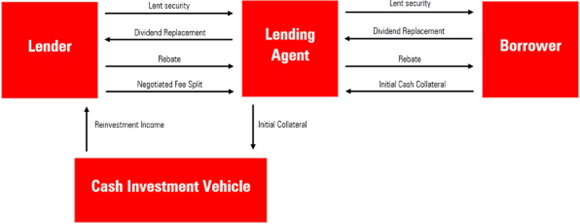
An ETF’s lending revenue comes from the cash investment vehicle’s reinvestment income. After the lending agent takes a cut, and other related fees have been addressed, leftover income is retained by the fund. The rebate paid from the lender to the borrower determines how much of that reinvestment income an ETF can keep and its level of securities-lending profit. Any amount of profit benefits investors. In the illustration below, demand value represents the potential income earned from lending a security.
Securities-Lending Income Breakdown
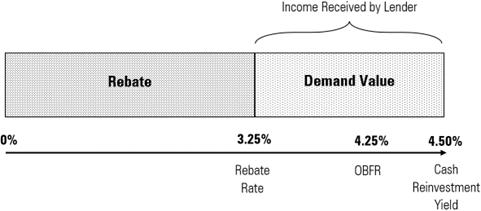
The rebate is paid at a negotiated rate relative to a risk-free rate (usually the overnight bank funding rate[2]). Securities with low borrow demand command a high rebate rate, sometimes very close to the risk-free rate. This pinches securities-lending profit. Securities with high borrow demand require a lower rebate, expanding profit opportunities for the lender. Liquid securities like government bonds or mega-cap US stocks aren’t typically in high demand, whereas less liquid securities can be highly valued by short sellers, broker/dealers, market makers, or other traders, driving down their rebates and increasing income potential for the fund.
The overall level of interest rates also influences a lent security’s income potential: high rates = higher potential lending income; low rates = lower potential income.
Risk Determines Securities-Lending Reward
Some ETFs generate so much income from securities lending that it fully offsets the fund’s annual fee. Investors should be skeptical of these strategies. After all, a fund’s investment merit is far more important than the securities-lending revenue it generates.
Revenue received for the lent security depends on its demand value. Securities in high demand are stocks or bonds of typically small, illiquid, or otherwise unpopular companies—which hedge funds might be selling short, betting their price will fall. ETFs full of these stocks generate much higher lending returns than broad-based index ETFs but are also likely to be far riskier.
ETFs earning the highest returns from securities lending in 2024 were usually highly volatile and followed a niche investment strategy, according to regulatory filing data compiled in Morningstar Direct.
Beware of ETFs Earning High Securities-Lending Returns
Just three of the top 10 ETFs listed above earned a positive return in what was a strong 2024 for markets. Just two outpaced the Morningstar US Market Index’s 24% rise. All were more volatile.
ETFs That Pay You to Invest
Thirty-four ETFs earned a higher securities-lending return than their annual fee in 2024.[3] By dividing “Securities-Lending Return” by “Annual Fee” for a given year, we find the percent of an ETF’s fee offset by securities-lending income. ETFs with a fee offset percentage greater than 100 effectively pay you to own them.
Most ETFs with high securities-lending returns are very risky, but some ETFs that fully offset their fee could be defensible components of a diversified portfolio. Five small-cap index ETFs fit this bill and are listed below. Each fully offset its fees in 2024, and four earn Morningstar Medalist Ratings of Bronze or better.
Small-Cap ETFs Who Fully Offset Their Annual Fee
Don’t choose an ETF just because it boasts high securities-lending returns. Costs, risks, and the merit of the investment strategy matter more.
The table above shows that some ETFs able to fully offset their fee were already cheap to begin with. None charged more than 0.10%, with SPDR Portfolio S&P 600 Small Cap ETF SPSM the cheapest at just 0.03%. Not only does a low fee lower the bar for outperformance, but it also makes it easier for securities lending to pay for an ETF’s fee.
The data also shows that ETFs with the highest securities-lending returns are also some of the most concentrated and volatile; there is more borrower demand for their relatively risky and illiquid holdings. Diversified index funds, like the ones noted above, hold smaller helpings of the same stocks and can still benefit investors by generating meaningful securities-lending income without offering such wild and uncertain rides.
[1] For example, ETFs organized as trusts cannot lend portfolio securities. Notable ETF trusts include SPDR S&P 500 ETF Trust SPY and Invesco QQQ Trust QQQ. Investors might favor ETFs that track the same index but can lend securities, like SPDR Portfolio S&P 500 ETF SPLG and Invesco NASDAQ 100 ETF QQQM. Both also happen to be cheaper than the equivalent ETF trusts.
[2] The overnight bank funding rate represents the rate of return a fund can reasonably expect to earn on its cash reinvestment vehicle. This vehicle may earn slightly more, but there are severe restrictions on how much risk it can take, so the OBFR is a good approximation of earning potential.
[3] Data is around 90% complete as funds continue to file 2024 reports. This number may increase. In 2023, 65 ETFs fully offset their fee.
Clarification: (Feb. 12, 2025): A previous version of this article suggested that a fund’s economic exposure to held stocks may change when lent to a third party. However, securities lending does not change the economic exposures of a fund.
The author or authors do not own shares in any securities mentioned in this article. Find out about Morningstar’s editorial policies.

 United States