
Fund Providers Flock to Vanguard’s ETF Share Class
It’s a great idea for the right funds.


Almost three dozen fund providers have requested approval from the SEC to use Vanguard’s previously patented ETF-as-a-share class fund structure. The unique hybrid structure essentially bolts an ETF onto an existing mutual fund.
The motivation for doing so is simple to understand. Taxable capital gains distributions have plagued many mutual funds over the past several years. Adding an exchange-traded share class extends its tax efficiency to mutual fund share classes and potentially solves part of the problem. But it isn’t an instant remedy, and it comes with additional considerations.
Exodus
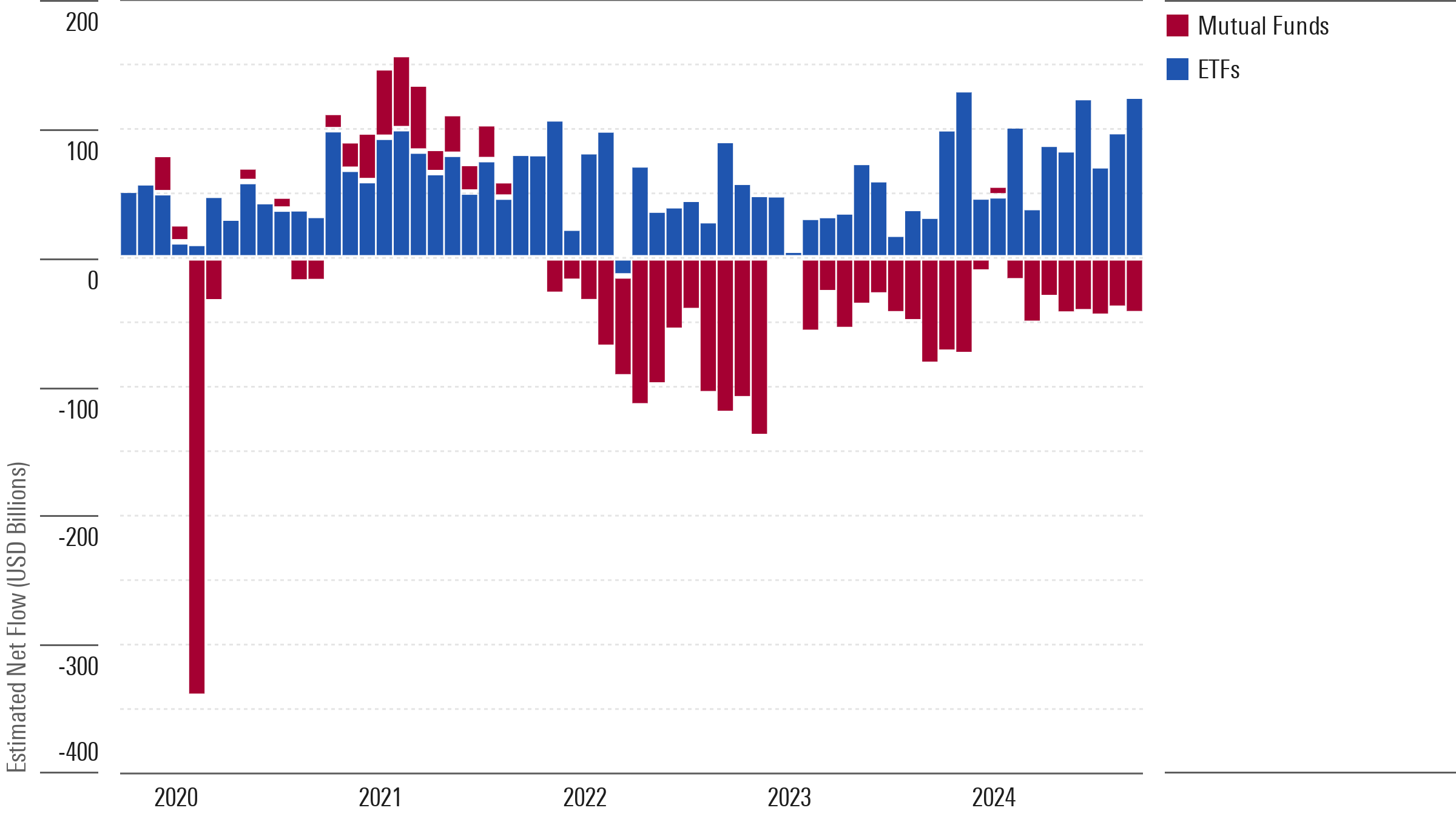
Mutual funds are struggling to attract investors. Many have not performed well, and investors have responded by moving their money. More than $510 billion left mutual funds in 2023. Another $300 billion exited over the first 10 months of 2024, while ETFs collected more than $800 billion of new money.
Appetite For Vanguard's ETF Structure Accelerates
Such large and persistent outflows from mutual funds have tax consequences for their investors. In many instances, large outflows force fund managers to meet those redemptions by selling stocks or bonds with appreciated prices. Selling realizes capital gains, which must be distributed to a fund’s remaining investors in the year they are incurred. Investors receiving those distributions owe taxes when the fund is held in a taxable account.
The relationship between forced selling and higher tax bills can swell into a vicious cycle when large amounts of money persistently exit a mutual fund. Persistent outflows require persistent selling among a shrinking investor base. So, capital gains distributions can stack up quickly for those that remain.
That has been the case for some mutual funds recently. Capital gains distributions are expected to hit nosebleed levels this year as more and more investors leave mutual funds. A handful of funds are expected to distribute 40% of their net asset value as capital gains, while many others are expected to make sizable distributions.
A Long Time Coming
A potential solution exists to reduce the tax burden on investors. Vanguard debuted a novel fund structure in 2001 that added an ETF share class to its existing index mutual funds. With this structure, the ETF’s ability to purge potential capital gains extends to the mutual fund share classes. Under the right conditions, a manager can jettison stocks with pent-up capital gains in the mutual fund share classes through the ETF share class. That reduces, if not eliminates, taxes owed on capital gains distributions.
Vanguard held a patent on this unique structure until May 2023, and it was allowed to deploy the hybrid structure on its index-tracking mutual funds only. It filed a request with the SEC to add the ETF share class to its actively managed mutual funds; the SEC denied that request in 2015.
A lot has changed since then. Active managers have increasingly moved toward ETFs to stymie outflows. Some have converted their existing mutual funds to ETFs, while others have opted to provide their investment strategies through brand new ETFs. The expiration of Vanguard’s patented ETF share class opened up a third avenue.
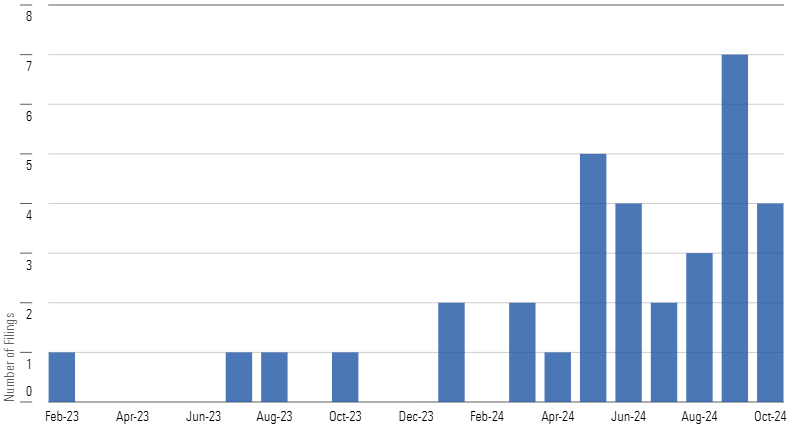
Interest in the hybrid structure was slow at first. Perpetual/PGIA was first out of the gate. It filed a request with the SEC in February 2023 to add an ETF share class to seven of its actively managed mutual funds. Dimensional made a similar request a few months later in July 2023, followed by F/m Investments and Fidelity later in the year.
The new year opened the floodgates. Another 30 mutual fund providers have submitted requests with the SEC since Jan. 1, 2024. Industry giants State Street and BlackRock threw their hats into the ring at the end of October.
Investors Leave Mutual Funds For ETFs
The appetite for this unique hybrid structure underscores the growing popularity of ETFs across the asset management industry. ETFs have become the primary vehicle of choice among index-tracking strategies. But lower fees and lower taxes through reduced capital gains distributions are proving to be strong selling points for actively managed strategies.
An Imperfect Solution
So far, the SEC has not provided any public comments about where it stands. However, some circumstances imply that it has communicated with fund providers behind the scenes. Perpetual’s initial filing was withdrawn in early 2024 after it failed to respond to SEC comments.
The adoption of Vanguard’s hybrid structure would be a big step toward improving the tax efficiency of mutual funds, but it won’t instantly cure all ills. First, the ETF share class needs time to gain assets, and its shares must trade. The trading, specifically of ETF share redemptions, is necessary for managers to purge stocks laden with unrealized capital gains. In the meantime, early adopters of an ETF share class may be subject to receiving capital gains distributions if the potential capital gains in the mutual fund’s share classes overwhelm the ETF’s ability to purge them.
Furthermore, the structure won’t fit every actively managed mutual fund. Other major mutual fund providers have yet to submit a request, including Capital Group/American Funds, Pimco, and Invesco. Why they haven’t filed isn’t clear, but the hybrid structure does have some drawbacks. ETFs can’t shut their doors to new money to control capacity and maintain their edge, a practice that some actively managed mutual funds have deployed under the right circumstances. Bolting an ETF onto a mutual fund effectively eliminates that capability.
Imperfect? Yes. But the hybrid structure would be a huge advantage for investors in the right types of mutual funds.
The author or authors do not own shares in any securities mentioned in this article. Find out about Morningstar’s editorial policies.

 United States