
The Future of CEFs Gets Dimmer With DOL Ruling
The Fiduciary Standard presents another hurdle for CEF IPOs.


Last month, the Department of Labor released its finalized rules on the Fiduciary Standard. We've discussed what that standard could mean for closed-end funds, particularly the IPO market, previously. This month, we will briefly revisit that discussion under the context of the new rules.
The Fiduciary Standard is the highest standard of care required by investment professionals. Before the DOL's ruling, it applied only to registered investment advisors under the Investment Advisor's Act of 1940. The lines between RIAs and broker/dealers are blurring, however, and regulators (rightly) want increased responsibility on the part of the broker/dealers. The Fiduciary Standard requires advisors (and now broker/dealers under certain circumstances) to put their clients' interests before their own and to eliminate conflicts of interest or disclose any conflicts that cannot be eliminated.
Under the DOL's new rules, broker/dealers must meet the Fiduciary Standard when dealing with retirement assets and accounts. But, because the DOL doesn't have domain over other types of investment accounts (that's the SEC), broker/dealers still do not have to apply this high standard to nonretirement assets and accounts. To be sure, broker/dealers must ensure that an investment is suitable for clients, but before this ruling, they were not required to put their clients' interests ahead of their own and were not required to disclose conflicts of interest. This opened the door for questionable investment recommendations that, while perhaps passing the test of suitability, provided the broker with large commissions at the investor's expense. Again, the new rule will only partially help investors as broker/dealers can still provide questionable advice for nonretirement assets.
What does this have to do with CEF IPOs? Stepping back, from a nuts-and-bolts perspective, launching a CEF isn't free, and traditionally investors have paid those fees. Mathematically, this means that all CEFs trade at premiums at the IPO, and history has shown that most IPO premiums dissipate within a few months of launch. Investors in the IPO are likely to lose money based on share price returns within the first few months of a fund's launch because of the premium dissipation. (For a more detailed discussion of the CEF IPO premium, see Morningstar's CEF Solutions Center.) So, while a newly launched fund may be suitable for inclusion in an investor's portfolio, a reasonable chance of losing money, coupled with the high commissions brokers earn for selling CEF IPOs, doesn't meet the Fiduciary Standard.
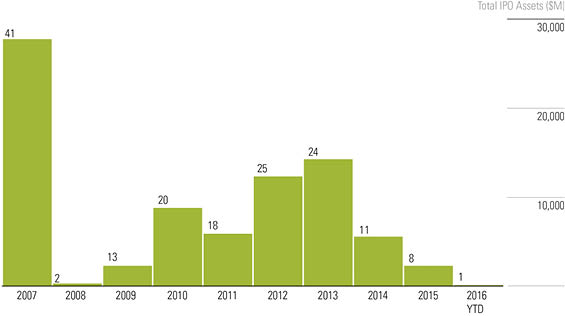
The imposition of the standard on brokers should worry CEF firms, especially if the SEC follows suit and requires the standard to be applied to all fee-based advice. Under the standard, it's hard to imagine the CEF IPO process continuing in its current form, because of the conflict between the broker's interest (earning high fees) and the client's interest (to not pay excessive fees). In fact, there has been a sharp decrease in CEF IPOs in the past few years; while the imposition of the Fiduciary Standard likely isn't to blame yet, it may make IPOs a more challenging proposition in the future. The table below shows the total assets gathered by CEF IPOs and the total number of CEF IPOs between 2007 and the year to date 2016. After a strong 2007, both measures have dramatically decreased. For the year to date, only one new CEF has launched: Nuveen Municipal 2021 Target Term NHA, raising just $81 million.
Source: Morningstar
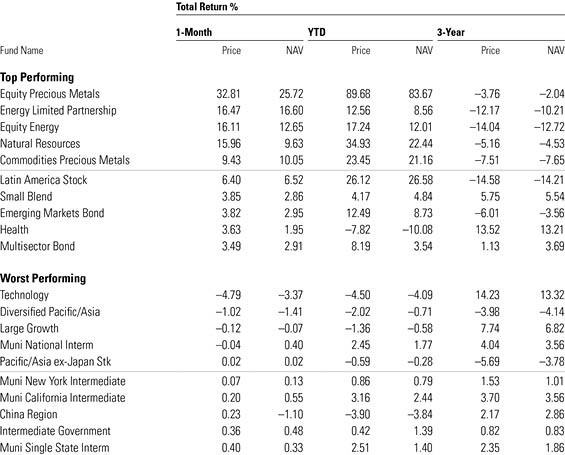
Best- and Worst-Performing CEF Categories April saw the momentum that began in mid-February continue for commodity-related equity CEFs--six of the top 10 categories (including Latin America, a country whose investments tend to be highly dependent on and correlated to the commodity market) fall under the broad "commodity-related" umbrella. Equity precious metals, in particular, have had a stellar year: Gold rose to close to $1,300 an ounce, a level it hasn't reached since 2014. Even though the equity precious metals CEF Morningstar Category has gained a shocking 90% based on share price and 84% based on net asset value during the first four months of the year, long-term investors are still underwater over three years, highlighting just how far out of favor these CEFs had fallen in recent years.
Another strong-performing category last month was multisector bond, a category with a wide variety of strategies, but a commonality of a large allocation to junk bonds. As energy and commodity names rallied, along with emerging markets (also often held in large chunks in these funds), these funds fared well in April, the average gaining 3.5% on share price and nearly 3% on NAV.
Technology, the worst-performing CEF category for the month, has been on an opposite path during the past three years. Its three-year annualized returns of 14% rank it as the top-performing equity sector during that time. This year, the sector has been stung by poor starts for tech bellwethers like
Exhibit 2 below shows the best- and worst-performing CEF categories in April, ranked by share price return.
Source: Morningstar
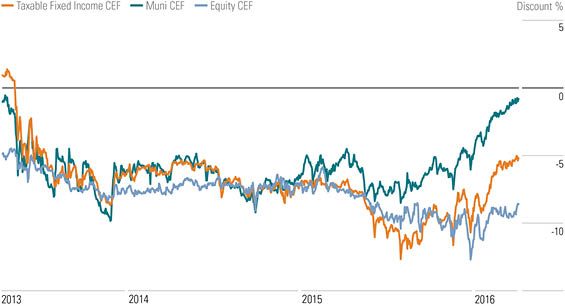
Discount Trends This year has seen a stunning narrowing of discounts in the average municipal-bond CEF. The average muni CEF was trading at a discount of less than 1% at the end of April, from 4.5% at the start of the year. It's the closest the average muni CEF has traded to par in the past three years. The category's average tax-free distribution rate of 5% has clearly drawn investors in, as the likelihood of aggressively rising interest rates seems to be waning.
Taxable-bond CEFs have also seen a widespread narrowing in discounts since the start of the year. The average taxable-bond CEF was trading at a 5% discount to NAV at the end of the month; the average was more than 8% at the start of the year. Equity CEF discounts came back in sharply in March after falling in the first six weeks of the year but remained relatively unchanged in April, closing the month at 8.6%.
Exhibit 3 shows the three-year average discount for taxable-bond, equity, and muni CEFs.
Source: Morningstar
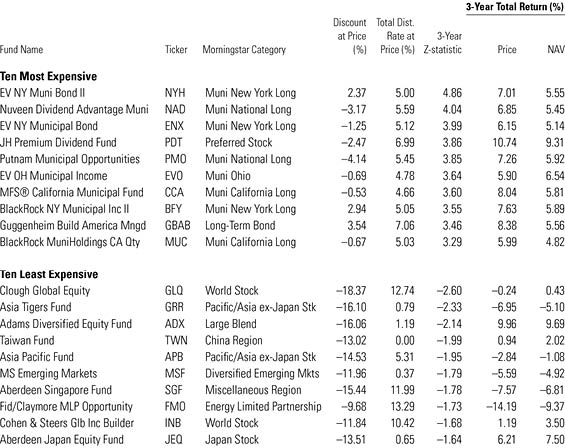
Most Expensive and Inexpensive CEFs We use a z-statistic to measure whether a fund is "cheap" or "expensive." As background, the z-statistic measures how many standard deviations a fund's discount/premium is from its three-year average discount/premium. For instance, a fund with a z-statistic of negative 2 would be two standard deviations below its three-year average discount/premium. Funds with the lowest z-statistics are classified as relatively inexpensive, while those with the highest z-statistics are relatively expensive. We consider funds with a z-statistic of negative 2 or lower to be "statistically undervalued" and those with a z-statistic of 2 or higher to be "statistically overvalued." That said, the z-statistic does have its flaws. Exhibit 4 shows the 10 most over- and undervalued CEFs as of May 5.
Source: Morningstar
Given the rally in muni CEF discount rates this year, it isn't surprising to see the most overvalued list littered with muni CEFs. As of the end of April, a whopping 95 muni CEFs were statistically overvalued based on a three-year z-statistic. The story remains relatively similar in muni land to the one we told in December, with rising demand (from income-starved investors seeking tax advantages and the relative safety of muni bonds) and reduced supply playing a large role in the group's favorable performance in recent months. Many muni managers expect these trends to continue, but investors should be wary of purchasing shares of any fund at such steep valuations.
Despite the snapback in some of the hardest-hit sectors in 2015 and into the first few months of 2016, many funds in those groups (energy limited partnership, Japan stock, world stock) are still reeling from the steep drop-off in share prices. But, as of May 5, 2016, only three funds look undervalued (z-statistic lower than negative 2) based on three-year trading patterns. That's not to say bargains don't exist: Many of the hardest-hit funds saw share prices and NAVs drop at about the same rate, which means the discounts during those time periods haven't changed too much (a fund's discount is simply a relationship between share price and NAV). Careful investors can scoop up shares of battered funds and rake in decent income streams based on low share prices, but future distribution payments are not a certainty.
Conclusion 2016 has been a roller coaster ride for investors of all stripes, and there's little evidence that the remainder of the year will be much different. For investors in CEFs, it's important to understand the added volatility that comes with investing in leveraged funds that often hold assets in illiquid corners of the market. These funds are largely held by individuals, which means there's added headline risk as well. But, for patient and careful investors, market dislocations can be a buying opportunity as investors are often all too eager to throw the baby out with the bath water.

 United States