
How to Find Small-Cap Funds With Long-Term Appeal
Good small-cap funds are harder to find than large-cap ones, but they deliver on diversification.

This article mentions funds that have an issuer-initiated rating and/or track a Morningstar Index. For full disclosure information, please refer to the specific funds, which are demarcated with a * symbol, listed below.
If you bought a small-cap fund and a large-cap fund recently, I bet it took you longer to find a good small-cap fund.
Limited capacity means there are fewer good small-cap funds, and some of those good ones are closed. Others that don’t close get too big and either graduate to the mid-cap Morningstar Categories or see performance slump because they can’t run the strategy the way they used to.
When you look at the options of still-open small-cap funds, you tend to find those mired in a performance slump. Passive funds are also a reasonable option, but historically, active small-cap funds have enjoyed more success versus their benchmarks than large-cap funds have. So, it’s worth seeking out good small-cap funds.
With that in mind, I sought out still-open gems that look appealing and have at least outperformed over the past five years. Then, I’ll highlight a couple of laggards that look appealing in any case and some of my favorite index funds and indexlike funds in the area.
Small-Growth Funds
Let’s start with small-growth funds that have Morningstar Medalist Ratings of Gold, Silver, or Bronze and are still performing well.
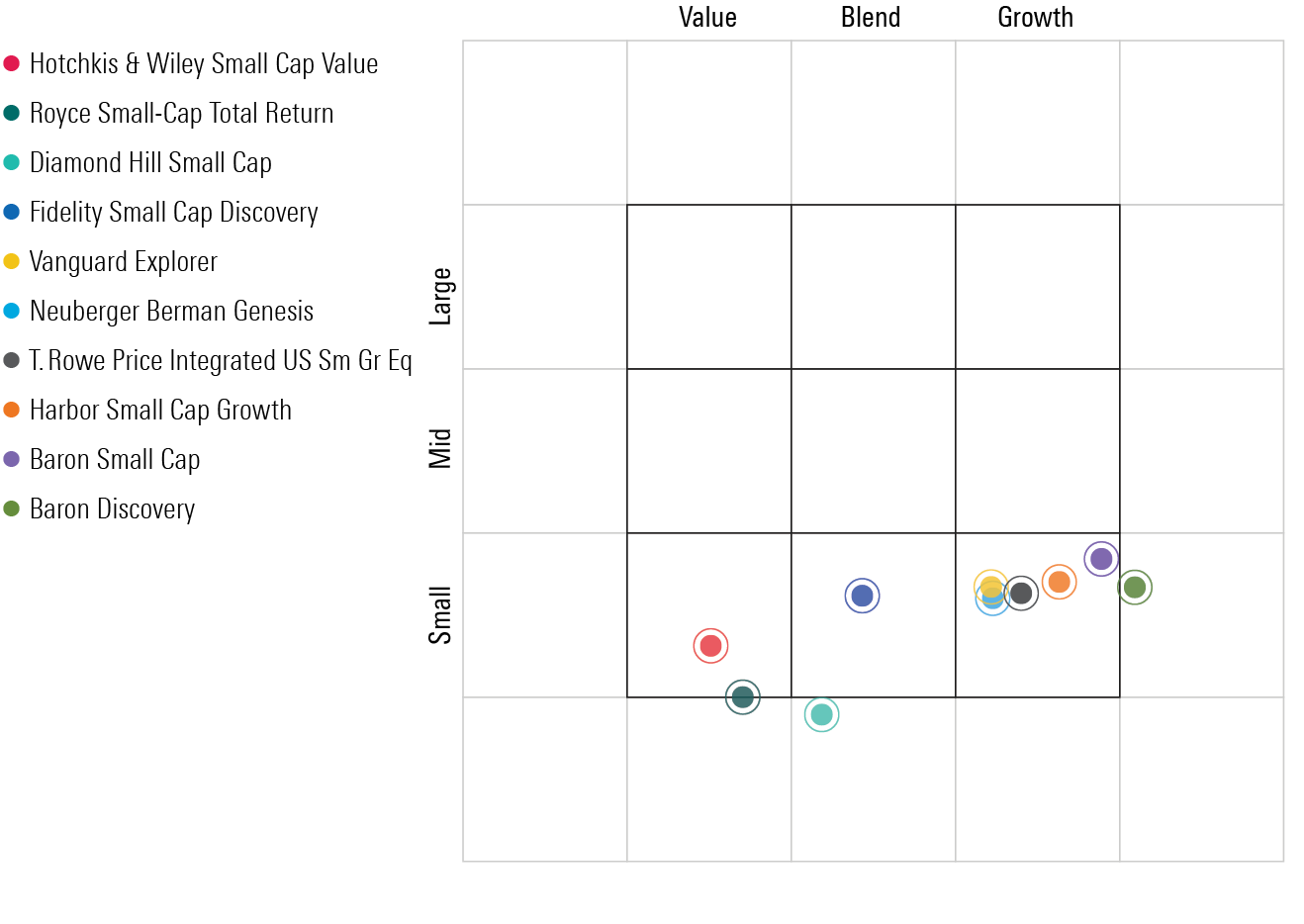
Baron funds’ main strategy is about finding small-cap compounders that produce strong earnings and cash flow growth. Baron is patient and lets winners run. Thus, we find that two of its small-growth funds look appealing. Bronze-rated Baron Discovery BDFFX is on the aggressive side of that house strategy as management is more willing to invest in earlier-stage companies with low or no profits, though it also has the higher-quality companies that we associate with Baron. Returns are in the top third for the trailing three-, five-, and 10-year periods. The fund has a $1.7 billion asset base but has been experiencing a trickle of outflows over the past year. That’s a pretty manageable situation.
Silver-rated Baron Small Cap BSCFX is probably the purest expression of that Baron strategy. It has very low turnover and is focused on high quality. As a result, the portfolio can be a little top-heavy, with the largest names around or just above 5% of assets. Cliff Greenberg has run the fund since its 1997 inception, and he has the help of assistant portfolio manager David Goldsmith. The fund has produced top-third returns over the trailing three-, five-, and 10-year periods. Despite that, it had $810 million in outflows to keep assets under management at $4.6 billion. I’d rather it were a $2 billion fund with a steady trickle of inflows, but I doubt outflows will accelerate given the solid results.
Vanguard Explorer VEXRX is actively managed, but the Bronze-rated fund has both passive and active aspects. It boasts a giant asset base of $22.3 billion, 742 stocks in the portfolio, and an expense ratio of only 0.35%. That fee is nearly 100 basis points cheaper than the ones charged by the above Baron funds. You’d expect indexlike returns from such a large but cheap fund, yet it is well ahead of the Russell 2000 Growth Index over the past 10 years. In other periods, returns were much closer to the benchmark’s. The current lineup of five subadvisors led by Wellington, which has 40% of assets, has done a fine job.
Silver-rated Neuberger Berman Genesis NBGNX just barely outperformed over the past five years and lagged for the trailing three. However, the bland results are understandable as the fund is run with a greater value discipline than most small-growth funds. That keeps risk levels below those of peers, but it means that the fund falls behind when growth stocks are really running. Besides modest valuations, the managers look for low debt, high returns on assets, and defensible competitive advantages. Brett Reiner and Greg Spiegel have maintained the fund’s investment discipline, and that’s a good sign. On the downside, the fund is a beefy $10 billion, with outflows of about $900 million over the past 12 months.
Harbor Small Cap Growth HISGX is kind of a similar story as it pursues a growth-at-a-reasonable-price strategy that has the Bronze-rated fund outperforming by just a hair during the past five years. The fund is managed by Will Muggia of subadvisor Westfield Capital Management. He looks for strong management and robust cash flows. Although the team is careful about valuations, it also makes an effort to cull losing bets. One concern we have is that there has been a fair amount of analyst turnover at Westfield. The $2 billion fund enjoyed $600 million of inflows in the past 12 months. We’ll watch closely to see how Westfield and Harbor manage capacity challenges.
T. Rowe Price Integrated U.S. Small-Cap Growth Equity PRDSX also just barely made it under the wire for five-year performance. The Silver-rated fund is a quantitative strategy that holds a diffuse portfolio of promising stocks. Longtime manager Sudhir Nanda handed the reins to David Corris and comanager Prashant Jeyaganesh last year, but we remain confident. Using fundamental and quantitative inputs, management seeks a variety of high-quality names and avoids more speculative stocks; that’s why performance has been middling as of late. The wide-ranging portfolio makes the $8.2 billion asset base tolerable. The fund shed $329 million over the past 12 months.
Small-Blend Funds
Silver-rated Fidelity Small Cap Discovery FSCRX is two years into manager Forrest St. Clair’s tenure, though St. Clair has 25 years of industry experience. St. Clair maintained the fund’s strategy of looking for fairly cheap companies with durable competitive advantages. The fund stands out for having 26% in the technology sector compared with 16% for peers and the benchmark. Obviously, its tech stocks have modest valuations but still retain elements of quality. The fund has $2.3 billion in assets, but sluggish recent results have spurred $500 million in outflows over the past 12 months. These next couple of years should be telling for St. Clair.
That’s it for active small-blend funds, but I’ll point out that this is the category where most passive small-cap funds reside, so you have options if you want a small-blend fund.
Small-Value Funds
Hotchkis & Wiley Small Cap Value HWSIX is enjoying a revival. This Bronze-rated deep-value fund has zipped to the top decile of small-value funds. Much of that five-year success owes to a great 2022 when the fund gained 3% and the typical peer lost 10% amid rising interest rates and inflation. Deep value isn’t always defensive, but it can be when rising rates cause high-multiple stocks to plummet. Lead manager Jim Miles is betting on mean reversion by targeting battered stocks that still have good long-term fundamentals. The fund has a very manageable $875 million in assets under management, and flows amount to a small positive trickle.
Bronze-rated Diamond Hill Small Cap DHSCX is an appealing fundamental-driven fund. Aaron Monroe buys stocks trading below his estimate of their intrinsic value and sells when they reach that value. With half of the fund in micro-cap stocks, it gets you more exposure to the smallest public companies than most small-cap funds do. That makes for nice diversification when the opposite corner of the Morningstar Style Box is dominating market benchmarks. The fund has $240 million in assets, and that small asset base is important for allowing it to invest in micro-caps. The fund has seen $11 million in outflows in the past 12 months.
Since taking the helm of Bronze-rated Royce Small-Cap Total Return RYTRX in 2021, Miles Lewis has pared the portfolio to 70 names from 200. He has tried to be more disciplined about what companies make it into the portfolio but still seeks those with solid returns on assets and relatively cheap share prices. Although the fund lagged in the 2022 selloff, it rebounded nicely in the ensuing two years. The fund has an asset base of about $1 billion but has endured outflows of about $100 million over the past year.
Small-Cap Picks Across the Style Box
Three Rebound Candidates
Artisan Small Cap ARTSX has absolutely dismal five-year returns that are right around the bottom decile of the small-growth category. Tolerance for high multiples in fast-growing companies hurt in 2022, but the fund also lagged in the 2023 rebound. Yet, we see seasoned managers and a sensible, though volatile, strategy that has a real shot at improved performance. We rate the fund Silver despite the slump.
Silver-rated T. Rowe Price Small-Cap Value PRSVX has been in a milder five-year slump that lands it in the third quartile of peers. Over manager David Wagner’s 11-year tenure, the fund has been just a hair behind the category benchmark. The emphasis here is on quality companies at modest prices. As a result, the fund straddles the value/blend line. We have it in the small-blend category, and its value leanings have held it back a bit. But Wagner has strong analyst support, and we think this fund has better days ahead.
Wasatch Small Cap Growth WAAEX has moved on from longtime manager J.B. Taylor, who handed off manager duties to Ryan Snow and Ken Korngiebel in 2024 and plans to retire at the end of 2025. Snow and Korngiebel have worked on the fund since 2017. Wasatch has a long record of doing best in small growth, so we still believe in this Silver-rated fund. The fund’s third-quartile five-year return is not impressive, but it is actually in the top third for the past year, thanks to a wide array of holdings rather than one or two dominating. That’s a good sign.
Passive and Nearly Passive Options
There are excellent index and indexlike options among small-cap funds. Gold-rated Vanguard Small-Cap Index
VSMAX
Gold-rated DFA US Small Cap DFSTX doesn’t track an index, and its managers have the freedom to make the most of attractive bid-ask spreads by trading them when it’s to their advantage. Thus, the fund is classified as actively managed. And yet, it’s a super diversified portfolio of nearly 2,000 stocks, and it charges just 0.27%. So, it works a lot like an index fund. I should note that DFA funds are not available in every sales channel, so check first before you dig too much into the fund.
Schwab Fundamental U.S. Small Company Index SFSNX strays from standard market-cap weightings based on the belief that mean reversion is a dependable factor and that it’s better to weight a portfolio on something other than market capitalization. These are both ideas from the value camp, and thus, the fund has tended to perform a little better in value-driven markets. The Silver-rated fund charges 0.25%, making it a little pricier than Vanguard and other cap-weighted index funds.
Worth the Effort
Small-cap funds take a bit more effort than large-cap ones, but they deliver diversification and research that you’d be hard-pressed to come by on your own. Small caps typically enjoy their own long stretches of outperformance versus large caps, though it has been a while since we had a sustained small-cap rally.
This article first appeared in the March 2025 issue of Morningstar FundInvestor. Download a complimentary copy of FundInvestor by visiting this website.
The author or authors do not own shares in any securities mentioned in this article. Find out about Morningstar’s editorial policies.

 United States