
How Morningstar’s New Medalist Rating Methodology Affects 11 of America’s Largest Funds
A closer look at the big funds, with some notable upgrades.

This article mentions funds that have an issuer-initiated rating and/or track a Morningstar Index. For full disclosure information, please refer to the specific funds, which are demarcated with a * symbol, listed below.
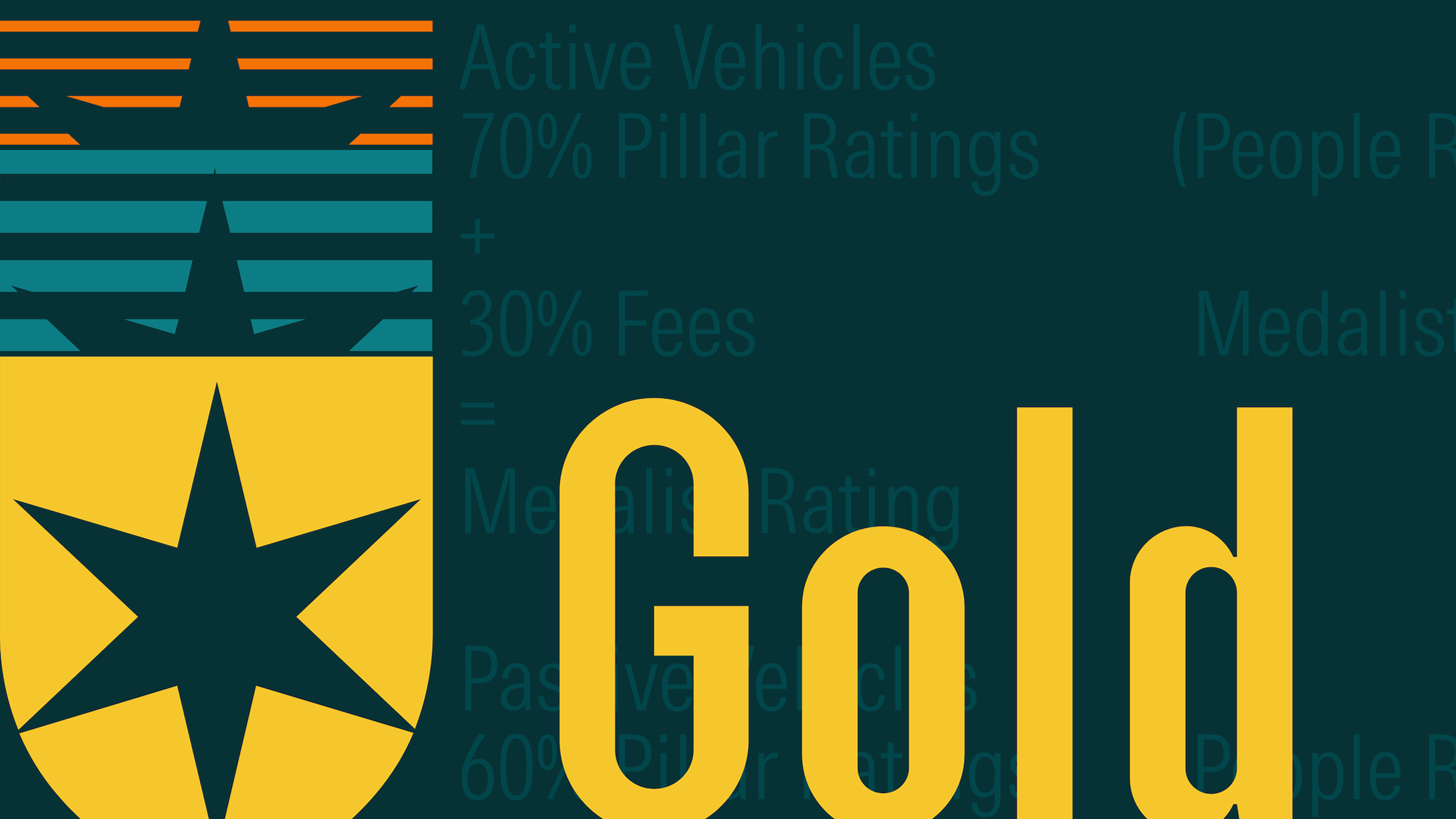
Our recently simplified Morningstar Medalist Ratings now have fewer moving parts. We assign points for People, Process, and Parent, then subtract a relative fee score to arrive at the overall rating, which reflects our view of the fund’s prospects relative to peers.
We give a 70% weighting to the three fundamental pillars and 30% to Price for actively managed funds; for passive funds, Price gets a 40% weighting. Each pillar is worth between +2 (High) and -2 (Low), including Price, which we rank by Morningstar Category and assign scores from +2 to -2, the former being the cheapest. Then we take a weighted average of the fundamental pillar and Price scores.
For active funds, the fundamental rating gives a 45% weighting to People and Process and 10% to Parent. For passive funds, we have 80% on Process, 10% on People, and 10% on Parent.
Active funds that average a 1.2 or higher earn Gold; 0.8-1.2, Silver; 0.5-0.8, Bronze; -0.5-0.5, Neutral; and less than -0.5, Negative. For passive funds, it is Gold at 1.4 or higher, Silver 1.0-1.4, Bronze 0.7-1.0, Neutral -0.3-0.7, Negative below -0.3.
Because we no longer grade on a curve and try to estimate the outperformance potential in each category, funds’ ratings will change only when their own fundamentals do. Overall, this change will boost ratings, especially among index, allocation, and bond funds.
To dive a little deeper, check out our methodology paper and this column on the subject.
We’ve updated our ratings for funds all at once, so any ratings you see now should reflect the new approach. Now that you have the basics, let’s take a look at how the largest funds look under the new approach. I’ll take them in alphabetical order rather than asset size to make it easier to find the ones you’re interested in.
I should note that by choosing the largest funds, I’ve selected some funds with very low fees and very highly regarded parents, which makes them look good relative to most rivals.
The Lowdown on the Largest Funds
American Funds American Balanced ABALX
This is a good fund to start with. Allocation funds were held to such a high standard by our old methodology that it was very hard to get a Gold rating. This is a low-cost, well-rounded fund from a strong firm, so now it gets credit for having the complete package.
American Funds Capital World Growth & Income CWGIX
This fund isn’t as cheap as American Funds American Balanced, so it gets almost a full point less. Also, it has an Average People Pillar, which means 1 point less on fundamentals. Sadly, we don’t give bonus points for having a really long fund name. So, this fund stays Bronze.
American Funds Fundamental Investors ANCFX
This fund’s pillars are similar to those of American Funds American Balanced, but it gets only a Silver, because here a 0.58% fee ranks lower, or looks a little more expensive, in its category. It’s a large-blend fund that goes head-to-head with a slew of total stock market and S&P 500 index funds, nearly all of which charge less than 10 basis points. It’s a strong fund, but its rating reflects how hard it has to work to overcome its fee hurdle and beat some of the best index funds around.
American Funds Growth Fund of America AGTHX
We raised this fund’s People rating to High in January, and that’s enough to get it over the line to Silver. Going by past performance, that looks pretty generous. However, these ratings are forward-looking, and the strong team behind this fund has the potential to deliver better results.
American Funds Investment Company of America AIVSX
This large blend fund is 2 basis points cheaper than American Funds Fundamental Investors, so its score comes out slightly higher but still Silver. This fund’s mix of dividend and growth plays has it shooting for its fifth straight year of category outperformance.
Fidelity Contrafund FCNTX
Will Danoff is going out in style. The Contrafund manager is wrapping up a great career by stepping down at the end of 2026 after putting up stellar returns in 2024, 2025, and the year to date. His impending departure led us to drop the fund’s People rating a notch to Above Average. We’re fans of the new managers Asher Anolic and Jason Weiner, but they are going to be running way more money than they had been, so Above Average seemed appropriate for now.
Pimco Income PONAX
This is the first Above Average fee in our group of giant funds, as you can see from its negative Price score; that keeps the fund at Silver. I’ve been using retail share classes here, and Pimco’s retail share classes are not cheap. On the plus side, Dan Ivascyn runs an aggressive, wide-ranging strategy that puts at his disposal many levers to produce an appealing yield.
Vanguard Developed Markets Index VTMGX
Our methodology for passive funds places a big weighting on the Process Pillar and very little on People, so Process and Price drive the story, and this fund is quite strong on both counts.
Vanguard Emerging Markets Index VEMAX
This fund almost gets the maximum Price score, but passive approaches don’t fare as well in more inefficient emerging markets as they do in more rationally priced developed ones, so the fund’s average Process rating limits it to Bronze.
Vanguard Total Bond Market Index VBTLX
Passive bond funds are kind of in between large-cap equities and emerging markets in terms of having an edge over active managers. There’s definitely room for active fixed-income managers to add value versus this fund’s largely government bond portfolio. You could still use a fund like this for cheap government exposure and add an active high-yield, corporate, or core-plus fund in an attempt to boost returns and yield.
Vanguard Total Stock Market Index
VTSAX
When you run a $2 trillion fund, you can charge just 0.04%. And when you track a broad, market-cap-weighted index, good things can happen. This fund has the highest raw score of the funds I’ve covered here.
In an upcoming article, I’ll share my take on some other notable upgrades and downgrades resulting from our new methodology.
Correction: A previous version of this article had an incorrect ticker and Morningstar Medalist Rating for Vanguard Emerging Markets Index. These have been updated, along with the new rating for American Funds Growth Fund of America. American Funds New Perspective and American Funds Washington Mutual were removed because their new ratings have not been published yet.
The author or authors own shares in one or more securities mentioned in this article. Find out about Morningstar’s editorial policies.

 United States