
How Private Assets Impede the Benefits of ETFs
ETFs holding private assets may give up some of their tax efficiency, and many look expensive.

This article mentions funds that have an issuer-initiated rating and/or track a Morningstar Index. For full disclosure information, please refer to the specific funds, which are demarcated with a * symbol, listed below.
Several exchange-traded funds have emerged claiming to offer exposure to private assets, but don’t be fooled by the terminology. The term “private” implies something exclusive, rare, and special. But in the context of investments, private simply means difficult to access and trade. Private assets are shares in smaller businesses (private equity) or loans (private credit) that seldom exchange hands, if at all. Wealthy investors typically invest in them directly or through a partnership that’s off-limits to smaller investors. You typically need millions of dollars to qualify for such investments, and the fees are steep.
Democratizing access to a wider swath of investors is the real game changer. While there’s nothing wrong with providing more investment options, new and interesting doesn’t always equate to strong merit. High fees still erode performance, and these difficult-to-trade assets may not benefit from the ETF’s tax efficiency.
The Odd Couple
ETFs have soared in popularity over the past decade. In most instances, they’re more tax-efficient than comparable mutual funds, and that’s one of their most attractive features. All in all, a well-managed ETF provides a higher aftertax total return than an equivalent mutual fund.
ETFs’ tax advantage stems from differences in how mutual funds and ETFs trade. Investors who want to sell their mutual fund shares deal directly with the fund provider. They send their shares back to the provider in exchange for cash, and the provider may have to sell stocks or bonds to meet their request. Those sales can trigger taxable capital gains distributions to the investors that remain in the fund.
ETFs work a little differently. Investors cash in their shares to a special trader, called an authorized participant, and the AP performs the redemption. It brings ETF shares to the ETF provider and trades them for an equivalent basket of the underlying stocks or bonds. No cash changes hands in that transaction. Stocks or bonds with appreciated prices are no longer on the ETF’s book, so it has eliminated potential future distributions of capital gains.
That’s a boon for the investors that remain in the ETF. They don’t have to worry about taxable capital gains distributions, but there’s a catch. The APs performing these trades inherit the risks of the individual stocks or bonds that they gained in the transaction. That usually isn’t a big deal because most stocks and bonds trade all the time, and their prices are easy to find. The AP can easily corral the risks.
Private assets throw a wrench into those tax-efficient transactions. They change hands far less frequently than publicly traded stocks or bonds, which makes it much more difficult for APs to accurately understand their fair value and any associated risks. Poor transparency may prevent them from wanting to deal with private assets. In those instances, the ETF will have to function like a mutual fund. It will need to find a buyer and sell its private assets for cash. Like a mutual fund, that cash transaction triggers capital gains that it will have to pass down to the ETF’s investors.
Demystifying Private Equity and Private Credit ETFs: What Every Investor Should Know
The Bogle Effect
Why are ETF providers trying so hard to fit a square peg in a round hole? Part of the reason has to do with the massive shift toward low-cost ETFs. More than $500 billion left actively managed mutual funds in 2024, while ETFs took in more than $1 trillion. Some of that money went into actively managed ETFs, but low-cost index-tracking ETFs from Vanguard and BlackRock account for the lion’s share. Just three ETFs—Vanguard S&P 500 ETF VOO, iShares Core S&P 500 ETF IVV, and Vanguard Total Stock Market ETF
VTI
ETFs Continue Winning Battles for New Money
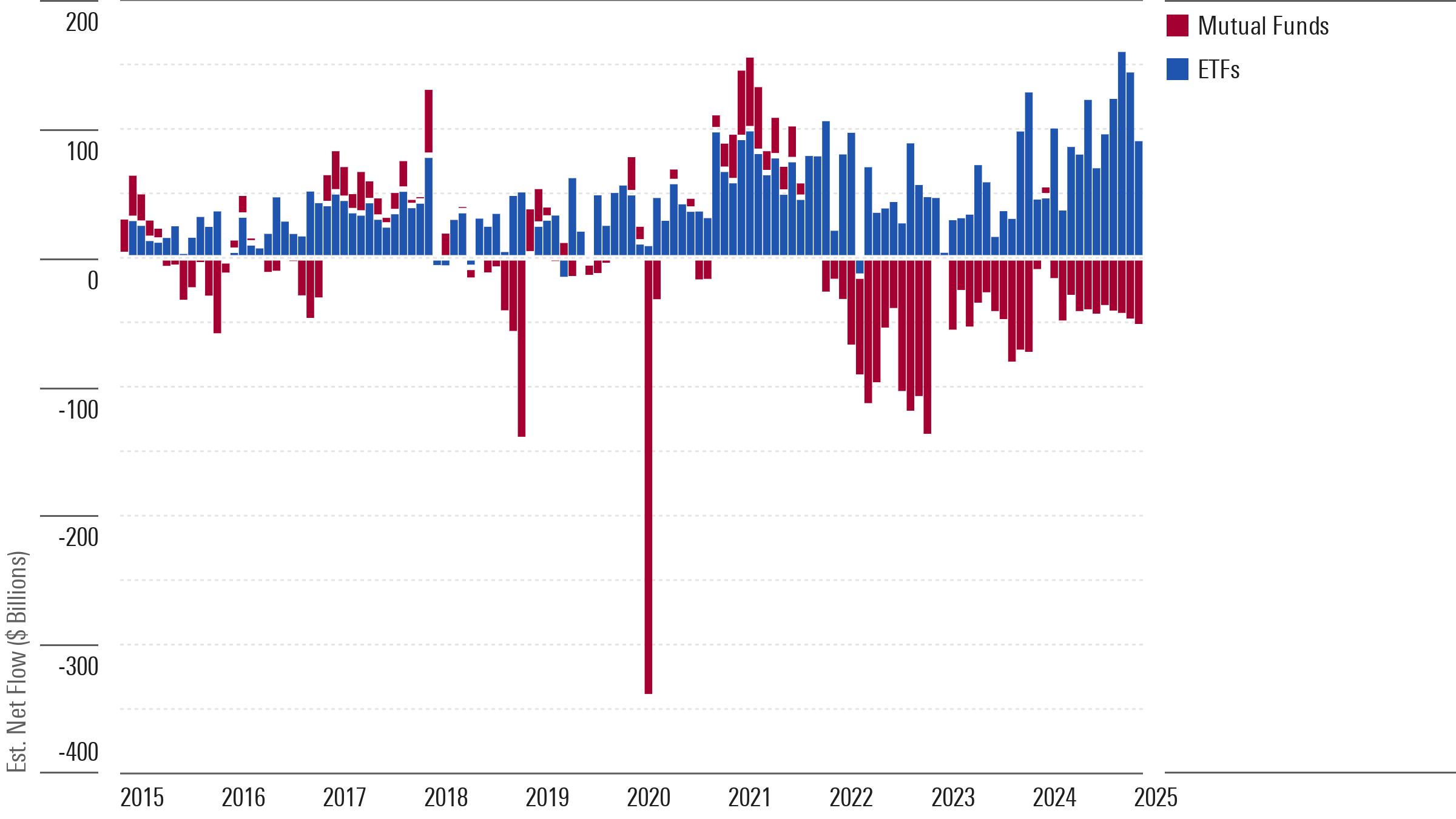
The shift away from mutual funds to low-cost ETFs has created a problem for a lot of mutual fund providers. Vanguard and BlackRock were among the first to offer low-cost ETFs. They have the name recognition and some of the largest index-tracking ETFs available. It’s too late for others to create their own and compete for new investors.
Instead, mutual fund and ETF providers have attempted to introduce new ETFs that Vanguard won’t offer. They can charge more for the novel risks and rewards in these ETFs, and they won’t have to deal with a lot of pressure to cut fees. That’s part of the reason cryptocurrencies, single stocks, defined-outcome strategies, and high-income covered-call strategies have all emerged, or reemerged, in ETFs.
Few ETFs offer exposure to private assets, and those that do charge high fees. For example, the expense ratio on ERShares Private-Public Crossover ETF XOVR—an ETF that holds shares in SpaceX—charges an annual fee of 0.75%. It’s benchmarked to the Russell 1000 Growth Index, and ETFs tracking that bogy are available for a fraction of the cost.
Private Assets Aren't Cheap

Making A Case (or Not)
To summarize, ETFs holding private assets may give up some of their tax efficiency, and the few that are available look pricey. Those points directly contradict why many investors use ETFs. It’s possible that fees will come down as competition increases. Tax efficiency could also improve, though that might require more substantial changes to how ETFs function.
There is another point of caution to consider. The wealthy investors who understand private assets—the risks, rewards, costs, and work necessary to successfully invest in them—can employ experts dedicated to finding the best deals. In other words, they aren’t going to use an ETF to invest in private assets. The ETFs are primarily aimed at smaller investors who don’t have the resources or information to understand the risks they’re taking. There’s no guarantee that they’ll get the best-performing loans or shares in the most attractive private companies.
You won’t miss out on much by forgoing these ETFs, either. As of today, ETFs and mutual funds are limited to a 15% (or less) stake in private assets. The remaining majority will invest in publicly traded stocks or bonds. In other words, don’t get too excited about an ETF’s private assets and ignore the investment process for the other assets it’s holding. Those will dictate most of an ETF’s risks and rewards, so they’re arguably more important.
At the moment, these ETFs look like a distraction. Transparency is low, fees are high, and the benefits appear questionable.
The author or authors do not own shares in any securities mentioned in this article. Find out about Morningstar’s editorial policies.

 United States