
How Smart People Screen for Funds
Get focused on fundamentals.


I recently wrote about how unwise people screen for funds, so now I’ll share how smart folks do it. To find good results, you need to go with fundamentals that endure and have predictive power.
It all starts with fees. I recommend something fairly strict like the cheapest quartile or quintile of the Morningstar Category. We use the prospectus-adjusted expense ratio in the Morningstar Medalist Rating equation, but the annual net expense or prospectus net expense ratios are also great. The prospectus-adjusted expense ratio backs out discretionary costs like leverage and shorting. The other two do not. The annual net expense ratio tells you what shareholders paid over the 12 months covered by the latest annual report. It’s backward-looking but still pretty close to what you would currently pay unless assets changed a lot or the fund company changed fee levels. The prospectus net expense ratio is a little better because it tells you what you would pay as of the moment the prospectus was written. So, it’s more of a current snapshot.
Next, screen for a Medalist Rating of Bronze or better. That tells you that our analysts did their due diligence and found fundamental strengths that should make its fees worthwhile. Our ratings are forward-looking, so a manager change or a strategy change would be reflected in our view regardless of past performance.
Then look for a manager investment of $1 million or more. That’s the highest reportable level, and it has solid predictive value because, of course, managers are pretty well-placed to assess the quality of their funds.
Next, screen out funds with high levels of risk relative to peers. I exclude funds with a Morningstar Risk rating of High. But you could also use standard deviation for equity funds and allocation funds, and credit quality and duration for bond funds. We do this because our studies show that investors get spooked by high-risk funds and tend to sell when the fund takes a big loss. That prevents profiting from the rebound and thus locks in subpar returns with high risk, even though high risk is supposed to get you high returns.
Next, screen for a Parent rating of Above Average or High. In the long run, the parent company has a big impact on a fund’s success or failure. Parents with good investment cultures can attract and retain good analysts and managers who can keep their funds going strong even through manager departures and retirements. In addition, good parents tend to be more ethical, charge lower fees, and close funds to new investors when needed. All that means better results.
Finally, look for funds with managers who outperformed their benchmarks and/or peer groups over their entire tenure. You want some signs of skill, and that requires as much data as possible.
How You Can Screen on Different Sites
The selector tool on the Morningstar FundInvestor website allows you to run all these tests. Unfortunately, you have to enter the ticker. It doesn’t show you all the funds that pass. Morningstar Direct has this screen, but it’s built for institutional investors.
You Can Run All These Screens on the FundInvestor Selector
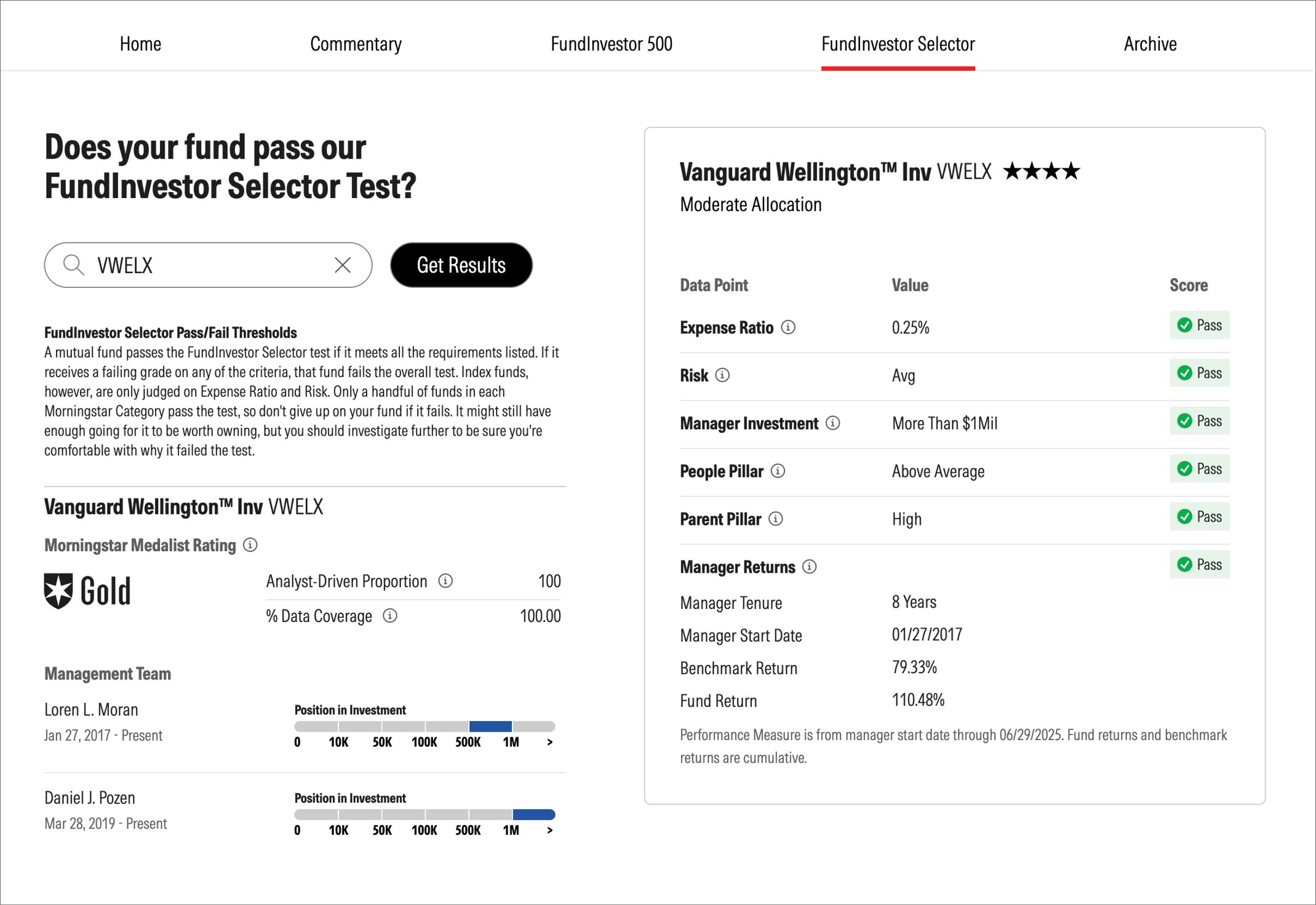
Here is how some other fund screeners can help with these tests. On Morningstar.com, you can screen for a Medalist Rating of Bronze or better and Morningstar Fee Levels that are either Low or Below Average. The other tests are not there, but it does have the Morningstar Rating, or star rating, which gives you an idea of how the fund performed over the trailing three, five, and 10 years. If the current manager has been there for 10 years or more, at least you’ve got a pretty good measure of how they did.
On Fidelity.com, you can screen on the Morningstar Risk rating and expense ratios. However, you have to pick one risk rating on a scale of 1 to 10; you can’t just exclude the highest 10%. You can also screen on the star rating or the Morningstar Return rating. It doesn’t have the Medalist Rating, Parent rating, or manager record, however. It also lets you screen on Fidelity’s picks, if you want something to stand in for the Medalist Rating.
On Schwab.com, you can screen for absolute expense ratios but not relative to a category. For risk, you can screen on standard deviation and duration, but only in absolute terms. For performance, you can also pick an absolute level, which isn’t very helpful, but you can use the star rating, which is at least relative to category peers. You can also screen on Schwab Select as a stand-in for Morningstar Medalist Ratings.
Vanguard lets you compare funds, but it doesn’t let you run a screen. On the plus side, if you limit yourself to Vanguard funds, you know you are getting a low-cost fund from a highly rated parent, so it’s not all bad.
Different Sites Have Different Screens

The author or authors do not own shares in any securities mentioned in this article. Find out about Morningstar’s editorial policies.

 United States