
Libor to Bank-Loan CEFs: Float On
Bank-loan CEFs may finally offer long-promised floating coupons.


With the U.S. election in the rearview mirror, the biggest question on investors' minds is when the Federal Reserve will raise rates again (it did so in December 2015, increasing its target rate by 25 basis points). According to the CME's FedWatch, as of early November, the market assigned a 76% probability to a 25- to 50-basis-point hike in December, which would move the target federal-funds rate to 50-75 basis points from 25-50 basis points.
For closed-end funds, rising rates are generally bad news, especially for fixed-income funds. This is primarily because most CEFs tend to have long durations. Because of the closed nature of the funds, managers can capture the illiquidity premiums on long-term bonds, increasing payouts to investors but lengthening duration as well. In addition, most CEFs utilize leverage, which increases the underlying portfolio's duration.
In periods of rising rates, leverage can also be a source of increasing costs because many CEFs borrow at short-term rates, usually based on three-month Libor. While Libor is not directly tied to the Federal Reserve's target federal-funds rate, the two tend to move in concert.
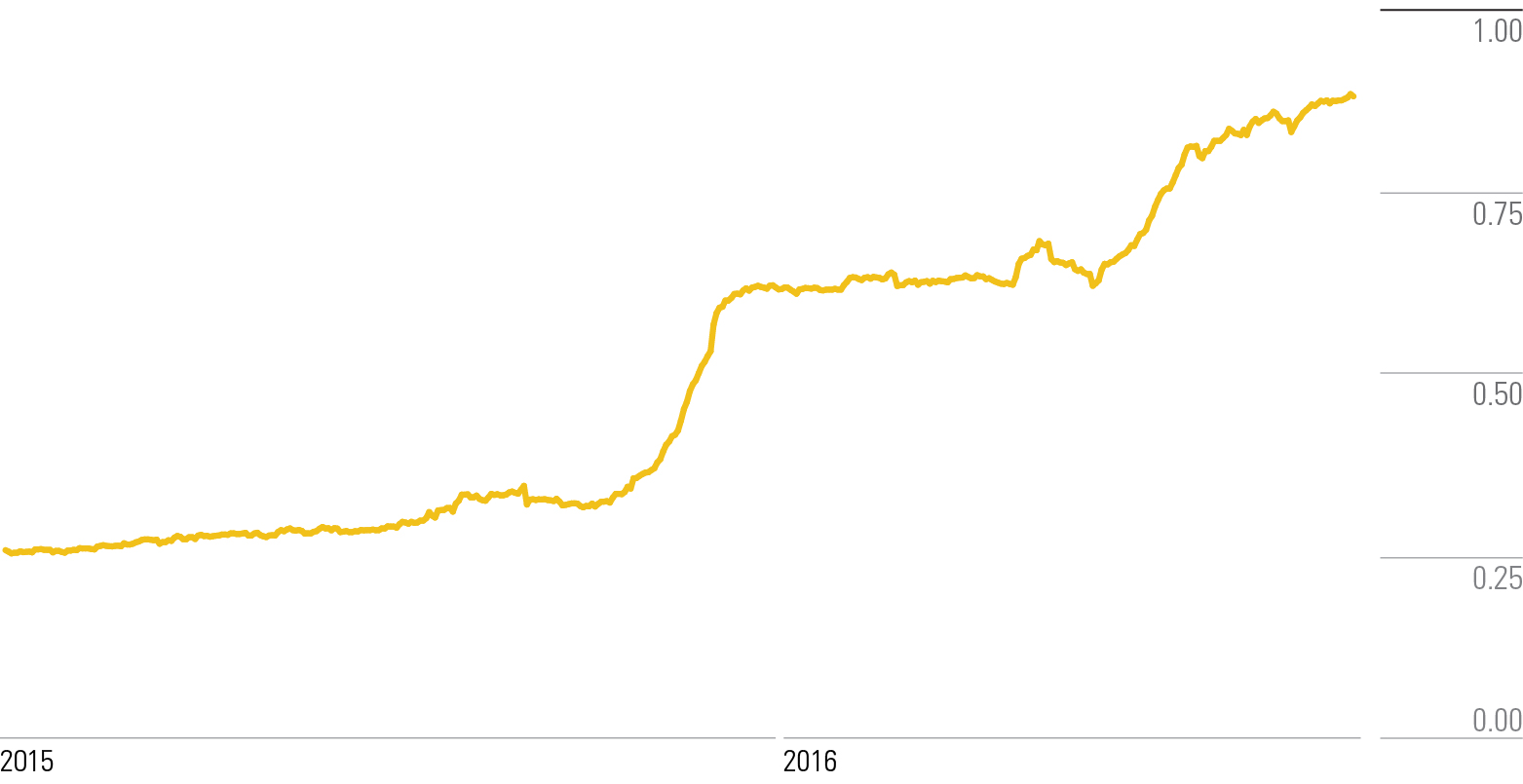
Exhibit 1: Three-Month Libor, January 2015 through October 2016
Source: Morningstar.
For example, three-month Libor jumped to 0.60% from 0.40% when the Fed increased rates in December 2015. Libor had already increased to 0.40% from 0.30% in late November 2015 in anticipation of the Fed's December move. Libor continued to rise throughout 2016, reaching 0.90% by the end of October. Exhibit 1 above shows three-month Libor from January 2015 through October 2016.
The increase in Libor has had an impact on CEFs that primarily invest in bank loans (also called floating-rate bonds) whose coupon payments are tied to three-month Libor rates. The rub for these funds for a long time had been that most of the floating-rate loans in the market were issued with a "Libor floor," which mandated a minimum coupon payment when Libor rates clocked in below that floor. According to Bloomberg, as of the end of 2015, the average Libor floor on outstanding bank loans was just above 80 basis points. This meant that if three-month Libor stayed below 80 basis points, the coupons on those bonds remained fixed. As Libor crept up to 90 basis points in early September of this year, however, those coupons were finally allowed to "float" and reset at higher rates. If the Federal Reserve increases the federal-funds rate in December, three-month Libor may continue to rise to the benefit of investors holding CEFs that invest in bank loans.
It's important to point out that bank loans are issued by companies with lower credit ratings (typically below investment grade), so investors are swapping interest-rate risk for credit risk. What's more, the discount/premium phenomenon of CEFs means that investors' total return (share price change plus distribution payments) may deviate from what is expected in an environment of rising rates. During the credit sell-off in January 2016, for example, the average bank-loan CEF's discount widened from 9% to 13% during January, despite the steady increase in three-month Libor rates. Of course, Libor was still below the average floor (by about 20 basis points), so from a practical standpoint, those loans tended to trade like junk-rated fixed-rate bonds.
Trading patterns after three-month Libor breached the average Libor floor, however, don't show much improvement. Three-month Libor rose to 0.90% from 0.80% in early September 2016, which means that the underlying loans within these CEFs are now likely to pay a floating-rate coupon (assuming the average Libor floor of 80 basis points). But the average bank-loan CEF's discount has not narrowed since that move. In fact, it widened to nearly 9.00% at the end of October from 7.75% in early September.
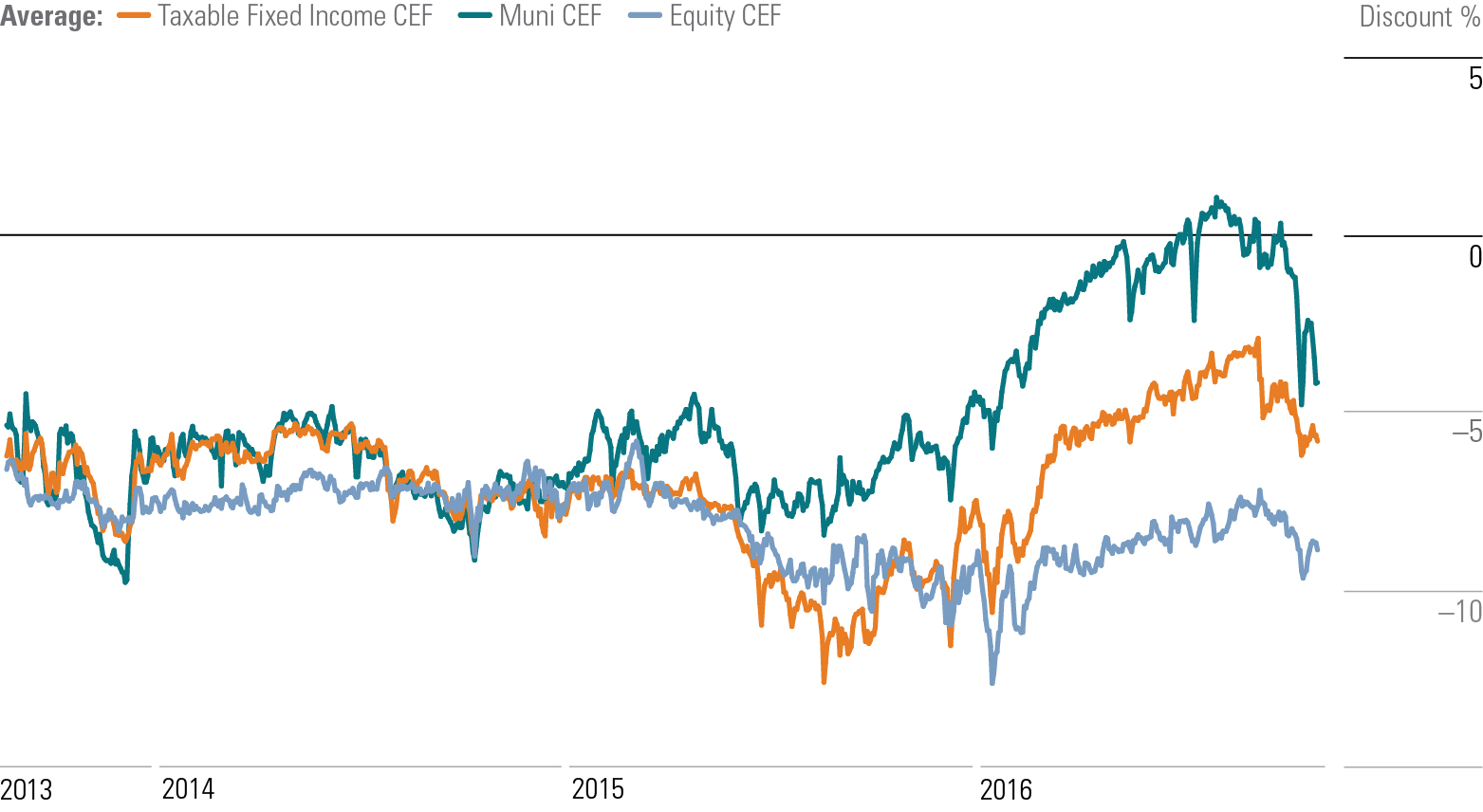
CEF Discount Trends October was a rocky month for muni-bond CEFs. Shares of tax-advantaged fixed-income CEFs were trading at par in September, but investors spooked by the threat of rising interest rates were aggressive sellers during October. The average muni CEF was trading at a 4% discount to net asset value at the end of the month, a 400-basis-point swing south from the start of the month. Taxable-bond CEFs, which began October at an average discount of 4.25% held up better, but saw discounts widen nonetheless. The average taxable-bond CEF was trading at a 5.80% discount at month-end. Exhibit 2 shows the average discounts for the three major CEF asset classes for the trailing three-year period.
Exhibit 2: Average Discounts
Source: Morningstar.
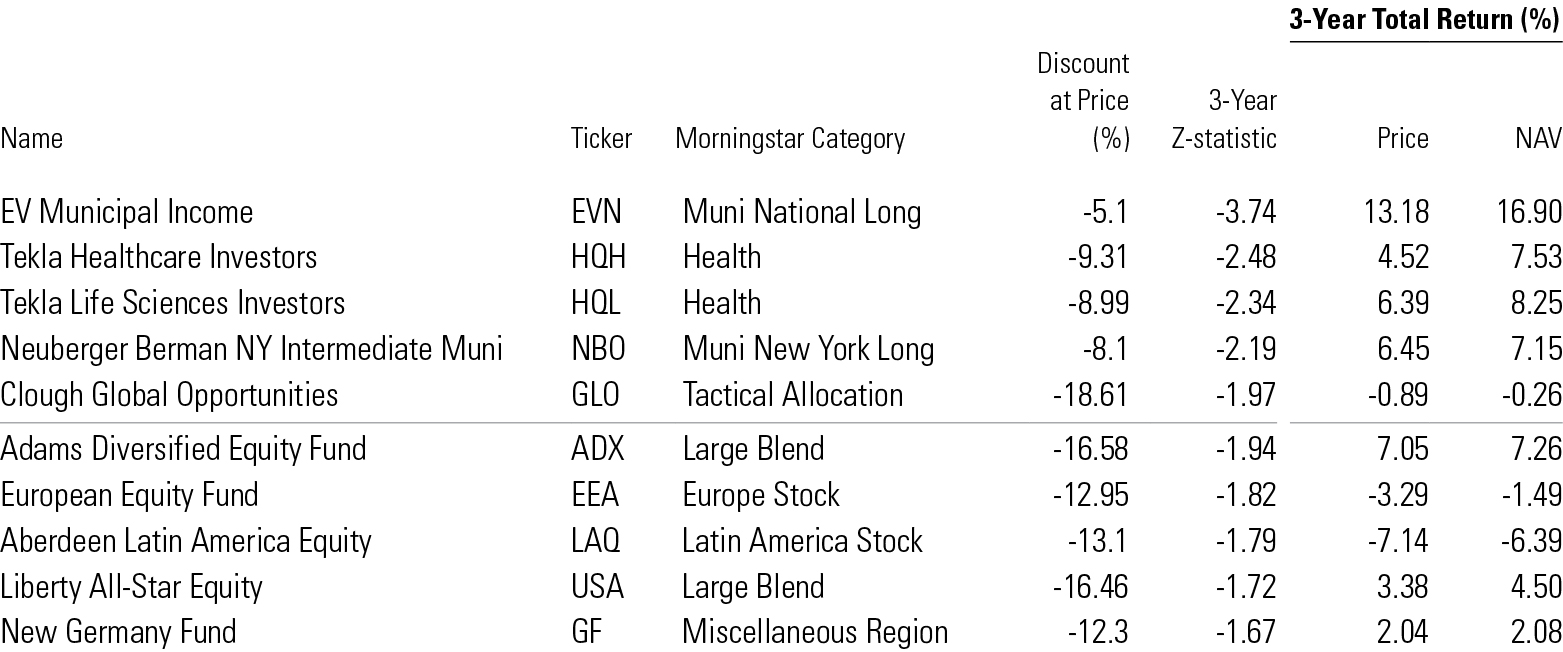
Valuations The steep sell-off in muni CEFs during the month of October led to two attractively priced muni CEFs based on their three-year z-statistics, a rare sight in 2016. Exhibit 3 shows the 10 most undervalued CEFs based on their three-year z-statistic.
We use a z-statistic to measure whether a fund is "cheap" or "expensive." As background, the z-statistic measures how many standard deviations a fund's discount/premium is from its three-year average discount/premium. For instance, a fund with a z-statistic of negative 2 would be two standard deviations below its three-year average discount/premium. Funds with the lowest z-statistics are classified as relatively inexpensive, while those with the highest z-statistics are relatively expensive. We consider funds with a z-statistic of negative 2 or lower to be "statistically undervalued" and those with a z-statistic of 2 or higher to be "statistically overvalued."
Exhibit 3: Most Undervalued CEFs
Source: Morningstar.
EV Municipal Income EVN was trading at a 5% discount in early November, far off its three-year average premium of 2%. The fund's premium was as high as 5% in March 2016. Neuberger Berman NY Intermediate Muni NBO also had a fall from grace, albeit not as far. Its 8.1% discount is about 500 basis points wider than its three-year average discount.
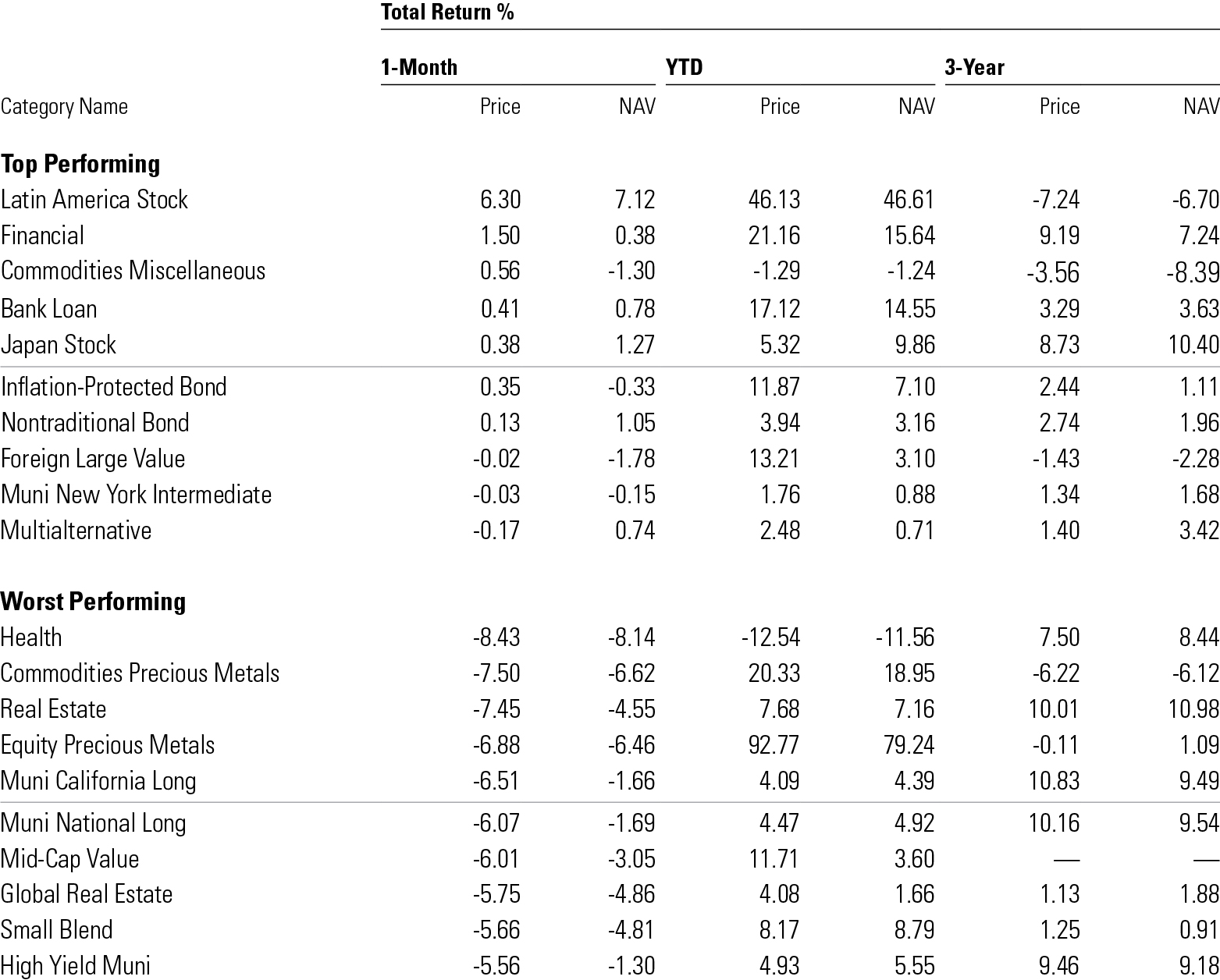
Best- and Worst-Performing CEF Categories At a bird's eye view, our CEF categories did not perform as well in October as they did in September. Only seven out of the 65 CEF categories had positive returns this past month, with the median return of the bottom 10 far outweighing the median of those at the top (an unsavory negative 6.29% compared with a lackluster 0.36%).
Exhibit 4: Best- and Worst-Performing CEF Categories
Source: Morningstar.
Reassuringly, CEFs weren't worse off than the rest of the market, as similar skewness could be seen among open-end funds and ETFs. Latin American stocks performed particularly well this month--their positive returns in the first weeks of October weathered short-lived dips on Oct. 26 and Oct. 28 when the FBI announced it would reinvestigate Hillary Clinton's email server. The municipal categories were less resilient toward market sentiment and were especially hit hard amid concerns around rising interest rates. But "sentiment" is the key word here, which we can see by the muni categories' price returns far outweighing those of their NAVs.
Conclusion All told, predicting the timing and magnitude of rising interest rates is difficult and investors should not be in the business of doing so. The market may react in a way that is counter to an investor's expectations. Investors are better served by sticking to long-term investment plans and holding funds through market cycles.
Alaina Bompiedi contributed to this article.

 United States