
No Market for Covered-Call CEFs
Covered-call closed-end funds can benefit when volatility rises, but recent returns have been disappointing.


The first quarter was a nearly perfect microcosm of the struggles of covered-call closed-end funds.
CEFs that utilize a covered-call strategy typically write call options on either individual stocks or indexes that represent the portfolio's holdings. Call options provide the buyer with the right--but not the obligation--to purchase a security at a specified price (strike price) at some point in the future (prior to the expiration date). For this option, the buyer pays the seller (or writer) a fee (option premium). In the context of a covered-call CEF, the fund is the call writer, or seller. Once a call option is written, the fund is obligated to sell the asset at the specified price should the buyer choose to exercise the option, or to buy back the call prior to it being exercised. In short, writing call options means the writer is selling some of the security's future upside potential to earn the option premium up front.
Option premiums are priced based on implied volatility: If investors think the market will be highly volatile, an option will be priced higher. In times of extreme volatility, option prices can skyrocket. Historically, implied volatility has been higher than realized volatility, which means call writers have been generally overcompensated for the risks of writing call options.
The premiums received from selling call options have generally acted as a buffer for covered-call strategies when equity markets are falling, like during the first half of the first quarter. While the Russell 1000 Index sold off almost 10% during the first 45 days of trading in 2016, many of the covered-call CEFs fell far less. Nuveen S&P 500 Buy-Write Income BXMX, for example, fell less than 6%.
The problem that covered-call strategies run into isn't during down markets, though, it's during up markets. Since the fund is obligated to sell the stocks or stock indexes at the specified price, the funds will trail when markets rally, like they did in the second half of the first quarter. From mid-February through the end of March, the Russell 1000 Index regained all its losses and ended the quarter up nearly 2%. Covered-call CEFs, however, missed out on much of the rebound. Nuveen S&P 500 Buy-Write Income rebounded but still ended the quarter with a slight loss.
It's not surprising to see these funds underperform when stock prices are rising. The funds are not earning all of the upside potential of the underlying equities in the portfolios. Instead, they are earning premiums on the call options and are forced to sell holdings that likely increased further in value after they were sold.
What may be unfortunately surprising to investors is that over the longer term, trading upside potential for downside protection has generally been a losing trade.
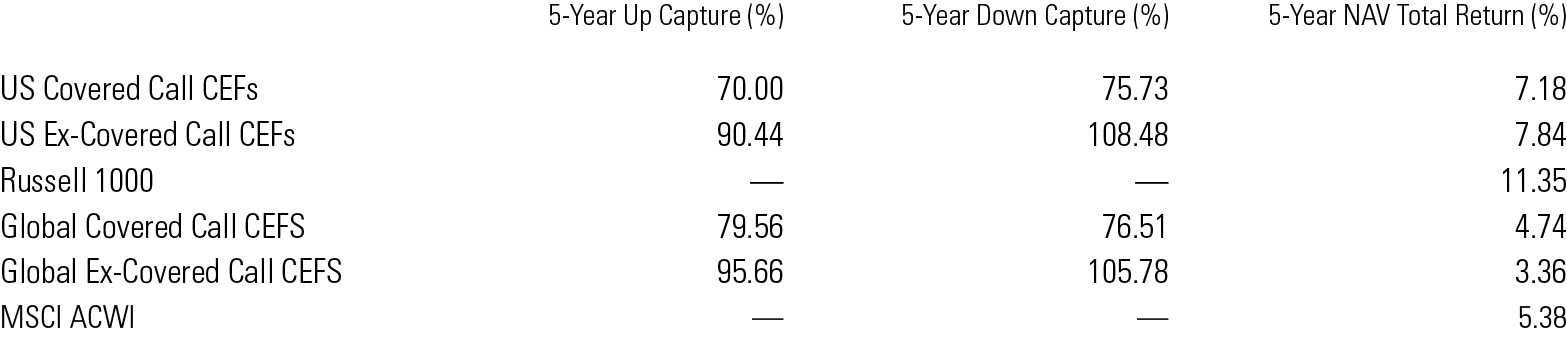
Exhibit 1 shows the performance of domestic and global covered-call CEFs versus non-covered-call equity CEFs and their respective benchmarks.
Performance of Covered-Call CEFs
Source: Morningstar Direct. Data as of 03-31-16.
Global covered-call strategies have fared slightly better on a relative basis than domestic-focused covered-call strategies, mainly because of global equity markets not reaching as high of highs as the U.S. stock market. Still, they have failed to match the returns of the MSCI All Country World Index on a total-return basis over the five years ended March 2016.
In order to understand the mechanics behind the returns, let's start from square one.
What Exactly Is a Call Option? As an extremely simplified example of how a call option works, let's say a fund writes one call option on a single share of ABC stock for $10, expiring in 30 days. The stock is currently selling at $9, so the call option is 11% out of the money (11% being the increase that a $9 stock has to enjoy before hitting $10). The fund receives $0.10 in option premium because in this example the call option is worth only $0.10. The fund will keep any gains from share price appreciation from $9 to $10.10 (again, the buyer won't exercise the option unless it provides a gain over the price paid, which in this case, is $0.10), plus it keeps the call premium. Should the stock appreciate past $10.10 in 30 days, the fund misses out on any of those gains above $10.10. Because of this, in a quickly and steadily rising market, a fund writing call options will tend to underperform a similarly invested fund that does not write call options.
On the flip side, in a steadily declining market, the fund will pocket call premiums because options generally won't be exercised, but its underlying portfolio will be declining in value with the market. The call premiums help soften the blow to total return (net asset value return plus distributions), allowing the fund to outperform similarly invested funds in down markets. Options on individual stocks generate a higher premium than options on indexes, but the research and analysis of doing so may be cost prohibitive for some funds. Most CEFs write call options on indexes.
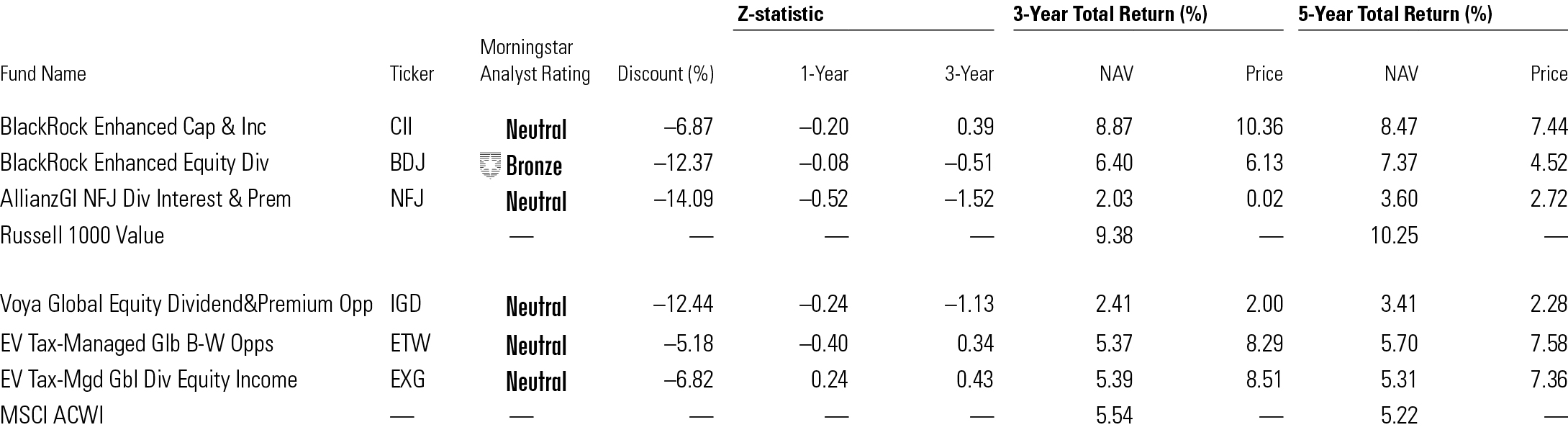
As of the end of March, Morningstar rated six CEFs utilizing the covered-call strategy. The table below highlights those funds and their Morningstar Analyst Ratings, valuation data, and performance data.
Covered-Call CEFs Rated by Morningstar
Source: Morningstar Direct. Performance data as of 03-31-16. Valuation data as of 04-06-16.
For the domestic-equity CEFs, returns are compared with the Russell 1000 Value Index as each of those rated funds falls into the large-value Morningstar Category. Over the three- and five-year periods ended March 31, the funds' NAV total returns (which include distributions) fell well short of the index's total return. The global funds fared better, with two of the three funds keeping pace with or slightly edging out the MSCI All Country World Index over the trailing three and five years.
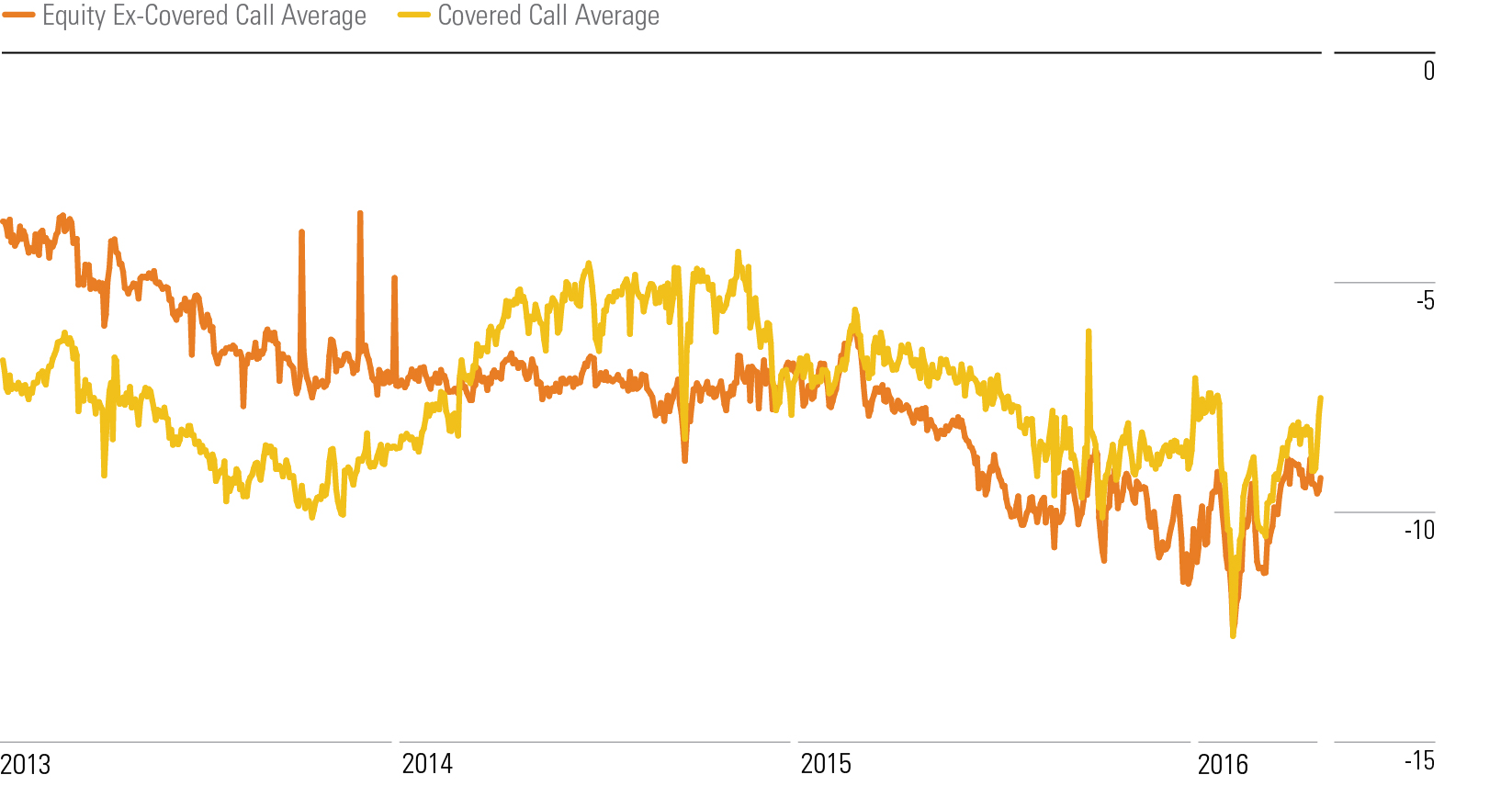
Evaluating Valuations Is there ever a reason to buy a covered-call CEF? The total-return story over the last three and five years is not too compelling, but perhaps there's a valuation story some investors may find appealing. The chart below shows the average discount of all covered-call CEFs versus all equity CEFs ex-covered-call funds during the last three years.
Average Discounts
Source: Morningstar Direct. Data through 03-31-16.
The trend in average discount has been similar for both groups, though given the poor returns in the domestic covered-call universe, it's surprising that the covered-call average discount hasn't been wider as of late. Of course, increased market volatility may have added to the appeal of some of these funds in recent months as they tend to be less volatile because of the call premium earned. But for investors willing to hold on to an investment over the long term (or even just through a rocky patch), the total-return proposition seems to be better for a straightforward equity CEF, or even better, a low-cost broad-based equity exchange-traded fund for mutual fund.
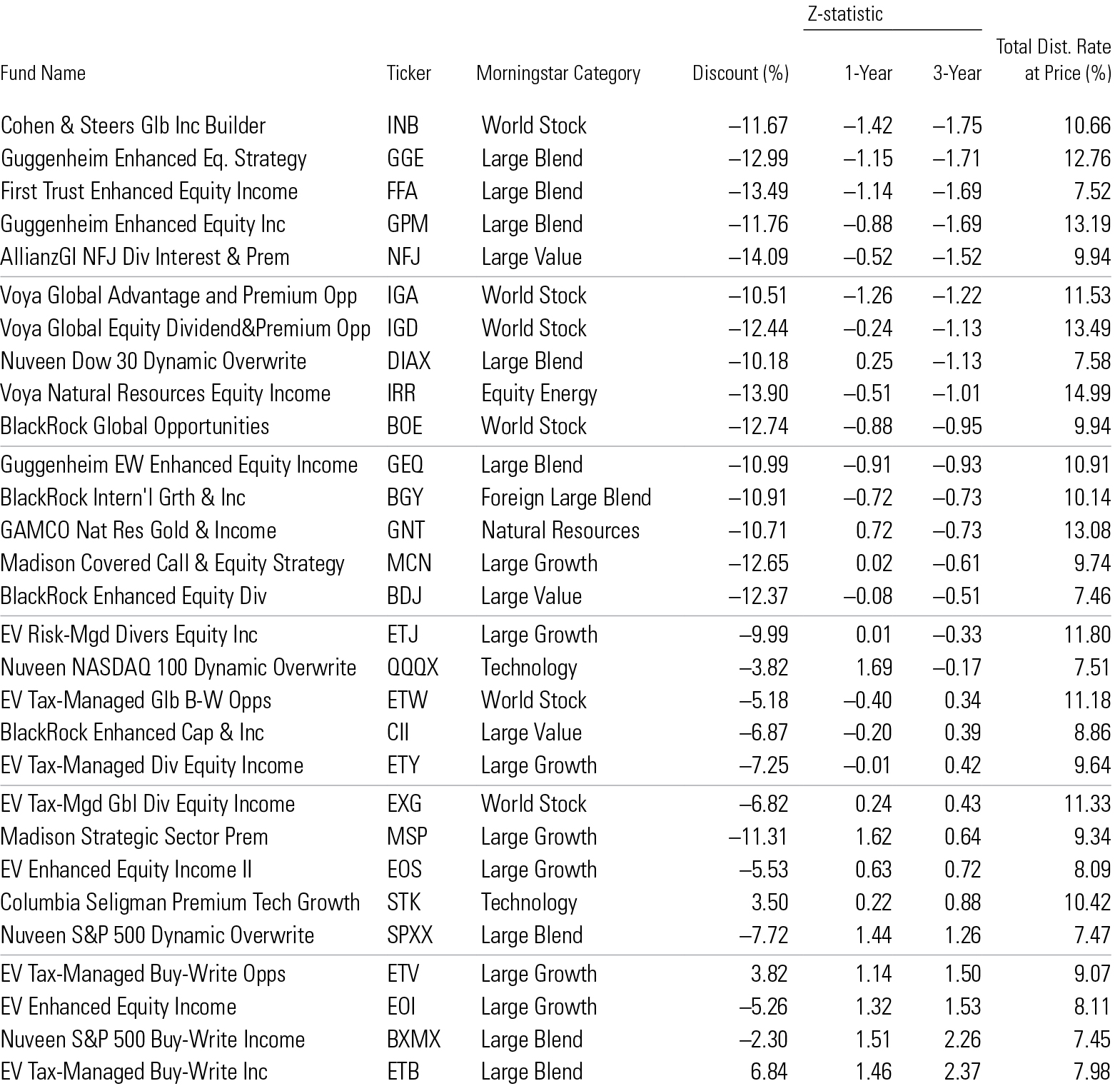
That said, absolute discount is not the best way to gauge valuation. We use a z-statistic to measure whether a fund is "cheap" or "expensive." As background, the z-statistic measures how many standard deviations a fund's discount/premium is from its three-year average discount/premium. For instance, a fund with a z-statistic of negative 2 would be two standard deviations below its three-year average discount/premium. Funds with the lowest z-statistics are classified as relatively inexpensive, while those with the highest z-statistics are relatively expensive. We consider funds with a z-statistic of negative 2 or lower to be "statistically undervalued" and those with a z-statistic of 2 or higher to be "statistically overvalued."
Looking at z-statistics, none of the 29 equity CEFs utilizing a covered-call strategy looks relatively cheap based on one- and three-year z-statistic as of April 6. In fact, a number look relatively expensive.
Covered-Call CEF Valuations
Source: Morningstar Direct. Data as of 04-06-16.
Of course, at any given point in time, the valuation story can look dramatically different, and short-term investors looking to add exposure to undervalued CEFs may find plenty of opportunities and reasons to hold covered-call CEFs (even for very short periods of time) as discounts and valuations fluctuate. Outside of these short-term valuation trades, we see little evidence for long-term-oriented investors to favor covered-call CEFs.
At this point, investors may point out that the distribution rates of covered-call CEFs tend to be much higher than similarly invested options (CEF, ETF, or open-end fund) without the call overlay. While this is generally true, investors should always be concerned with total return over a fund's distribution rate. Looking at total return, investors would have been better off investing in a low-cost index fund over the trailing three and five years. Also note that these total returns do not take into account the fee differential of CEFs and other investment vehicles, which can be significant. Nuveen S&P 500 Buy-Write Income, for example, charged an expense ratio of 91 basis points last year while
At this point, some sophisticated CEF investors will note that many (if not all) covered-call CEFs distribute return of capital for much (if not all) of their distributions, and that return of capital is tax-advantaged. They may also point out that for funds selling at a discount, return of capital is accretive to shareholder value, so taken on an aftertax basis, these funds may offer a decent return stream for investors. It's true that return of capital is tax-advantaged and that the math is in an investor's favor when it's distributed by funds selling at persistent discounts. While this may work for certain investors who fully understand the CEF wrapper and the call overlay, most long-term-oriented investors seeking exposure to the equity markets are likely better off looking elsewhere.

 United States