
A Practical Test for Contrarian Investing: When Should You Go Against the Grain?
Plus, five funds for contrarians to hold or even buy.


We like funds with great long-term performance, but if short-term returns get red hot, we get a little wary.
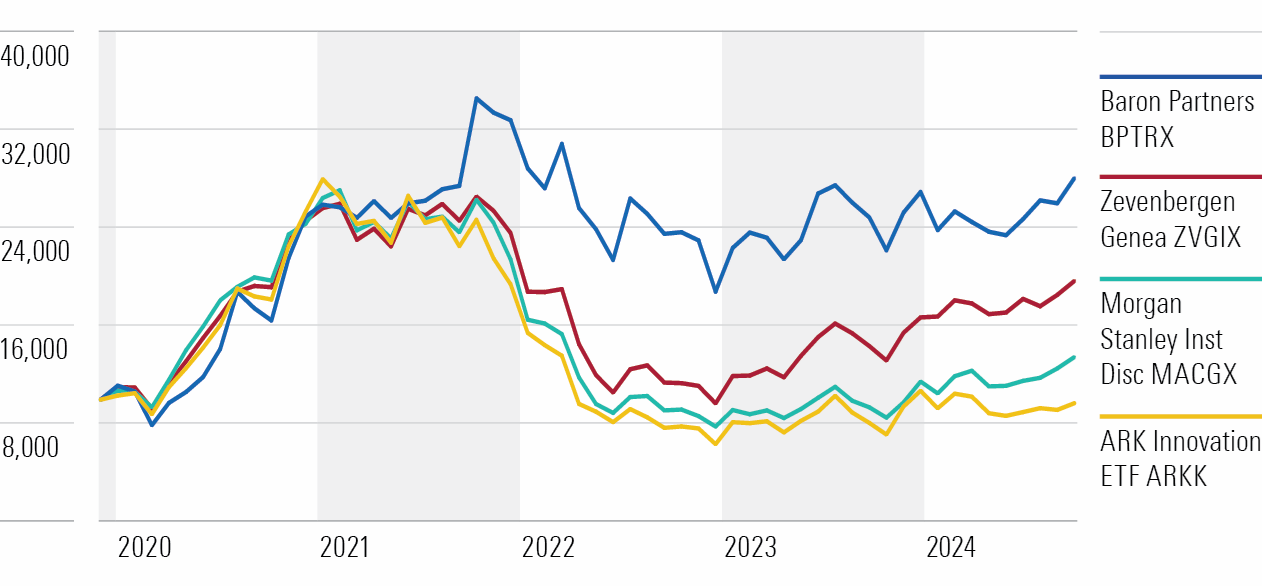
As you may recall, a couple of years ago Morningstar’s Jeff Ptak looked at extreme cases where funds earned returns of 100% or more in a single year. In nearly every case, losses in ensuing years were dismal.
You can see the bubbles burst in the exhibit, where we track four funds that gained 100%-plus and then crashed back to earth in short order.
What Happened to Funds That Doubled in a Year?
Our annual Buy the Unloved study is also something of a contrarian bet. It suggests buying Morningstar Categories where investors have mostly preferred to pull their money. In general, that tactic has been roughly equivalent to buying underperforming categories. However, the shift to passive from active means the large-growth category has consistently been in net outflows despite strong returns, and oddly enough, large growth continued to be a winning bet even though it wasn’t really contrarian.
That quirk tells me that simply betting on top or bottom categories isn’t sufficient. Better to find good funds and stick to a portfolio plan than make big bets on reversion to the mean.
Both Buy the Unloved and the appalling losses of 100% gainers are studies performed on the 8,000 US funds. To be sure, random funds with big losses or big gains are very risky gambles. But I was curious about how this would play out in the Morningstar FundInvestor 500. Most of the 500 are funds that we recommend after having done thorough research on the firms and strategies, so I’m less concerned about shorter-term results.
Rather than investigate funds’ huge losses and gains, I looked at the Morningstar 500 funds with 1- or 5-star Morningstar Ratings for the trailing three-, five-, or 10-year periods. That means that they rated in the top or bottom 12.5% of their peers on a risk-adjusted basis—so pretty good or pretty bad performance but generally not extreme. It is, of course, the sort of situation that Morningstar FundInvestor readers are likely to be looking at on a regular basis.
(I should note the overall star rating is a weighted average of those three-, five-, and 10-year periods.)
I looked back to October 2021, October 2019, and October 2014 to see what performance each group produced through September 2024.
2021
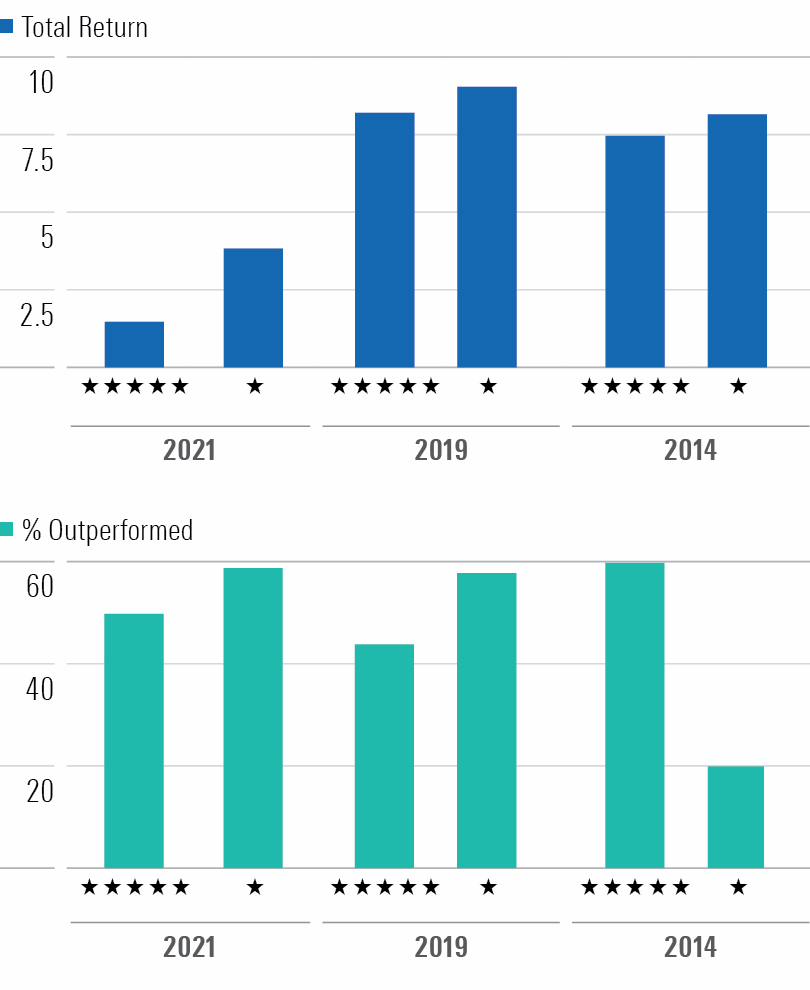
The 60 funds in the Morningstar 500 with 5-star three-year ratings in 2021 went on to return 1.5% annualized with 50th percentile rankings, on average, over the next three years. The 30 funds in the M500 with 1-star ratings returned 3.9% and averaged a top 41% relative performance ranking.
Shorter-term performance is particularly out of a manager’s control, so I wasn’t too surprised to see that 1-star funds fared slightly better. However, it’s not a big difference in the grand scheme of things.
Also worth noting is the fact that there were twice as many funds with 5-star three-year ratings than 1-star. In the entire universe, the numbers are equal, but because we select above-average funds for the Morningstar 500, better results are expected, as the star ratings bear out.
2019
The 78 Morningstar 500 funds with 5-star five-year ratings in 2019 returned an annualized 8.35% over the ensuing five years with a below-average 56% relative ranking. The 14 M500 funds with a 1-star rating for five years produced annualized returns of 9.20% over the next five years and a below-average 58% ranking. (Two of those 14 suffered bottom-percentile returns.)
So, even the five-year results were not too helpful in selecting stellar funds.
2014
The 84 funds with 5-star 10-year ratings in 2014 went on to produce annualized returns of 7.6% and land in the top 40%, on average, for the next 10 years. The nine funds with 1-star ratings for 10 years went on to return 8.3% with a dismal 80% relative performance ranking, or bottom quintile, on average. The higher return was because all nine were equity funds, whereas there were bond and allocation funds in the 5-star cohort.
Now the tables have turned, and we see a stark pattern. The 10-year performance of these funds actually served as a useful guide to future performance. Some persistent factors show up in longer-term performance such as fees, skill, and stewardship, but market volatility tends to dominate the short run.
Betting on 3-Year, 5-Year, and 10-Year Performance
Funds to Keep the Faith In
I went hunting for funds with Morningstar Medalist Ratings of Gold, Silver, or Bronze that had a 10-year rating that was at least 3 stars higher than their three-year star rating as of Sept. 30, 2024. These might be good funds to hold or even buy if you’re a contrarian. There were five funds with 5 stars for 10 years and 2 stars for three years. I also found three funds with 4-star 10-year track records and 1-star three-year ratings.
Brown Advisory Sustainable Growth BIAWX is rated Silver with Above Average Pillar ratings across the board. The fund’s recent slump hasn’t diminished its long-term record. It boasts a stable management and process, so we don’t think the recent underperformance is a symptom of something breaking down. The large-growth fund has been underweight some strong-performing mega-caps like Apple AAPL and Eli Lilly LLY. That has put it at a disadvantage next to peers that hew more closely to the benchmark, but it’s a reasonable thing to do, and we won’t penalize the fund for it.
Silver-rated Jensen Quality Growth JENSX has Above Average ratings for People and Process and a High rating for Parent. The fund is still buying the high-quality companies it always has, but those that are on the slower-growing side have lagged in the strong growth rally of the past two years. Jensen has a deep team and a solid culture along with a strategy that you could set your watch to. (I’m holding my shares.) One note of caution: Outflows are likely to lead to a big capital gains payout in December, so best to keep this fund in a tax-sheltered account.
Loomis Sayles Global Allocation LGMAX is a Silver-rated fund scoring a High for People, an Above Average for Process, and an Average for Parent. The past two years have been good for the fund, but it got thumped in 2022, losing 23.25%. That’s enough to hold its three-year star rating at 2, which is not unexpected as the fund has a strong tilt to large-growth stocks in a category where most funds are value or blend, thus its poor 2022 and strong rebound since. The fund is run by a seasoned team that has made good use of a flexible-allocation mandate. On the bond side, the fund runs an aggressive multisector strategy that would be familiar to those who know Loomis Sayles Bond LSBRX.
When an index fund underperforms, you can be certain that it hasn’t changed its stripes. I’m glad Vanguard FTSE Social Index VFTAX is here to prove my point. Environmental, social, and governance screens give this fund a growth tilt relative to large-blend peers, so like the Loomis Sayles fund, it had a rough 2022 and rebounded nicely. But its 10-year return tops peers and the category benchmark alike. A low 0.14% expense ratio makes this Silver-rated fund appealing.
PGIM Jennison Global Opportunities PRJAX is a Bronze-rated fund that has a focused global growth portfolio. It has plenty of appeal, provided your portfolio won’t be thrown off by adding a fairly high-risk strategy. Mark Baribeau and Tom Davis seek out market leaders with big-time growth potential. The portfolio’s top four holdings—Apple, Nvidia NVDA, Microsoft MSFT, and Ferrari RACE—illustrate that aggressiveness well. In the past five years, the fund has logged three calendar-year gains greater than 30% and one loss worse than 30%, so please use moderation with this one.
Now for the funds with 1-star ratings for the past three years and 4 stars for the past 10.
Silver-rated T. Rowe Price New Horizons PRNHX has had a straight-up awful three years, losing 10% annualized. In 2022, it was burned by having a lot of tech and not much energy. In 2024 through September, it had a tiny 2% gain partly because it focuses more on smaller market-cap names than peers at a time when the tech and biotech giants are winning prizes. Yet, we still like the fund. Joshua Spencer looks for companies with a record of earnings growth and competitive advantages.
Bronze-rated WCM Focused Emerging Markets WFEMX absolutely earned its 1-star rating for the past three years. The prior four years were excellent for the managers’ quality-driven approach. They look for companies with strong business models, a healthy corporate culture, and low levels of debt. And they have a focused portfolio, so big ups and downs are baked into the process. This is another fund I would limit to a small position size even though the managers and process are appealing.
Vanguard Star VGSTX is a very different animal. It’s a balanced fund run as a basic fund of funds. It invests in 10 actively managed Vanguard funds and doesn’t make many changes from year to year. It holds gems like Vanguard Primecap VPMAX and Vanguard International Growth VWILX alongside funds like Bronze-rated Vanguard Windsor II VWNAX and Silver-rated Vanguard GNMA VFIJX. Having more in foreign equities than peers has led to the recent slump, but these things usually even out. This works nicely for someone’s first fund, but there are more sophisticated choices in allocation that you might find more rewarding.
Conclusion
These results underscore for me why paying attention to short-term performance is of limited value. It’s worth understanding why a fund is doing what it’s doing, but it’s generally not going to change a fund’s fundamental case. If you own a highly rated fund that’s slumping, you should probably stay patient.
This article first appeared in the October 2024 issue of Morningstar FundInvestor. Download a complimentary copy of FundInvestor by visiting this website.
The author or authors own shares in one or more securities mentioned in this article. Find out about Morningstar’s editorial policies.

 United States