
The Thrilling 33
Just a few screens are all you need to find winning funds.


It’s time once again for our popular thrilling funds feature. As you may recall, this is a list I generate with simple, strict screens to narrow a universe of 15,000 fund share classes down to a short list ranging between 25 and 50. It’s purely a screen; I don’t make any additions or subtractions.
The basic idea: With so many funds out there, you can be choosy. It’s better to be choosy by setting high standards on the most important factors than by screening on a lot of minor data points. I emphasize fees, the Morningstar Medalist Rating, long-term performance, and fund company quality.
I also throw out funds with Morningstar Risk ratings of High because investors have a hard time using the most volatile funds well—they’re hard to hold on to in downturns and tempting to buy after they’ve already rebounded from past lows. The Morningstar Risk measure is relative to peers, meaning there are emerging-markets funds with Low risk ratings and short-term bond funds with High risk ratings. It tells you about relative risk, not absolute risk. Specifically, it tells you about downside volatility over the trailing three, five, and 10 years.
Here are the tests:
• Expense ratio in the Morningstar Category’s cheapest quintile. (I use the prospectus adjusted expense ratio, which includes underlying fund fees but does not include leverage and shorting costs.)
• Manager investment of more than $1 million in the fund (the top rung of the investment ranges reported in SEC filings).
• Morningstar Risk rating lower than High.
• Morningstar Medalist Rating of Bronze or higher.
• Parent Pillar rating better than Average.
• Returns greater than the fund’s category benchmark over the manager’s tenure for a minimum of five years. In the case of allocation funds, I also used category averages because benchmarks are often pure equity or bond, and therefore not good tests.
• Must be a share class accessible to individual investors with a minimum investment of no greater than $50,000.
• No funds of funds.
• Funds must be rated by Morningstar analysts.
Subscribers to Morningstar Direct, our institutional fund database, can run these screens for themselves by using our Fantastic Funds notebook. The only difference in the notebook is that I didn’t screen out institutional share classes. There’s also a simple tool on the Morningstar FundInvestor site that lets you enter a ticker and see how your fund stacks up on the tests.
This year, we have 33 funds. Amazingly, all 33 were on the list last year. Three did drop out, however. I’m pleased that nearly all the funds continued to pass the tests. It suggests that the tests and the funds that pass them endure. (Technically, T. Rowe Price Mid-Cap Growth RPMGX did pass the tests, but Brian Berghuis is retiring at the end of 2025, and the fund won’t qualify after.)
The Thrilling 33
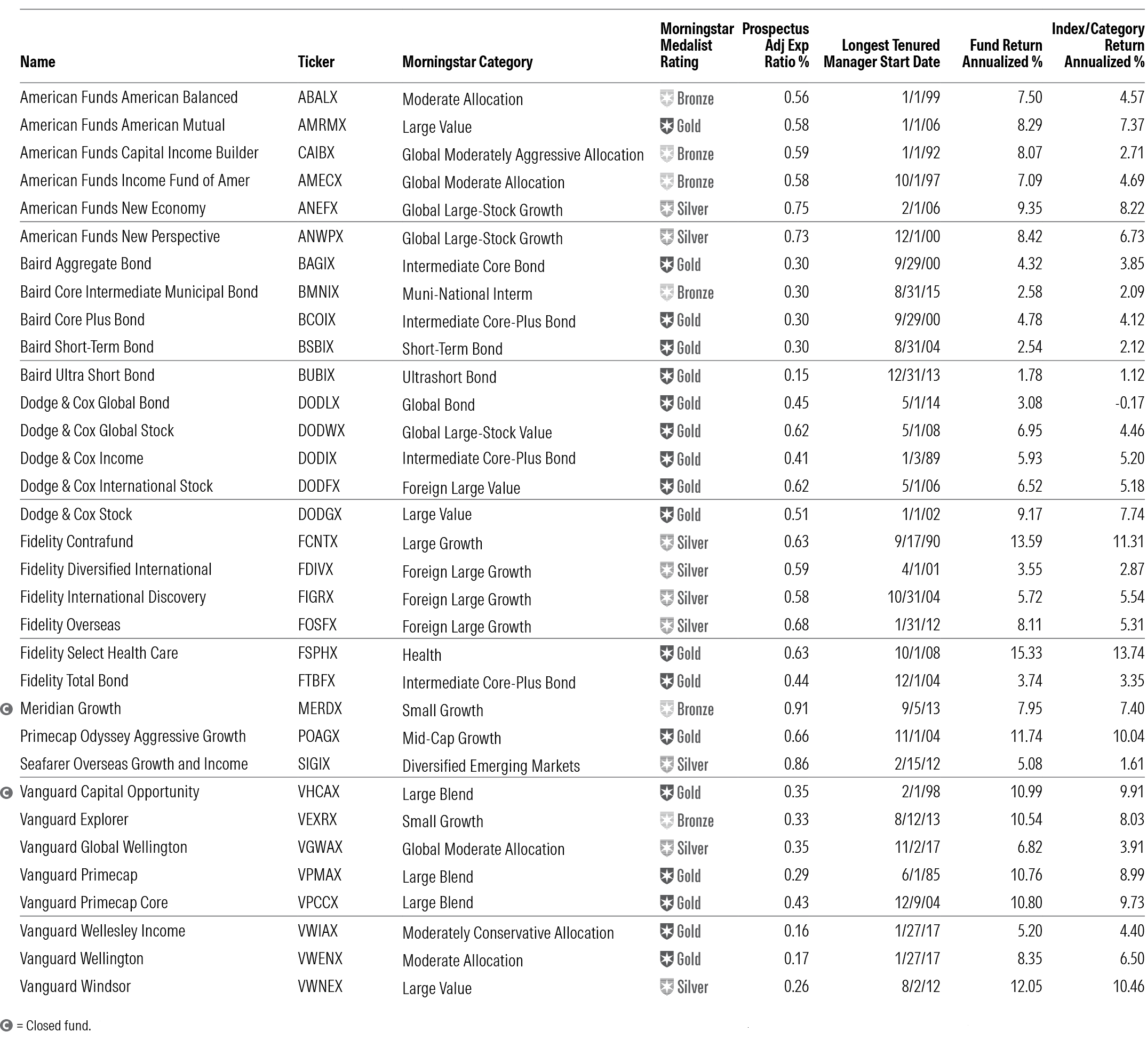
Since all the funds are repeats—the most in many years—I thought I’d highlight where each fund has placed its biggest bets. This will help you decide if a fund is a fit for your portfolio. I’ll skip the funds that avoid big bets to focus on those with bigger tilts.
Seafarer Overseas Growth and Income SIGIX is in the diversified emerging-markets category but doesn’t have emerging markets in its name. That explains why its biggest country overweight is Singapore, and its biggest underweight is China. The fund’s 13% Singapore stake is 12 percentage points above its benchmark’s, and its 8% in China is 19 percentage points below. The managers look for durable companies with steady income streams, and Singapore fits the bill.
Fidelity Overseas FOSFX manager Vincent Montemaggiore’s fondness for financials (29%) and industrials (28%) illustrates that this is a wide-ranging fund. Fidelity has plenty of growth funds with huge weightings in technology and healthcare, but not Overseas. Thus, it really works more like a core or blend fund for portfolio-building purposes. Montemaggiore looks for quality and low valuation, hence the dual nature of the portfolio.
Fidelity International Discovery FIGRX is likewise in the cautious growth camp. Bill Kennedy has 26% in financials and 25% in industrials. He wants companies with strong growth prospects, but their shares must be cheaper than their peers or the companies’ own valuation history.
Fidelity Diversified International FDIVX is also a valuation-conscious growth fund with big weights in financials (28%) and industrials (27%). Performance has been more steady than spectacular.
Dodge & Cox Global Bond DODLX leverages the security analysts on the stock team as well as other bond specialists, so it’s not a big surprise that the fund has 32% in corporate bonds and 28% in securitized debt. Those are near low points because the fund boosted its government stake to 37% (still 25% below the category) to position the fund more conservatively. I own this fund.
American Funds New Economy ANEFX has 40% of assets in tech stocks compared with 30% for the global large-stock growth category. The fund’s focus on services and information companies ensures it will keep that overweighting. For similar reasons, the fund has a 76% weighting in the US versus 63% for peers. That puts it in a sort of tricky spot when figuring out its role in a portfolio, but the team has done a fine job, making it a compelling, if unusual, fund.
American Funds Capital Income Builder CAIBX does a skilled job of finding securities with growth and yield potential. At the end of March 2025, it was near its max equity limit of 80%. That hurt in the initial tariff selloff in April, but it helped in the rebound because equities came back stronger than bonds. As you’d expect from a dividend-focused fund, it overweights consumer defensive and underweights tech. (I don’t own this fund, but I do own American Funds New World NEWFX.)
Fidelity Select Health Care FSPHX has somehow overcome manager Eddie Yoon’s fondness for UnitedHealth UNH. The fund has about 13% of its assets in the much-unloved stock. The company is down 38% for the year and recently fired its CEO because of a disappointing outlook. Also, there are reports of a criminal investigation of the company. Despite that flop, the fund’s 15-year annualized returns are a robust 13%, placing it in the top 10% of peers.
These 16 Standout Funds Are Making Big Bets. Do They Fit in Your Investment Portfolio?
Vanguard Primecap VPMAX, Vanguard Primecap Core VPCCX, Vanguard Capital Opportunity VHCAX, and Primecap Odyssey Aggressive Growth POAGX are ready to take advantage of a rebound in healthcare stocks, as healthcare weightings are around 30% of assets at each fund. That’s a polite way of saying their favorite sector has done poorly so far in 2025. This overweight is nearly a permanent feature of Primecap-run funds, so they are naturally a better fit if the rest of your portfolio is underweight or market-weight healthcare. (I own Primecap Core, Capital Opportunity, and Odyssey Aggressive Growth.)
Fidelity Contrafund FCNTX tends to have more blend-style stocks than most large-growth funds. That explains some of its relative performance ups and downs. More interesting, though, is that Will Danoff still makes big stock bets despite the huge asset base he has to put to work. Meta Platforms META takes up 16% of assets, Berkshire Hathaway BRK.A takes up 10%, and Nvidia NVDA is at 7%. They have been excellent performers for the year to date and the past 12 months, making this fund a standout.
Vanguard Windsor VWNEX doesn’t have big stock weightings, and its sector weightings are close to those of the Russell 1000 Value Index. However, it does have one big tilt: It leans to the smaller side of large caps. It has 44% in mid-caps, compared with 22% for the index and 30% for the average large-value fund.
Dodge & Cox Stock DODGX has 26% of its assets in healthcare. That’s unusually high for a large-value fund. Its healthcare picks tend to lean more toward value than Primecap’s. Names like CVS Health CVS, Sanofi SNY, and Gilead GILD lead the way at Dodge & Cox. Healthcare isn’t always an overweight, either, the way it is at Primecap. (I don’t own this one, but I do own Dodge & Cox International Stock DODFX.)
Although American Funds American Mutual AMRMX cares about valuations and dividends, its sector weightings look more like those of a blend fund. It has 20% in tech compared with 12% for peers and 14% in financials compared with 21% for peers. So, if you want to leaven a growth-tilting portfolio with a bit of value exposure, this fund might not be ideal. But it is a solid income-focused equity fund that should produce over the long haul.
Vanguard Wellington’s VWENX 29% tech weighting is about 5 percentage points greater than the moderate-allocation category norm. It’s noteworthy because the fund used to be more value- and dividend-oriented. Managers decided that the fund’s equity portfolio should be more benchmark-aware. As a result, stock and sector weightings are closer to those of the S&P 500 than they used to be.
Enduring Appeal
You can afford to raise the bar for your selection criteria, given how massive the fund universe is. These funds have tremendous advantages that tend to endure, so you can hold them for the long haul.
This article first appeared in the June 2025 issue of Morningstar FundInvestor. Download a complimentary copy of FundInvestor by visiting this website.
The author or authors own shares in one or more securities mentioned in this article. Find out about Morningstar’s editorial policies.

 United States