
Vanguard’s Active Funds Provide Stiff Competition for Its Passive Funds
They are the second-best value in investing.


This article mentions funds that have an issuer-initiated rating and/or track a Morningstar Index. For full disclosure information, please refer to the specific funds, which are demarcated with a * symbol, listed below.
Vanguard’s index funds are the best value in investing. They are very cheap, well-constructed, and reliable. The next-best value might be Vanguard’s actively managed funds. They are cheap, generally well run, and reliable—though not quite as reliable as the index funds.
Probably the biggest reason that actively managed funds have a hard time beating passively run funds is expenses. But Vanguard really narrows the gap by providing active funds at cost and using its enormous scale to keep costs low. (The subadvisors build profitable margins into their fees, of course, but not very large ones.) For example, actively managed Vanguard Wellington VWENX charges just 0.17% compared with 0.07% for Vanguard Balanced Index VBIAX. That’s a hurdle much easier to overcome than for most active funds in the moderate-allocation Morningstar Category, whose fees are typically in the range of 0.60% to 1.00%. In fact, Vanguard Wellington has beaten Vanguard Balanced Index over most time periods, including the trailing three-, five-, and 10-year periods.
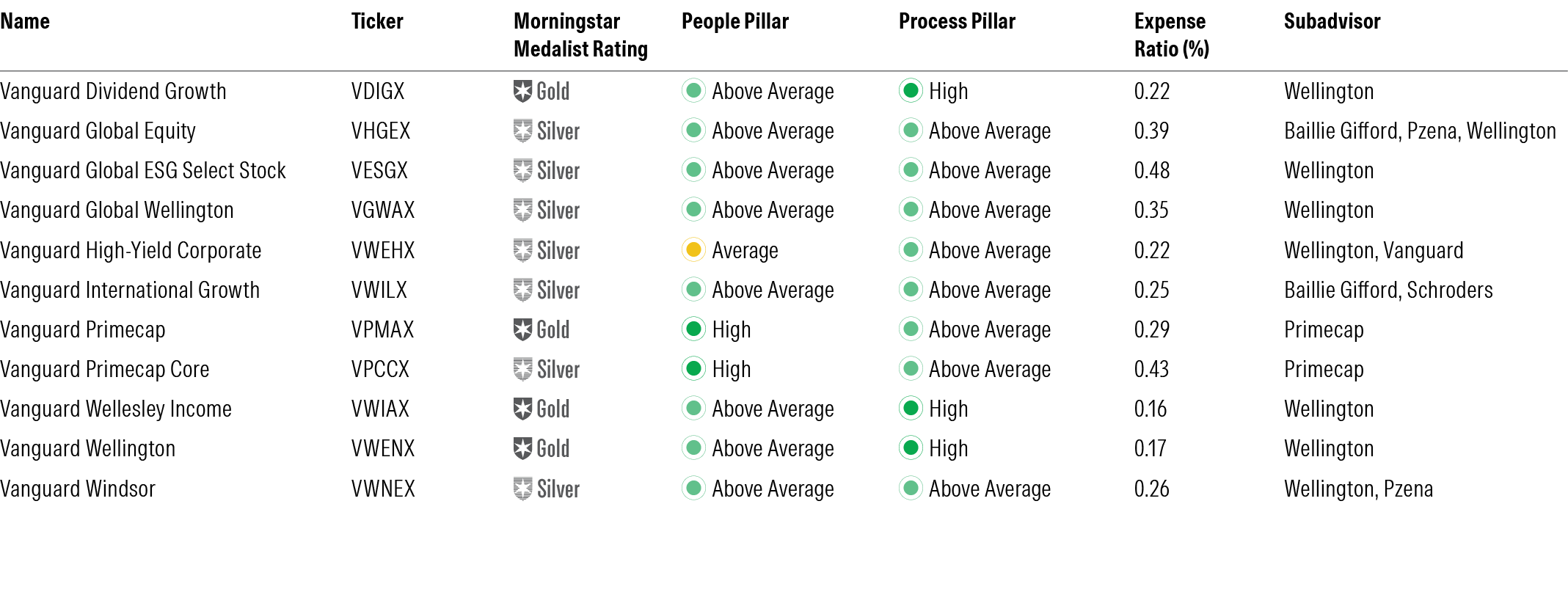
How does Vanguard get such good subadvisors when it often pays out lower management fees in basis-point terms? Economies of scale explain a lot. The asset management business is very scalable. Take a firm that already has scale like Wellington or Baillie Gifford, and it doesn’t cost much more to run $10 billion than it does $1 billion in large-cap equities or investment-grade debt. Not many firms can reasonably expect to draw that amount of money, and Vanguard handles the asset-raising and back-office functions. Firms also appreciate having another customer base because it makes them less susceptible to outflows if one group is cashing out.
Vanguard has also cultivated long-standing relationships with subadvisors. The Wellington relationship dates back to Vanguard’s origins, as Jack Bogle was fired from Wellington. The firm also has a close relationship with Primecap. You may have noticed that Wellington and Primecap have more funds where they are the sole subadvisor, whereas Vanguard often has multiple subadvisors. Vanguard also continues to research and engage with firms that are not currently running money for Vanguard so that it will have a list ready should one of its existing subadvisors need to be replaced.
Wellington runs $373 billion for Vanguard, and that figure dwarfs the rest. Primecap runs $105 billion. Baillie Gifford runs $40 billion, including a sleeve of Vanguard International Growth VWILX. Lazard Asset Management runs $17 billion, and Schroder Investment Management runs $15 billion. Hotchkis & Wiley and Sanders Capital both run $14 billion.
Some aspects of Vanguard’s subadvisor management can rankle investors, but there are reasons why it does things. For example, Vanguard prefers to add subadvisors rather than close funds outside of the Primecap/Wellington sphere. This can lead to an indexlike portfolio of diffuse positions. However, staying open means lower costs and lower tax bills. And at the fees Vanguard charges, there is much less reason to fret over “closet indexing” than at a fund charging 100 basis points. Still, it does mean that Vanguard does not have many focused portfolios in the style of Oakmark Select OAKLX.
In addition, Vanguard keeps its cards close to the vest. When it fires a subadvisor, it usually gives little to no explanation why. The reason is that Vanguard doesn’t want to publicly criticize advisors in a way that makes other prospective subadvisors fear running money for Vanguard.
Vanguard’s Top Subadvised Funds
So, Are Vanguard’s Active Funds a Good Bet?
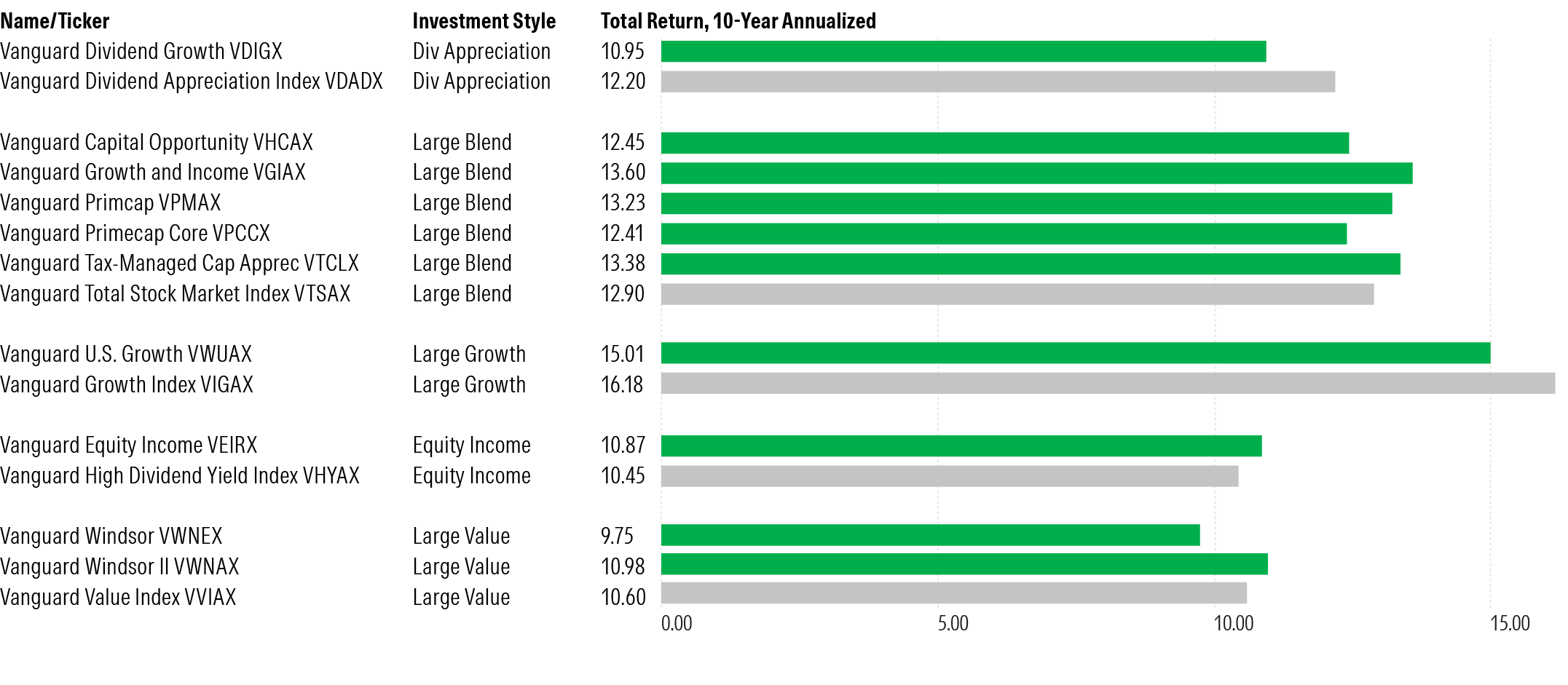
I compared Vanguard’s actively managed fund returns with those of the best Vanguard index funds in their same categories. Of note is not just how many beat their index counterparts, but how different returns are and how great the difference is in fees. That gives you some idea of how much you are gambling relative to the index funds.
The results told me that it’s pretty much a coin flip between the two. For the trailing periods ended in June 2025, I found that 48% of active Vanguard funds beat their passive Vanguard peers over the trailing three years. In addition, 55% of active Vanguard funds beat their passive peers over the past five years, and 44% won over the past 10 years.
The aforementioned Vanguard Wellington beat Vanguard Balanced Index by 30 basis points annualized over the trailing three years, by 122 basis points for the past five years, and by 50 basis points over the past 10 years.
Generally, returns were close. One of the bigger differences was Vanguard Mid-Cap Growth Index
VMGMX
Most fee differentials were about 10 basis points for bonds and 20 for stocks. The largest was between Vanguard Total World Stock Index VTWAX and Vanguard Global ESG Select Stock VESGX, which charge 0.09% and 0.48%, respectively. The gap is partly due to the size difference, as the environmental, social, and governance fund is a fairly new and small fund.
Vanguard Large-Cap Active Funds vs. Vanguard Large-Cap Passive Funds
Deciding Between Active and Passive
Check out the differences in fees, portfolios, and performance to understand how close the funds are. Standard deviation and sectors will help to give you a sense of whether the active fund is much bolder or keeps its bets small.
Vanguard Strategic Equity VSEQX and Vanguard Mid-Cap Index
VIMAX
Vanguard’s active bond funds have fared well versus their index peers. In the bond world, a fund’s market-cap weighting means a hefty dose of high-quality government debt, so the path to outperformance is clear. Take on modestly more credit risk, and you’ll get enough yield to surpass lower-yielding high-quality government debt.
Vanguard Core Bond VCOBX only charges 0.10%, so it doesn’t need a lot of help to beat Vanguard Total Bond Market Index VBTLX, which charges just 0.04%. Core Bond outperformed by about 45 basis points annualized over the past three years and by about 50 basis points annualized over the past five years. In this case, you’re only taking on a tad more fees and risk to get there.
The story is similar for Vanguard Intermediate-Term Tax-Exempt VWITX versus Vanguard Tax-Exempt Bond Index VTEAX. Fees are 0.17% versus 0.07%, respectively. The active fund outperformed by about 65 basis points annualized over the past three years and by 50 basis points over the past five years.
What About Taxes?
Three of the fund-versus-fund battles swung from active to passive when taxes were factored in. All three were in large-cap equity. Thus, the coin-flip analogy isn’t quite right for large-cap equity funds in taxable accounts. Index funds’ low turnover makes them more tax-efficient, as does Vanguard’s ETF share classes.
Keep an Open Mind
We tend to think of active versus passive decisions as being hugely different, but with Vanguard, it’s often incremental differences. Investors should be open to both when looking for the best fit for their portfolio.
This article first appeared in the August 2025 issue of Morningstar FundInvestor. Download a complimentary copy of FundInvestor by visiting this website.
The author or authors own shares in one or more securities mentioned in this article. Find out about Morningstar’s editorial policies.

 United States