
Markets Brief: Tech Stocks Back in the Lead
Plus: CPI, momentum investing, and jobs.


Insights into key market performance and economic trends from Dan Kemp, Morningstar’s global chief research and investment officer.
Stock Valuation Gap
Last week’s narrow 1% rise in the Morningstar US Market Index was reminiscent of earlier market conditions. The gains came from three sectors: technology (up 3.3%), communication services (up 4.1%), and consumer cyclicals (up 4.3%). Most other sectors were down sharply. While the US market moved further into overvalued territory, the valuation gap widened between large-growth and small-value companies. Although this creates opportunities for attractive investments in unloved parts of the market, it is naturally frustrating for those who have already adjusted their portfolios.
Stock Market Momentum
The momentum in large technology-related companies can be seen more clearly with the Morningstar Momentum Factor Index, which tracks the stocks with the highest price appreciation over the 12 months. This index has risen 2% over the last week, 23.1% over the last quarter, and 52.5% over the year to date.
Momentum is a product of sentiment that confounds the thoughtful investor and ensnares the impatient, as it can push stock prices well beyond what most investors believe is reasonable and last far longer than expected. As changes in sentiment are difficult to predict, it is important to prepare yourself and your portfolio for a range of potential outcomes.
Owning Defensive Assets
Ensuring your holdings are trading at reasonable (or even attractive) valuations, or holding more defensive assets, can help reduce the impact of a sudden change in momentum, as we saw in 2022. However, this will likely act as a drag on short-term performance while momentum remains strong.
Owning stocks with high momentum could improve short-term returns, but as prices become increasingly detached from a realistic assessment of value, there are fewer obvious prompts to act, increasing the probability that you will reach the point of maximum momentum exposure when investor sentiment changes. Thinking independently and maintaining a long-term perspective in these situations is hard. To dig into this topic, check out this great article from 2018 by Morningstar Wealth’s Daniel Needham.
Jobs Report: Hiring Increasing
The Federal Reserve released its Beige Book of anecdotal economic reports last week. This appeared to support the view that the US economy is on course for a soft landing. Businesses appear cautiously optimistic despite some input cost pressure. This view was reinforced by the November jobs report, which showed an increase in hiring despite an uptick in unemployment. We have more details on the report, along with senior US economist Preston Caldwell’s perspective.
The growing consensus of a soft landing for the economy has likely contributed to a reduced spread between short- and long-term Treasury bonds. Investors should understand the role of these bonds in the portfolio. Bonds can be used to adjust the risks in a portfolio. Those who want to pay for living expenses with their yields currently have little reason to take additional interest rate risk by holding longer-dated bonds, which are likely to experience more volatile prices. But a longer-dated bond will probably be more useful if its primary role is protection from fears of a weak economy. Selecting the wrong tool can be as destructive as using a hammer when a screwdriver is required.
November CPI
The economy’s next test will be the Consumer Price Index report, released Wednesday, followed by the Producer Price Index report on Thursday. Annualized core CPI (excluding food and energy costs), is expected to be 3.2% a slight fall from October. With the next meeting of the Federal Open Market Committee just over a week away and strong expectations of another 0.25-percentage-point cut in interest rates, market commentators will closely watch this data. You can find all the important economic releases in our calendar.
- Monday, Dec. 9: Earnings from Oracle ORCL
- Wednesday, Dec. 11: November Consumer Price Index report, earnings from Adobe ADBE
- Thursday, Dec. 12: November Producer Price Index report, earnings from Broadcom AVGO and Costco Wholesale COST
For the Trading Week Ended Dec. 6
- The Morningstar US Market Index rose 0.93%.
- The best-performing sectors were consumer cyclical, up 4.27%, and communication services, up 3.33%.
- The worst-performing sector was energy, down 4.69%.
- Yields on 10-year US Treasury notes fell to 4.15% from 4.18%.
- West Texas Intermediate crude prices fell 1.63% to $67.15 per barrel.
Stock Highlights for the Week
- Of the 881 US-listed companies covered by Morningstar, 345, or 39%, were up, eight were unchanged, and 528, or 60%, were down.
Which Stocks Are Up?
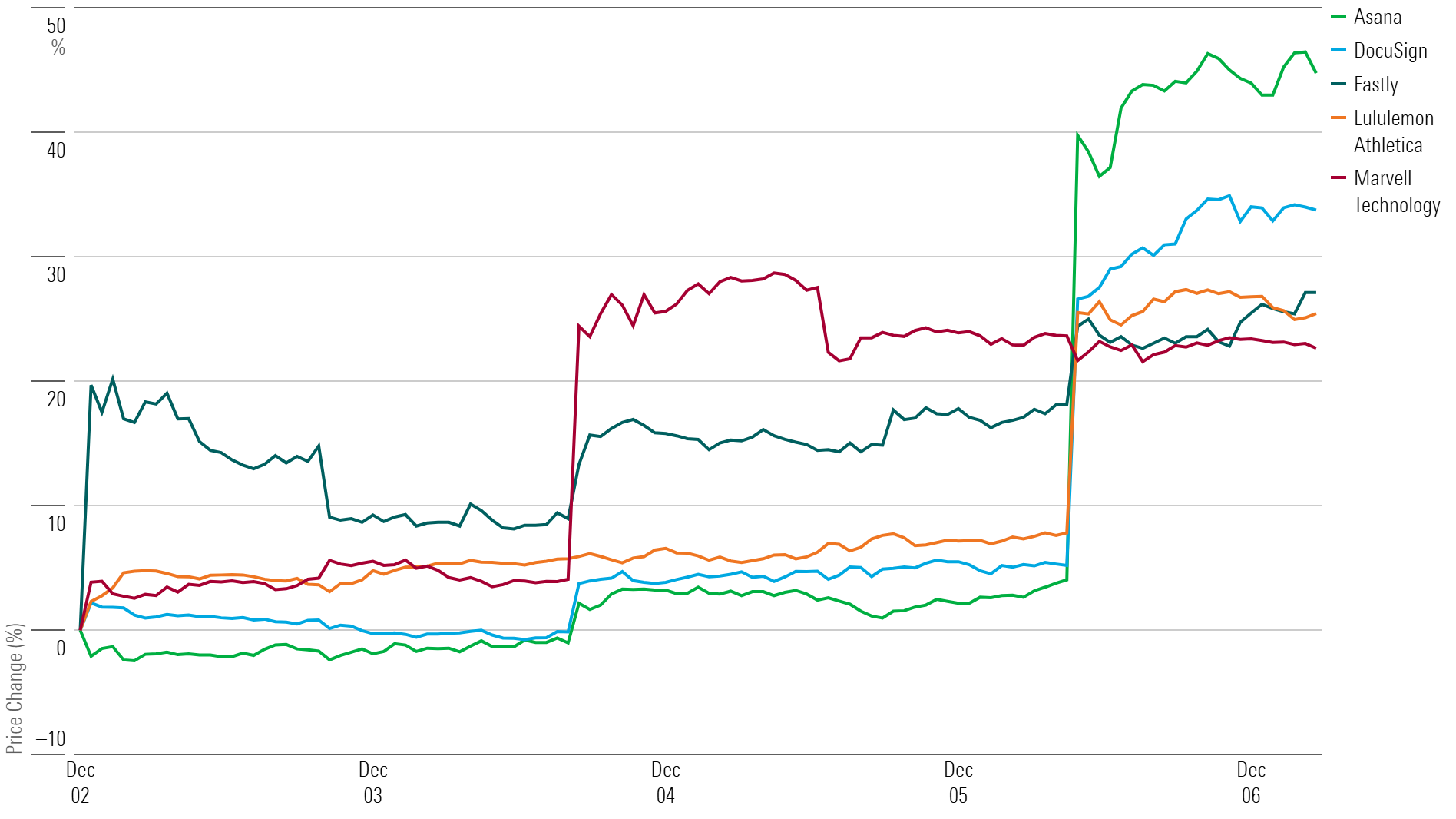
Asana ASAN, DocuSign DOCU, Fastly FSLY, Lululemon Athletica LULU, and Marvell Technology MRVL were the top performers among US-listed stocks covered by Morningstar analysts.
Best-Performing Stocks of the Week
Which Stocks Are Down?
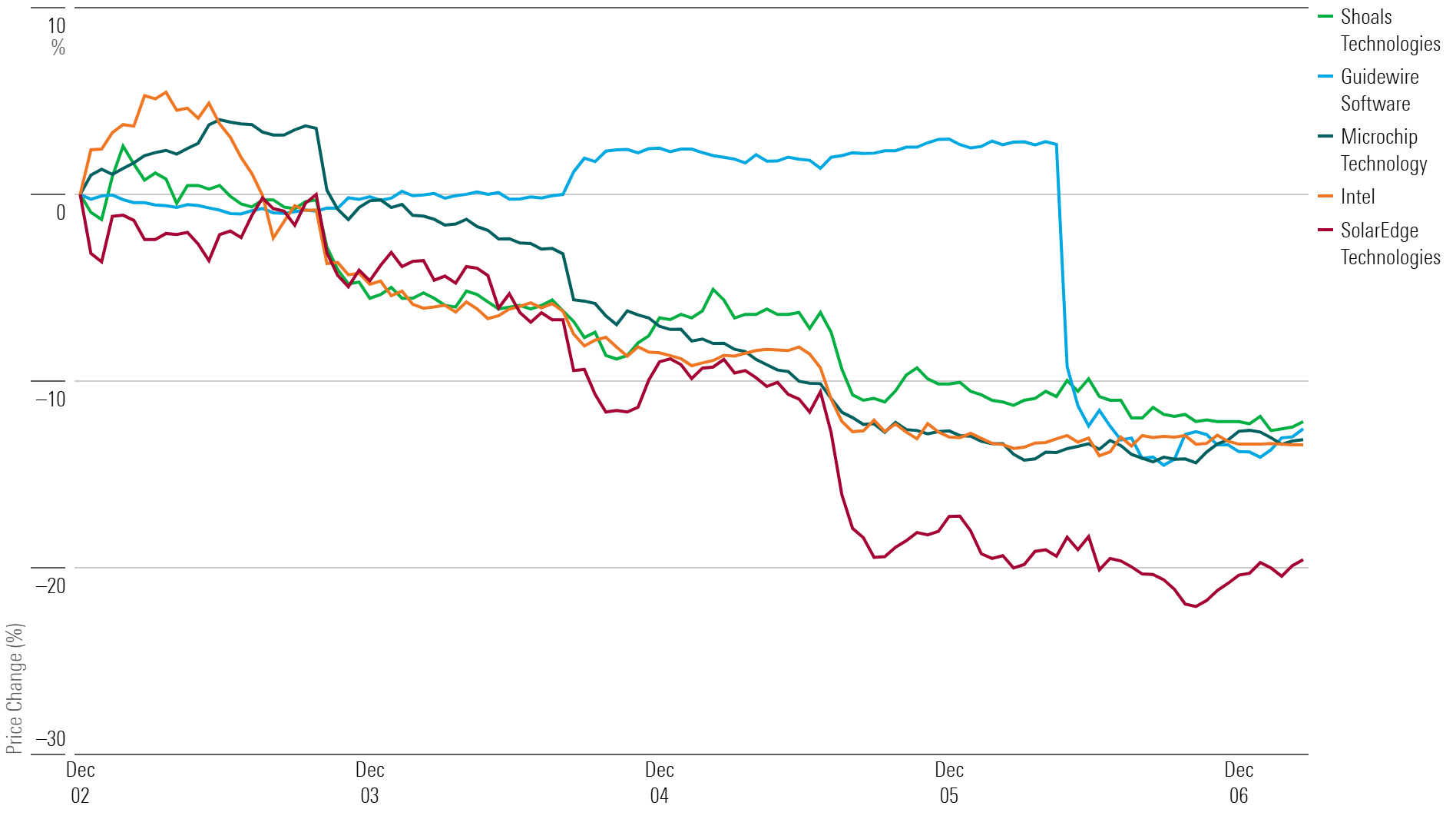
SolarEdge Technologies SEDG, Shoals Technologies SHLS, Microchip Technology MCHP, Intel INTC, and Guidewire Software GWRE performed worst among US-listed stocks covered by Morningstar analysts.
Worst-Performing Stocks of the Week
The author or authors do not own shares in any securities mentioned in this article. Find out about Morningstar’s editorial policies.

 United States