
Markets Brief: What if the Stock Market Fell a Further 20%?
Short-term returns often loom larger in investors' minds than long-term goals.

The Morningstar US Market Index rose 0.6% as investors appeared to react positively to comments from Federal Reserve Chair Jerome Powell following the latest meeting on Wednesday. However, as Morningstar’s Senior US Economist Preston Caldwell points out in this article, those assumptions appear to reflect extreme uncertainty rather than a cogent forecast. Developed markets outside the US and emerging markets continued to fare better despite the headwind provided by a slightly stronger US dollar.
Should Investors Stick or Twist?
Investors appear caught between a desire to buy stocks following the recent falls in the market or sell existing holdings as the economic outlook becomes less favorable and the range of possible outcomes appear to widen.
While these tendencies are natural, they reflect an investing myopia that represents the key risk to investors in volatile market conditions. The potential impact of this myopia is highlighted in this article that identifies funds that have lost the most money for shareholders. A cursory glance at the list reveals that most are leveraged ETFs explicitly designed to target short-term returns at the risk of long-term damage to an investors’ portfolios. To dig further into how these products work, check out this excellent explainer by Jeff Ptak.
What if the Market Fell 20%?
Those tempted to increase their stock exposure are likely expecting a near-term rise in price rather than being attracted to the long-term benefits of owing more of the companies in which they invest. Similarly, those tempted to sell are likely expecting near-team declines rather than questioning the ability of the companies they own to deliver attractive returns to stockholders over the next decade. To test this idea, ask yourself what you would do if the market fell a further 20% from current levels? If your instinct would be to reverse what you are currently planning, then it is likely that you are focusing too much on the short term.
A Handy Guide for Investors
So how should we respond as investors to the current situation? A good place to start is by entering the information you use to make investment decisions into the following matrix:
A Matrix for Investors on Markets
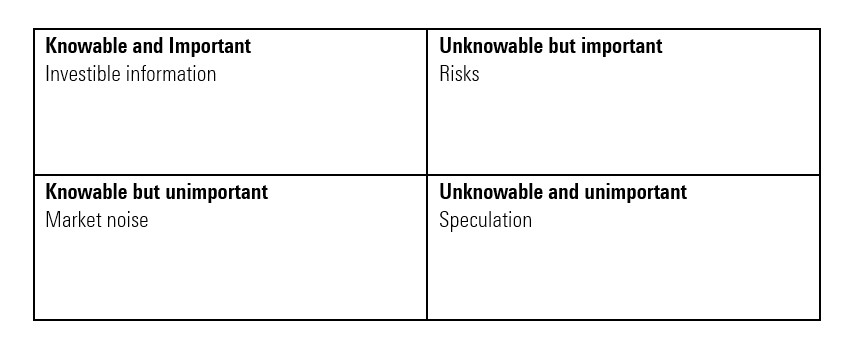
Our focus should be on the top-left quadrant which represents information on which we can build an investment decision, the most obvious being the quality and price-to-fair-value of assets, which can be found on Morningstar’s markets and stocks pages. Items in the top-right quadrant represent risks, such as high inflation, that we should seek to manage, while items in the bottom row, such as minor fluctuations in price or future readings of economic data points can be ignored.
Sometimes Investors Should Do Nothing
Before making any investment decisions consider whether the probabilities associated with the information in the top boxes have changed since you last reviewed the portfolio and if so, whether they have changed sufficiently to justify the potential costs, such as trading and tax. If not, the best course of action is to sit on your hands!
It is also worth remembering that short-term returns often loom larger in our minds due to their prominence in the communication between financial institutions and investors. This research by Danielle Labotka shows that by changing the focus of our communication, we can reduce the prominence of returns in our minds and become less vulnerable to short termism.
Inflation in Focus Again
There is a torrent of economic data in the week ahead, leading up to the latest Personal Consumption Expenditures measure of inflation on Friday. This is the Federal Reserve’s preferred measure of inflation and so will be watched closely by economists. Core PCE, which excludes volatile energy and food prices, is expected to rise slightly to 2.7%. Any significant deviation from this outcome is likely to lead to volatility. You can get more details of the upcoming economic releases on this calendar.
The author or authors do not own shares in any securities mentioned in this article. Find out about Morningstar’s editorial policies.

 United States