
When Social Security Benefits and Medicare Premiums Collide
An unusual confluence of flat Social Security benefits and rising healthcare costs could turn up the pocketbook pressure on some seniors next year, writes contributor Mark Miller.

Editor’s note: Congress and the White House reached a tentative budget deal this week that includes a provision blunting the 52% increase in Medicare Part B premiums that Mark discusses in this column. If the deal is signed into law, Part B premiums for the 30% of beneficiaries not “held harmless” would rise from the current rate of $104.90 per month to $120 per month next year, plus a $3 surcharge.
Something unfair is afoot for many seniors next year: Some Medicare beneficiaries could wind up paying 52% more than others for their monthly Part B premiums unless Congress steps in with a legislative fix. The potential imbalance stems from an unusual confluence of a flat cost-of-living increase (COLA) for Social Security and renewed cost pressure in the Medicare program.
In my next column, I'll examine healthcare inflation and seniors. But for now, let's run down what's going on with Social Security benefits and Medicare Part B premiums--and how a legislative solution could ride to the rescue.
Social Security's Inflation Adjustment The Social Security Administration (SSA) announced recently that there will be no cost-of-living adjustment (COLA) in benefits for 2016. It's not a subjective call: Since 1975, the COLA has been determined by a formula that ties it to the Consumer Price Index for Urban Wage Earners and Clerical Workers (CPI-W). Before Congress decided in 1972 to automate the COLA, inflation increases were sporadic and very uneven. A COLA has been awarded every year since 1975, with two exceptions--2009 and 2010, when inflation flat-lined during the Great Recession.
The lack of COLA fizz for 2016 has renewed debate in Washington about the formula used to calculate inflation adjustments. Here's the issue: The CPI-W gauges a market basket of goods and services of working people--who tend to be younger and spend less on healthcare than seniors. For 2016, the flat benefit calculation is due to the unusual plunge in energy prices, which have depressed the overall CPI-W market-basket figures.
In reality, the inflation rate experienced by seniors is higher than that of the overall economy. From 1985 to 2014, the Consumer Price Index ran 5.1% behind the CPI-E, an experimental measure created by the U.S. Bureau of Labor Statistics to measure the inflation affecting elderly Americans, according to research by J.P. Morgan Asset Management. Meanwhile, research by the Senior Citizens League shows that Social Security beneficiaries have lost 22% of their buying power since 2000.
(The SSA announcement also means that the maximum earnings subject to the Social Security tax will remain at $118,500 next year; also unchanged, at $15,720, is the amount of income from work exempt from the "retirement earnings test" penalty, which is applied to people who claim benefits before their full retirement age. For details on the numbers, see this page on the Social Security website.)
Medicare Premiums In a case of bad--but coincidental--timing, the zero COLA has created a potentially painful situation for 30% of Medicare beneficiaries. While 70% of enrollees will see their premiums hold steady at $104.90 per month, the remainder are facing a potential 52% spike in their rates--to $159.30. And all enrollees in Part B (which covers outpatient services) are looking at a big increase in the annual deductible, to $223 from $147. (That increase won't impact you if you have a first-dollar Medigap supplemental policy or use Medicare Advantage).
Why?
A "hold harmless" provision in federal law requires that no premium increase for Part B produce a net reduction in Social Security benefits. That means anyone already enrolled in Social Security this year (roughly 70% of Medicare beneficiaries) will see their Part B premium hold steady.
By law, enrollees bear 25% of whatever cost Medicare projects for the coming year in Part B--the remainder comes from federal coffers. Absent the hold-harmless provision--that is, if program costs were spread across all enrollees--the Part B premium still was forecast to rise 15%, to $120.70 per month. But the hold-harmless clause effectively would force the 30% of nonprotected Medicare enrollees to shoulder the entire burden of rising costs--and that could push their premiums up a whopping 52%, to $159.30.
(Separately, costs are rising in Medicare's Part D prescription-drug program, as noted in my previous column).
Who would be affected by these large Part B increases?
- Anyone who is delaying their filing for Social Security benefit
- Federal retirees who participated solely in the older Civil Service Retirement System and, therefore, don't receive Social Security benefits
- State government workers--most of whom participate in defined-benefit pension plans and are not covered by Social Security during their tenure as state employees
- Low-income "dual-eligible" seniors who receive Social Security and also participate in both Medicare and state-run Medicaid programs (Their premiums are absorbed by state Medicaid budgets.)
- Anyone enrolling in Medicare for the first time next year
Higher-income beneficiaries already subject to an income-adjusted Part B premium would be hit with the 52% increase as well, producing some eye-popping numbers. For example, enrollees in the initial income threshold ($85,000 modified adjusted gross income for an individual tax return and $170,000 for a joint return) would pay $223 monthly, compared with $146 this year. But in the highest income bracket, the monthly premium would jump to $509.80 from $335.70 (see table below).
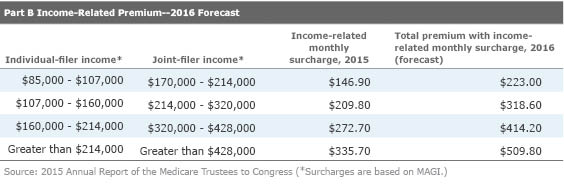
A Fix in the Works? The official Medicare premiums haven't been released as of this writing; the premiums discussed here are based on the projections made earlier this year by Medicare's trustees. And most important, a move is afoot in Congress to blunt or cancel entirely the projected increases. But considering the current chaos in the House of Representatives, it's difficult to forecast what kind of fix might be approved.
Advocates for seniors are nevertheless confident that Congress will pass a short-term fix to prevent the big spike. Bills have been introduced in the Senate and House that would hold premiums steady for all beneficiaries next year. The deductible for Part B for all beneficiaries would stay at $147, staving off a projected increase to $223. The key issue is how to pay for the fix; protecting all Medicare beneficiaries from the increase would cost $10 billion to $12 billion.
The guess here: Something will be done to protect most enrollees from the big premium hike, with the possible exception of those paying high-income surcharges. Congress has a consistent track record of tapping wealthy seniors to foot part of the bill for Medicare reform--most recently in the "doc fix" legislation.
Longer term, Congress should re-examine the hold-harmless provision itself. We are no longer in an era in which Medicare and Social Security enrollment are synchronized for all Americans, and it makes no sense to leave a portion of beneficiaries exposed to outsize premium hikes.
Mark Miller is a retirement columnist and author of The Hard Times Guide to Retirement Security: Practical Strategies for Money, Work, and Living. The views expressed in this article do not necessarily reflect the views of Morningstar.com.
The author or authors do not own shares in any securities mentioned in this article. Find out about Morningstar’s editorial policies.
Mark Miller is a freelance writer. The opinions expressed here are the author’s. Morningstar values diversity of thought and publishes a broad range of viewpoints.

 United States