
How Far Out-of-Whack Are Fund Investors’ Asset Allocations? $800 Billion, Give or Take
Fund investors seem to be overallocated to stocks and lacking bond exposure.


My colleague Amy Arnott recently wrote an article in which she argued investors ought to consider rebalancing their portfolios. Her reasoning was sound―stocks have run up, other asset classes haven’t kept pace, and so if you haven’t rebalanced in a while, then your overall asset allocation has probably gotten lopsided, to paraphrase her.
Building on that, I dove into the mutual fund data to see how much asset allocations have shifted over the past decade based on the asset mix of funds’ holdings. What I found only further reinforces Amy’s argument: Investors own more in stocks than they have in a decade (78% of fund assets versus 75% in 2015), and conversely they’re light on bonds (22% versus 25% a decade ago).
To estimate how much fund investors had allocated to stocks, bonds, cash, and other instruments, I compiled each stock, bond, and allocation fund’s (excluding funds of funds) monthly total net assets and multiplied those assets by each fund’s monthly percentage allocation to stocks, bonds, and other instruments (using the “Asset Alloc Equity % (Long Rescaled),” “Asset Alloc Fixed Income % (Long Rescaled),” “Asset Alloc Cash % (Long Rescaled),” and “Asset Alloc Other % (Long Rescaled)” data points in our database). I then summed those products to arrive at funds’ overall dollar allocations to stocks, bonds, cash, and other instruments each month, repeating in successive months. From those sums, I was able to derive fund investors’ percentage allocations to each asset class over time.
Percentage Allocation of Fund Assets, by Asset Class
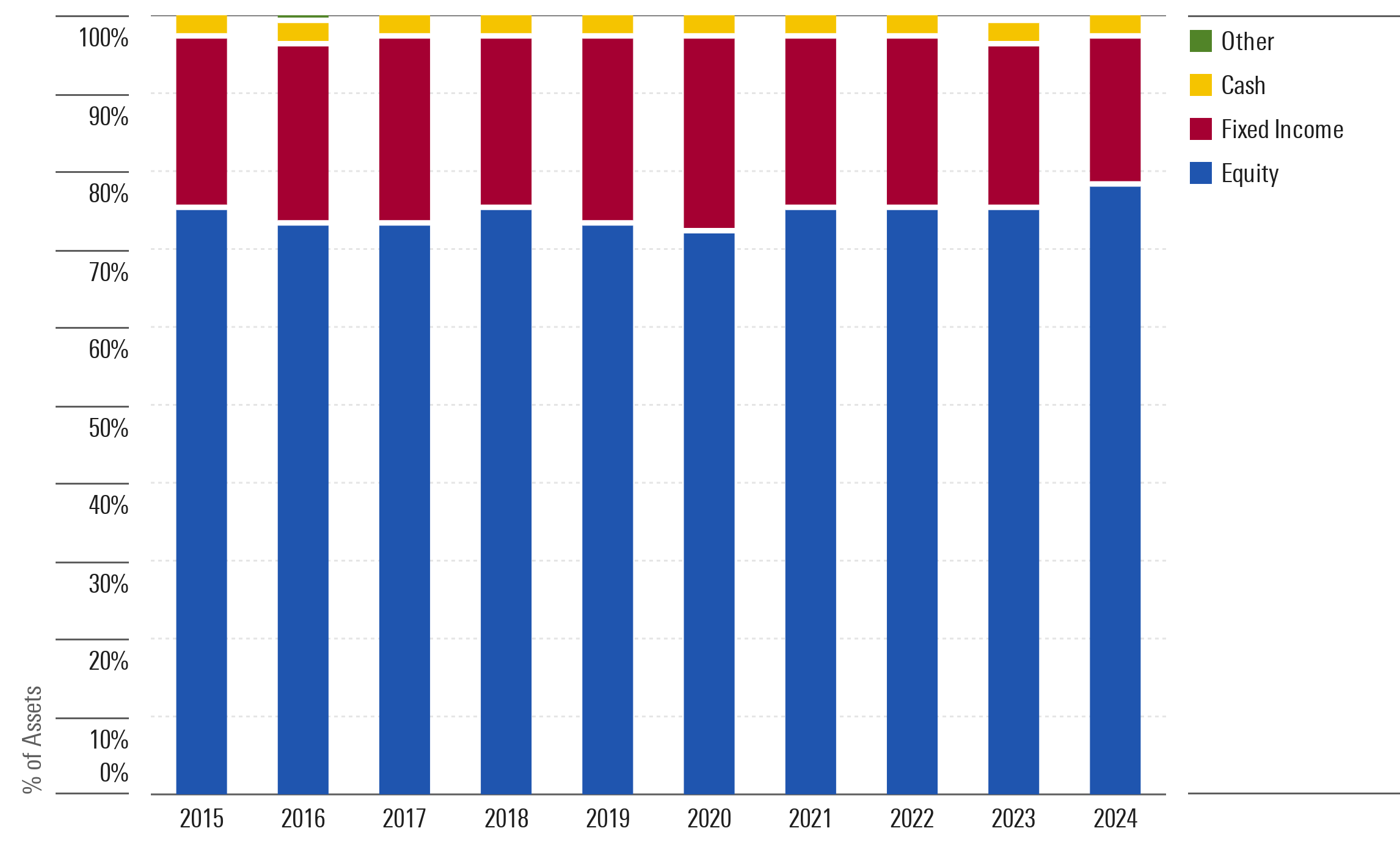
If you want to think of it in dollar terms, I estimate fund investors are overexposed to equities and underallocated to bonds, by around $800 billion.
I arrive at this estimate by multiplying the total dollar value of fund investments as of Nov. 30, 2024 (approximately $20.5 trillion) by fund investors’ average percentage stake in equity and fixed income over calendar-year 2015 (75% and 22%, respectively). I then compare those products to fund investors’ dollar stake in stocks and bonds as of Nov. 30, 2024. The difference in those figures represents the dollar adjustment that would hypothetically need to be made as part of a rebalancing back to the 2015 percentage weights.
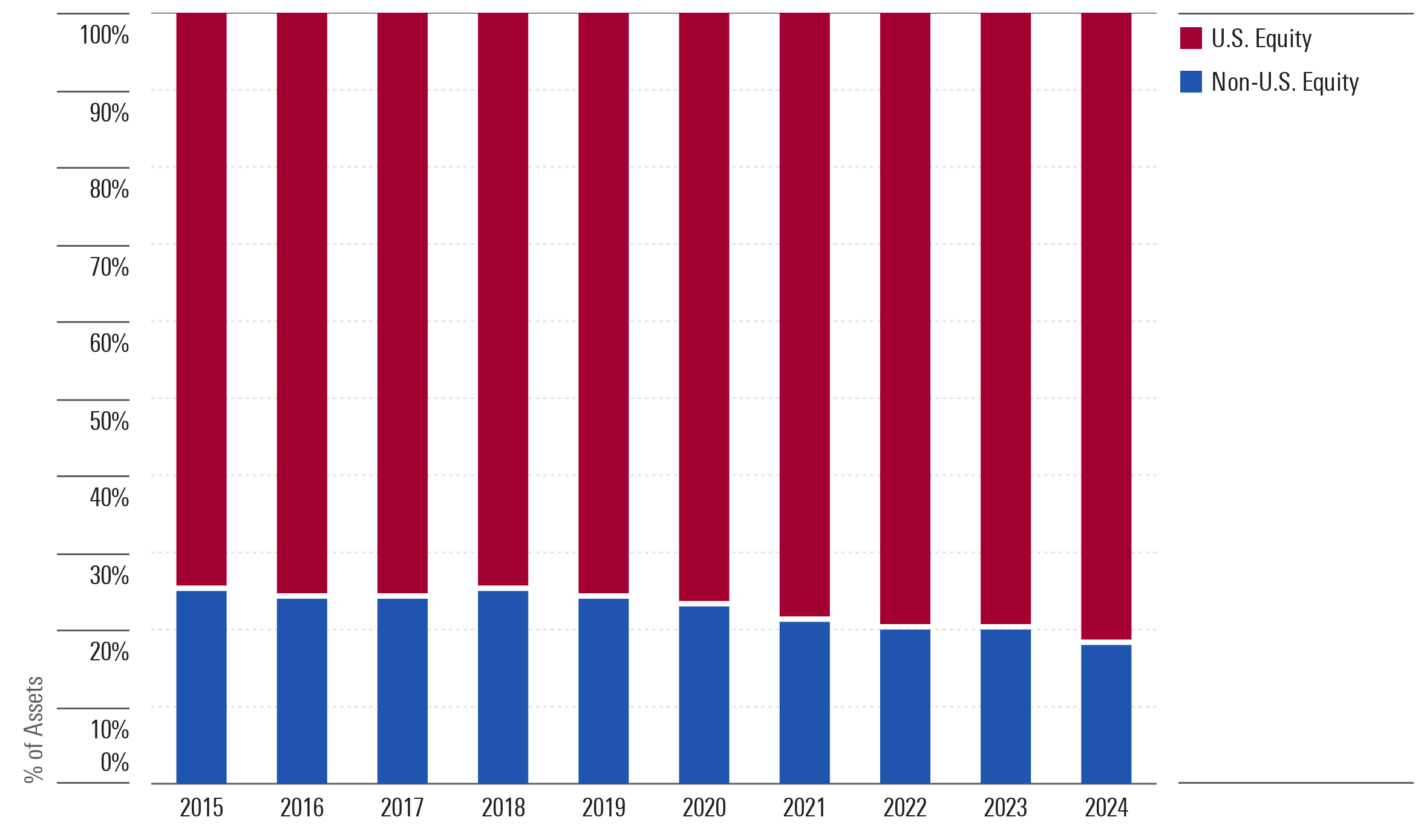
What’s more, within the stock sleeve, US equities have come to dominate. A decade ago, US and foreign stock exposure was split around 75/25%, but lately it’s been closer to 82/18%. That’s a big jump.
Percentage Allocation of Fund Assets, by Stock Domicile
What Could Have Been
One thing that’s interesting is that the asset mix of “allocation” funds—that is, target-date and target-risk funds—hasn’t drifted like the overall fund universe has. In 2015, allocation funds split their assets roughly 64%/36% between stocks and bonds, and that mix has held more or less steady in the time since.
Percentage Breakdown of Allocation Fund Assets, by Asset Class
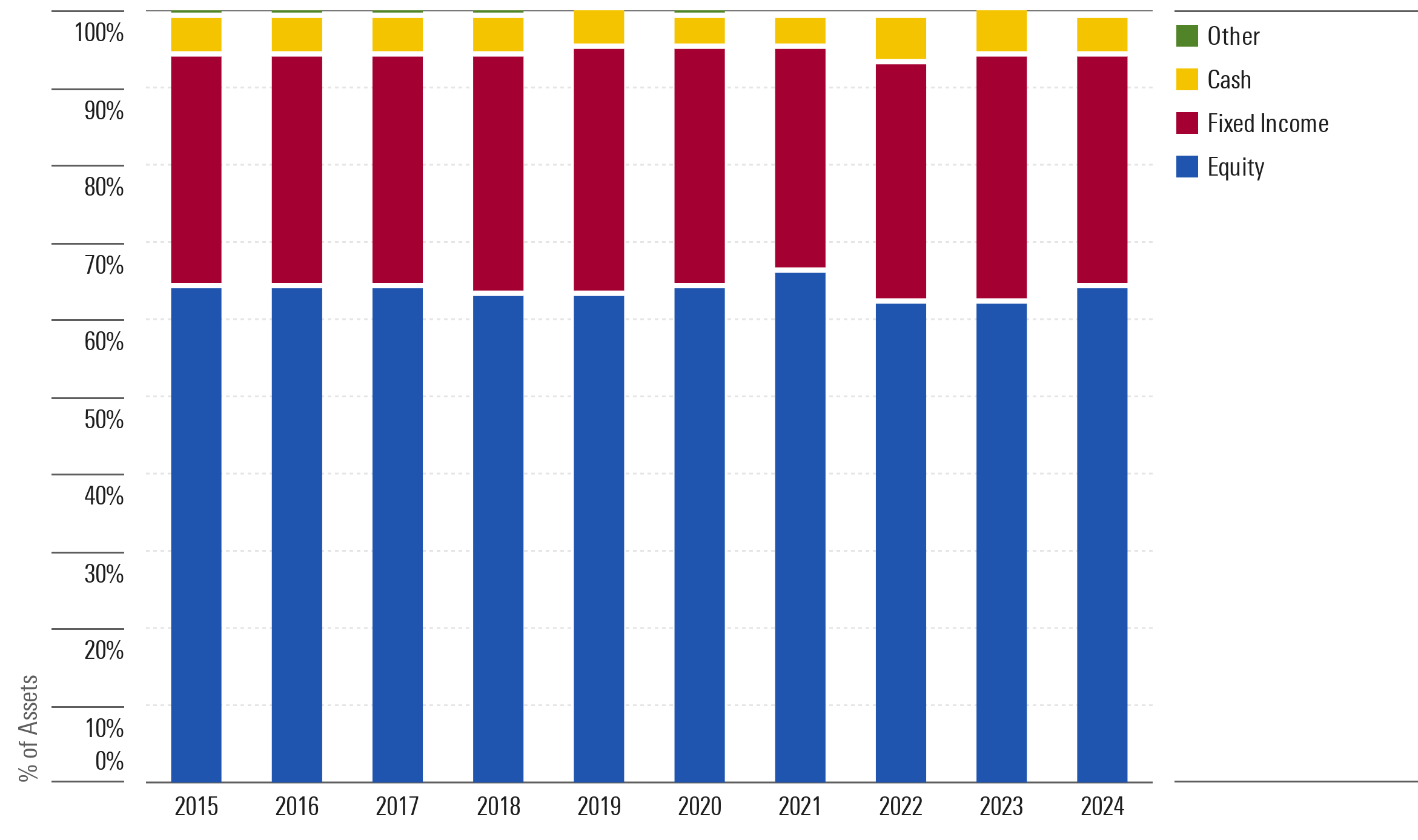
That’s notable because target-date and target-risk funds automate rebalancing. As such, they hint at what might have been had investors regularly rebalanced their portfolios writ large.
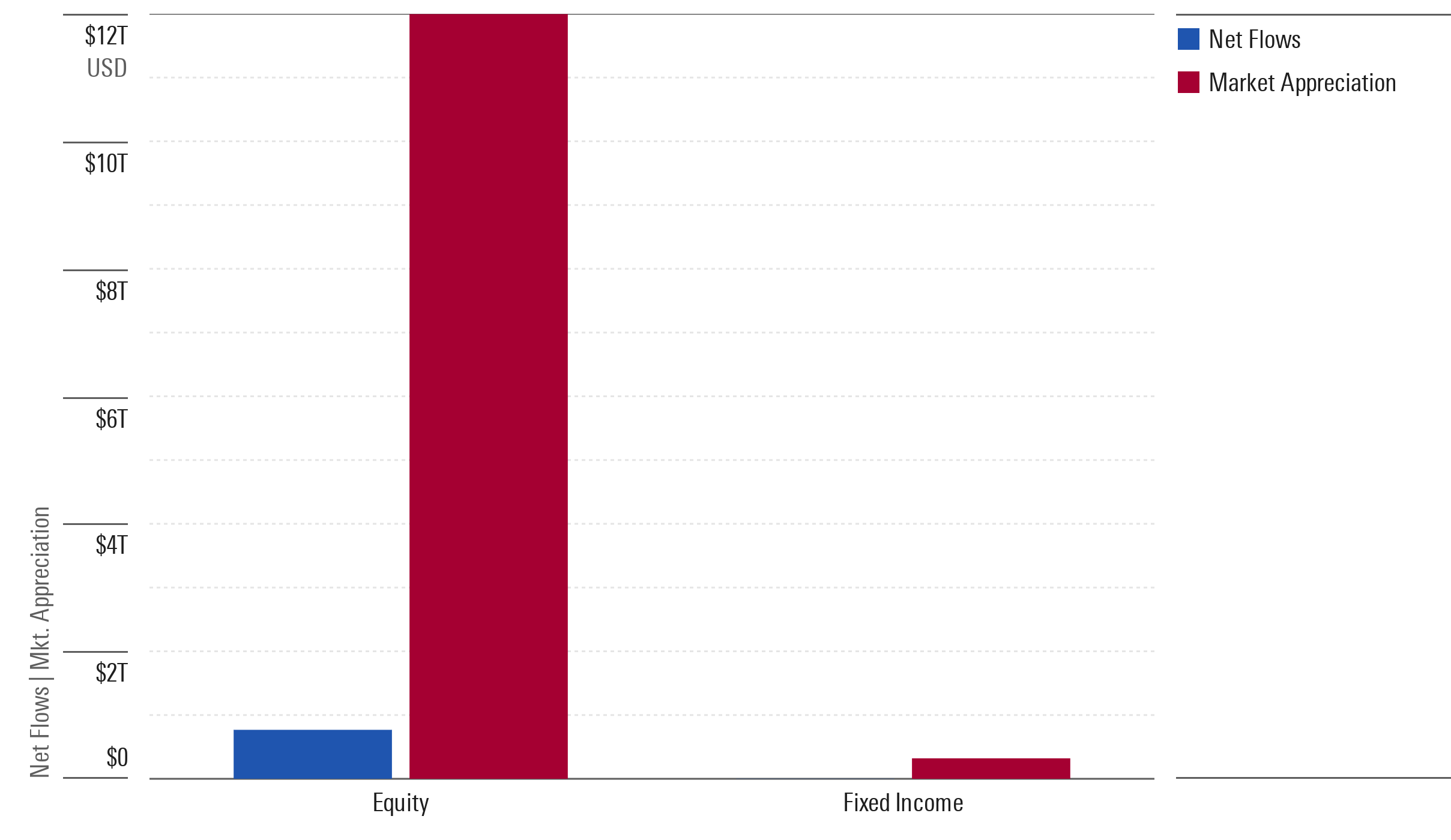
What brought us here? The market. Allocations are out-of-whack because stocks have trounced bonds and cash over the past decade. Equity funds saw roughly $12 trillion in market gains over that period, dwarfing bond funds’ haul.
Fund Net Flows and Market Appreciation, by Type of Fund
Risky Business
This drift toward equities, US stocks in particular, is worrisome. In her recent roundup of fund company market outlooks, my colleague Christine Benz noted that most of the forecasters had tempered their expectations for US stocks. Here’s how Christine put it:
“In their most recent release, nearly every firm in my roundup had reduced their return expectations for US stocks. Meanwhile, every firm in my survey is expecting higher returns from non-US stocks than domestic over the next 10 years, and some firms’ 10-year bond market forecasts are higher than their return expectations for US stocks.”
Expert Forecasts for Long-Term Asset-Class Returns
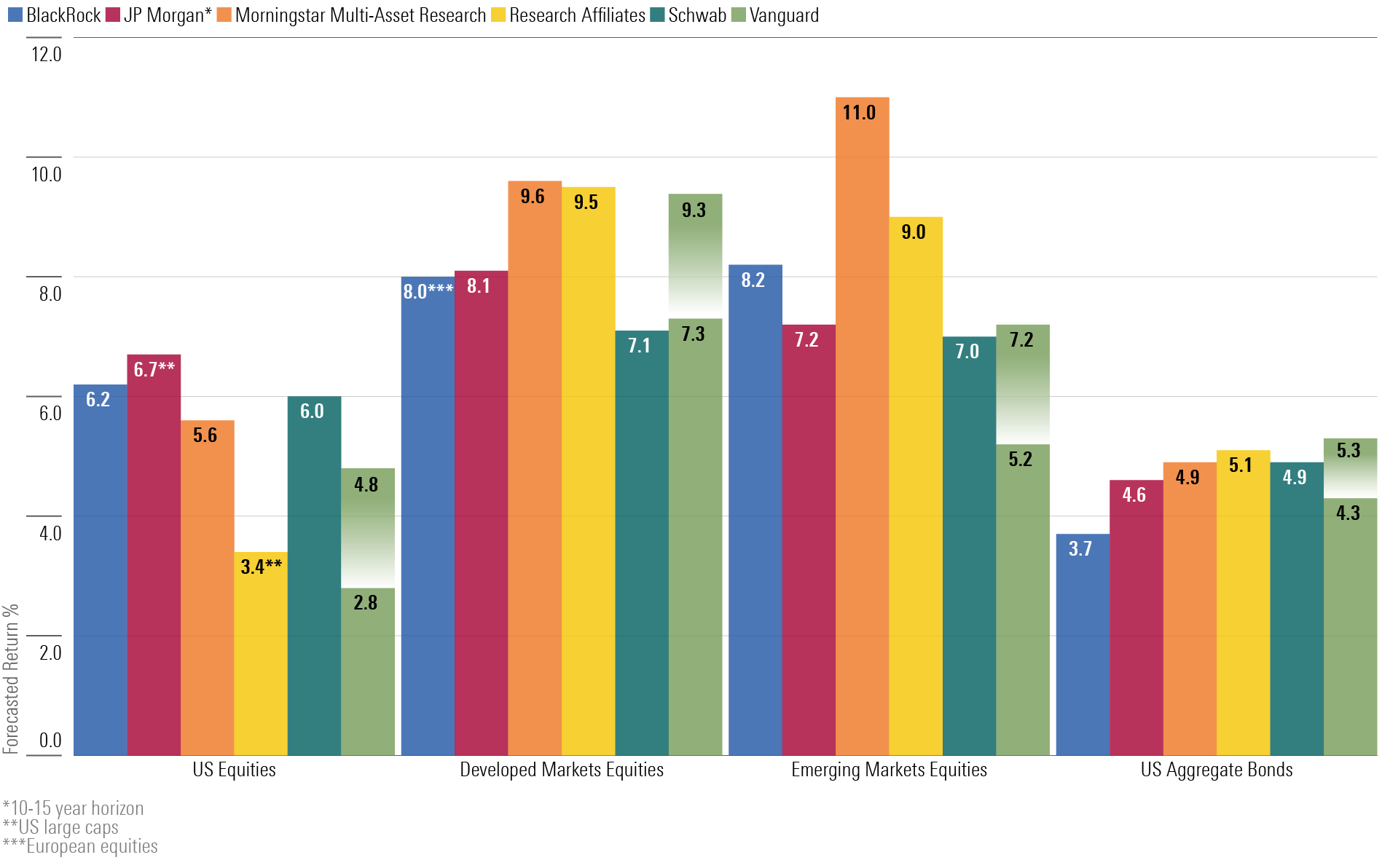
In other words, investors appear to have piled their assets high into the areas where the outlook is most subdued and withdrawn from those, like bonds and cash, where the risk/return trade-off looks to be more attractive.
Takeaways
It’s time to check your asset allocation. Compare where it was three or five or 10 years ago with where it is today. If the mix has changed but your goals, risk parameters, and circumstances haven’t, then it’s advisable to rebalance the mix.
Will this feel good? Not especially. You’ll be taking from parts of your portfolio that have treated you well and giving to those you might feel ready to give up on. But remember that if markets followed a predictable path, with stocks unerringly beating bonds, you wouldn’t expect to earn more in stocks to begin with. (Stocks’ higher expected returns are predicated on the notion that from time to time they’ll get crushed; thus, the higher potential return compensates you for that extra risk.)
If you’re finding it difficult to maintain your portfolio, or if you’d just rather not have to deal with the hassle and emotion of rebalancing, consider a target-date or target-risk strategy that takes care of it for you. You’ll be ceding some control to the fund manager, but these strategies have generally proved their mettle, keeping asset allocations in line at a reasonable cost while participating in market gains.
Switched On
Here are other things I’m reading, listening to, and watching:
- Dave Nadig on the public/private convergence: “What’s Wrong with XOVR and SpaceX”
- John Rekenthaler is back on Morningstar.com (“The Stock Market is Both a Voting and Weighing Machine”); he’s also started a Substack (“How to Live Longer? Move to New York City”)!
- Sam Ro on how investment strategists’ market targets are just noise: “8 Chaotic Scatterplots—and the Bullish Quality They All Share”
- Cullen Roche on why interest rates are rising: “Three Things I Think I Think”
- Ben Carlson on why index concentration isn’t a black-and-white issue: “Mega Cap World Domination”
- Pimco’s cyclical outlook: “Uncertainty Is Certain”
- Masters in Business podcast—Barry Ritholtz interviews Jonathan Clements, founder and editor of HumbleDollar: “Why Dying Is Hard Work”
- Allan Roth takes direct indexing for a whirl: “I Decided to Try Direct Indexing. Here’s What Happened”
- For everything else investing and finance: Abnormal Returns
- King Hannah: “Big Swimmer”
Feed Me!
I love hearing from you. Have some feedback? An angle for an article? Email me at jeffrey.ptak@morningstar.com. If you’re so inclined, you can also follow me on Twitter/X at @syouth1, and I do some odds-and-ends writing on a Substack called Basis Pointing.
The author or authors do not own shares in any securities mentioned in this article. Find out about Morningstar’s editorial policies.

 United States