
How Guaranteed Income Can Boost Retirement Spending
We assess the role of Social Security and other forms of guaranteed income in retirement.


In our recent annual study on safe withdrawal rates, my colleagues Amy Arnott, Christine Benz, Tao Guo, and I estimated that retirees who want to maintain a consistent spending amount adjusted for inflation will need to keep their starting withdrawals at 3.7% or lower if they want to lock in a 90% probability of success over a 30-year time horizon. We also looked at some flexible withdrawal strategies that can lead to higher spending.
Portfolio withdrawals aren’t the only source of funding retirees have, though. Almost all retirees receive at least some type of nonportfolio lifetime income, often Social Security, and in many cases that income is their largest source of cash flows in retirement. Incorporating Social Security into your retirement income strategy can also make some flexible withdrawal strategies, like the guardrails approach, more efficient. Retirees can also use some, or all, of their portfolio to lock in a steady stream of income by purchasing a Treasury Inflation-Protected Securities ladder or annuities.
Exhibit 1 depicts some of our key findings, showing the interplay between lifetime spending, the median balance left over after 30 years, the combined amount of lifetime spending and ending balances, and the ratio between lifetime spending and ending balances. For this exercise, discussed in depth in the report, the starting portfolio balance is $1 million, and we assume a $36,000 Social Security benefit at age 67. Our base-case scenario is on the top line; it assumes a 3.7% fixed real withdrawal (for example, a $37,000 initial withdrawal, with a 2.3% annual inflation adjustment thereafter) combined with Social Security filing ($36,000) at age 67, also adjusted by 2.3% annually. (In reality, Social Security payments depend on an individual’s own earnings, and future adjustments are linked to the Consumer Price Index.)
Retirement Spending With Guaranteed Income Summary

The trade-off of allocating a portion of the portfolio to guaranteed income is generally lower median ending balances. For retirees who prefer maximizing lifetime spending over leaving behind large bequests, these strategies may be more appealing. But retirees who don’t live at least the full 30 years that the strategies measured won’t benefit as much from guaranteed income.
Because our base case assumes fixed real spending and such static spending strategies are geared toward a worst-case scenario, this approach leaves more in the portfolio to compound and leads to the highest ending balance at year 30. Meanwhile, strategies such as delaying Social Security or purchasing an annuity help enlarge lifetime spending at the expense of year-30 balances. We’ll take a closer look at annuities in a future article.
To Bridge or Not to Bridge?
Conventional wisdom says retirees should delay taking Social Security as long as they can. Every year it’s delayed after the full retirement age of 67 leads to more generous payouts (and taking it early is punished), as shown in Exhibit 2.
Social Security Benefit % by Claiming Age, Birth Year 1960 or Later
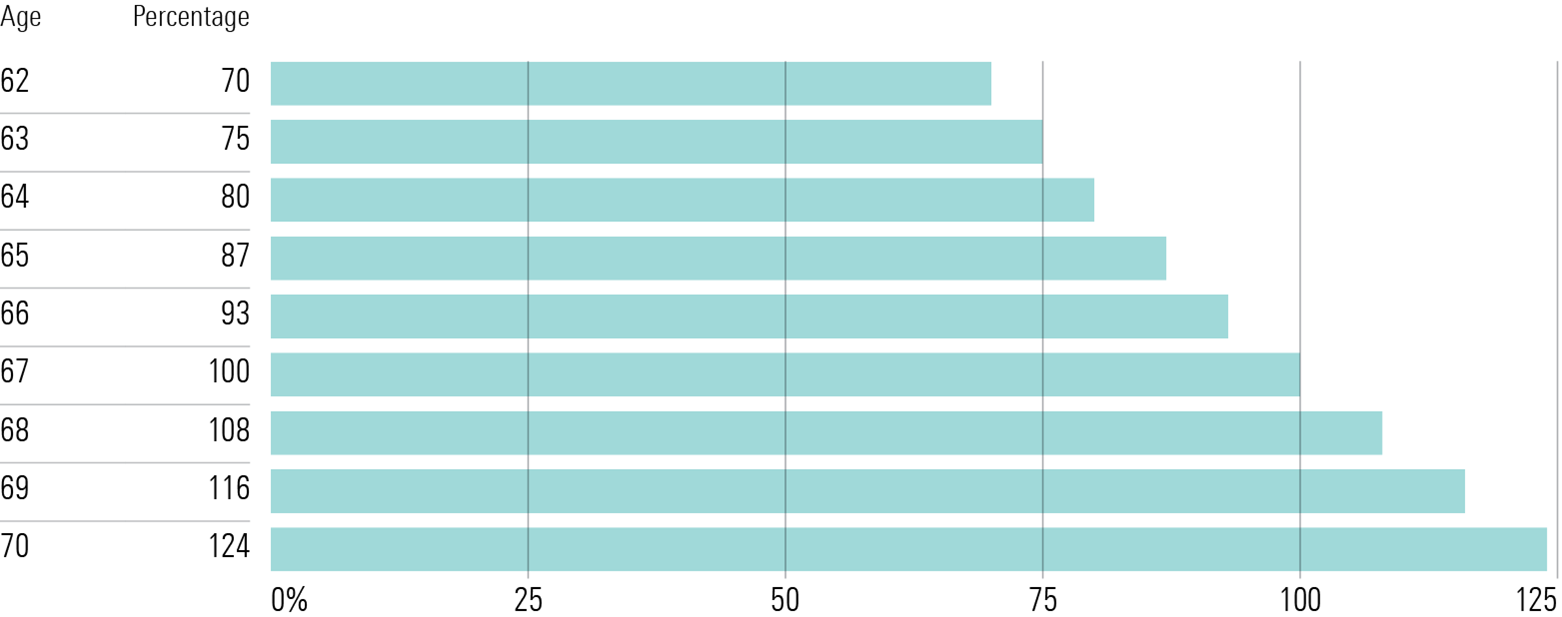
Delaying Social Security and portfolio withdrawals until age 70 is the ideal strategy (for example, by using working income to meet cash flow needs), though many may not be fortunate enough to do so. Delaying both leads to first-year spending of about $82,000 ($37,000 from portfolio withdrawal plus the $44,640 from Social Security), up from $73,000 for those who claim their benefit at age 67 and start taking portfolio withdrawals the same year. It also results in the highest lifetime spending amount and total spending plus median ending balance.
Someone could work until age 70 or choose to retire at age 67 and delay claiming their benefit and withdrawing from the portfolio, but they would need some other form of income for three years (typically referred to as a “bridge strategy”). That could potentially come from a spouse who is still working or income from a nonportfolio source like a rental property. Exhibit 3 compares the lifetime spending and ending values of different Social Security claiming ages, including delaying until age 70 with and without a bridge strategy.
Base-Case Lifetime Spending and Ending Value by Social Security Claiming Age
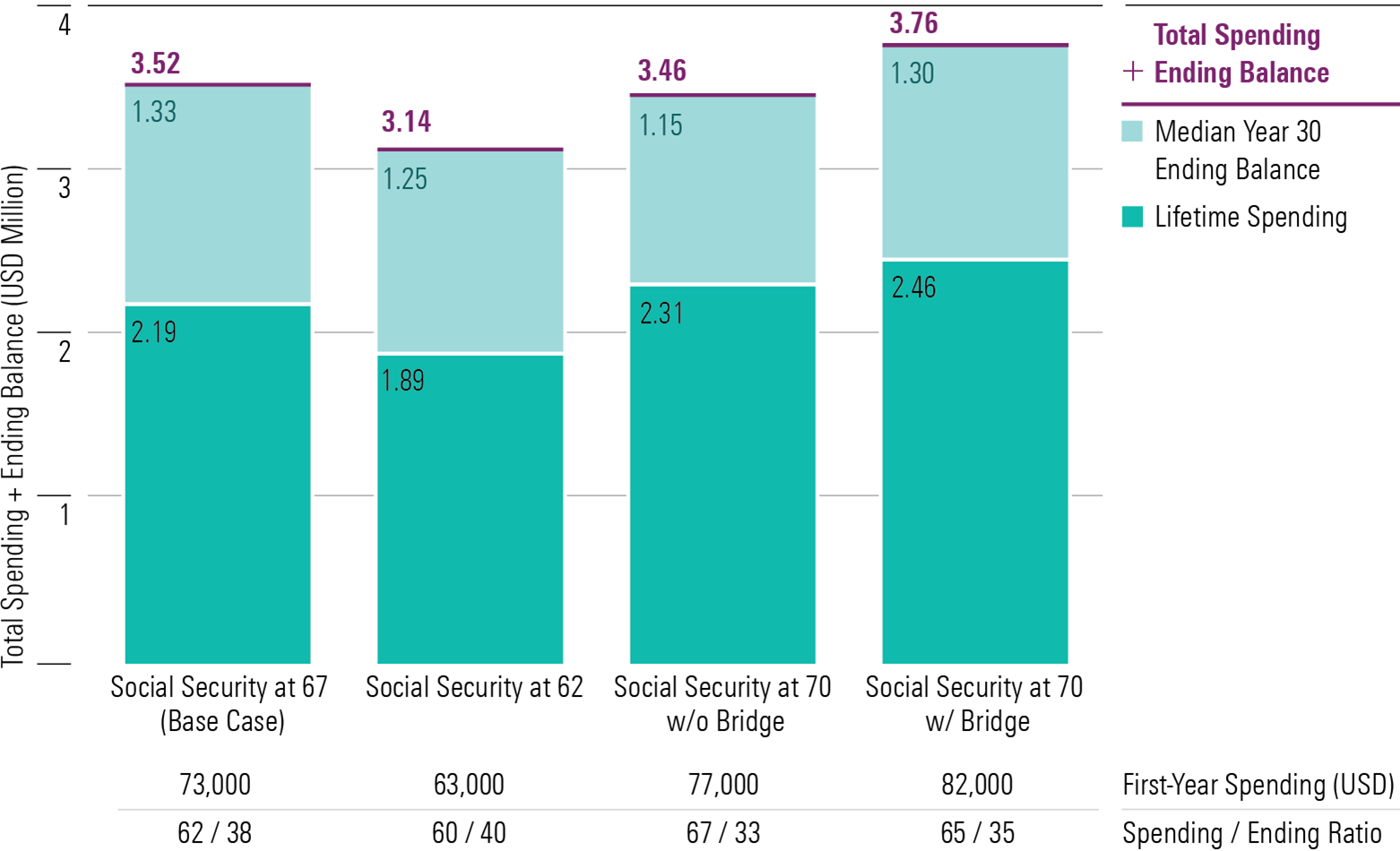
Retirees who delay and must use portfolio withdrawals from age 67 to 70 still see a boost in lifetime spending relative to those who begin taking benefits at 67. However, to maintain the same standard of living as someone who took Social Security at age 67, the age 70 Social Security filer may need higher withdrawals from the portfolio to bridge the gap between ages 67 and 70.
In our baseline scenario, the retiree who takes Social Security at 67 has about $73,000 in total income in the first year of retirement (the $36,000 from Social Security plus the $37,000 withdrawn from the $1 million investment portfolio in year 1). To match that, the retiree delaying Social Security must withdraw the full $73,000 from the investment portfolio for the first year. Adjusted for inflation, the withdrawal becomes $74,693 in year 2 and $76,426 in the final year before claiming Social Security at age 70.
Lifetime spending is still higher over the full 30-year period than it is for the base case with Social Security starting at age 67, but the steeper withdrawals early in retirement lead to a median ending balance of the portfolio that’s about $100,000 lower for retirees who delay taking Social Security. This may counter the consensus that it’s always better to delay Social Security if the retiree can afford to do so and has an average or above-average life expectancy. However, that only holds if the retiree has an alternative form of income, as described above.
Finally, it’s worth pointing out that our analysis doesn’t adequately capture another valuable trait of Social Security: its ability to track the inflation rate directly. That, in turn, provides valuable purchasing-power protection. If inflation runs higher than the 2.3% rate assumed in our research, the benefit of delaying Social Security and in turn enlarging eventual payments would be even greater.
The author or authors do not own shares in any securities mentioned in this article. Find out about Morningstar’s editorial policies.

 United States