
8 Stock Picks in the Apparel Industry
The industry has struggled to find any consistency, but there are attractive long-term opportunities.


The share prices of most apparel companies under our coverage have rallied over the past year.
Even so, as of January 2025, about 40% are trading at 4 or 5 stars.
This high percentage reflects investors’ concerns about the industry returning to typical patterns of excessive merchandise and discounting.
While we share investors’ view that the apparel industry has seen better days, we also believe that inventory levels are declining and that some participants are operating more efficiently than in the past.
In our view, investors have punished these stocks too severely after an industry lull following the pandemic. However, it is also true that industry participants have struggled to forecast their own results and were too optimistic.
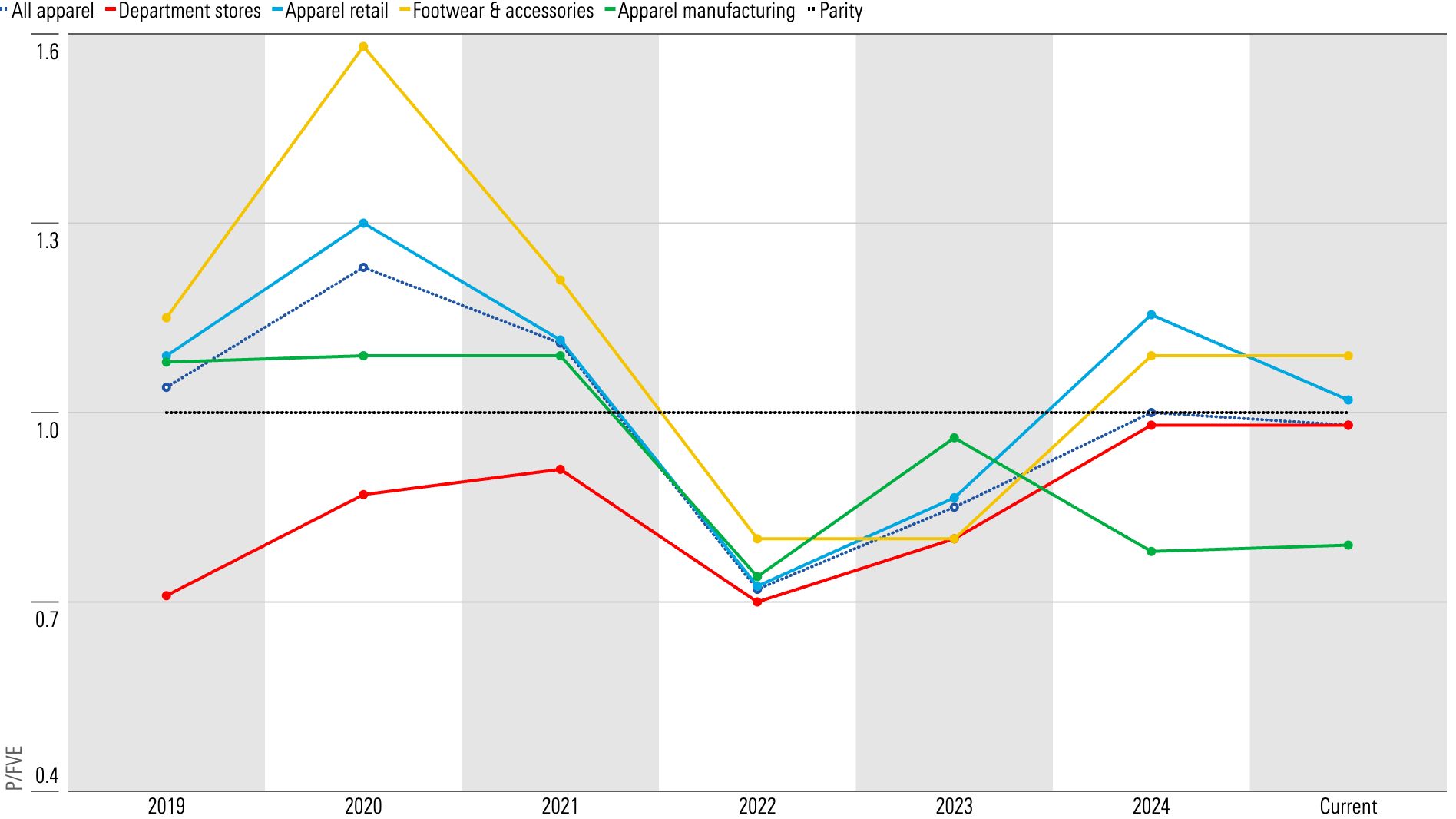
Recently, the industry has contended with spending shifts away from clothing and macroeconomic challenges in North America, China, and Western Europe. But by the end of 2024, the median apparel firm was trading at our median fair value estimate—a big reversal from two years prior.
After Two Years of Discounts, the Median Apparel Firm Matched Our Fair Value Estimate at Year-End 2024
Nonetheless, we think there are investment opportunities in apparel despite the sharp rally.
4 Key Themes to Know in the Apparel Industry
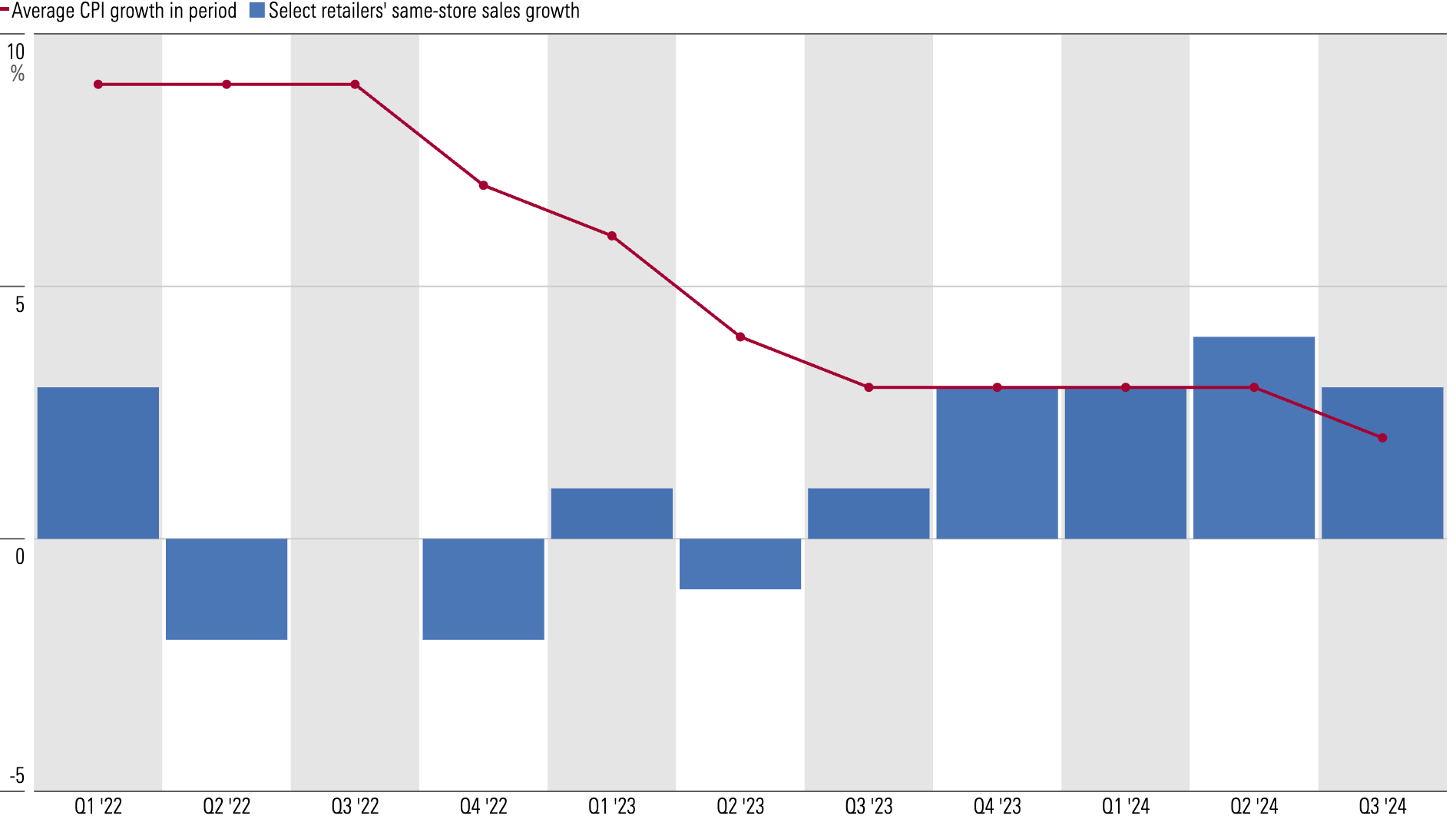
High same-store sales growth has been elusive for most apparel and footwear sellers. Some issues, such as shipping and inventory problems, have begun to abate over the past year, and average same-store sales growth has been close to the inflation rate. Ultimately, though, apparel is not a high-growth industry in the developed world, and same-store sales growth is likely to be in the low single digits in the long run.
Recent outperformers in terms of comparable sales include those catering to wealthier consumers (such as Ralph Lauren RL and Urban Outfitters’ URBN Anthropologie and Free People) and deep discounters (such as Ross ROST and TJX TJX). However, mass-market stores, especially department stores, have often disappointed investors with poor results.
Select Group of Retailers' Sales Results Show Industry's Recent Struggles, but Stability Has Improved
More work is necessary for apparel firms struggling with excess inventory. Many clothing firms have been plagued by excess inventory for years. They have struggled to match production with demand from wholesale partners and consumers. Most of these companies have invested in efficiency, but progress has been slowed by market conditions.
Firms that typically have less than 100 days’ sales in inventory include discount stores like Ross and TJ Maxx; and these retailers tend to have higher operating margins. Meanwhile, apparel producers like Puma PMMAF and PVH PVH report five or more months’ inventory. These firms have been affected by reductions in wholesale orders and inconsistent sell-through. Department stores like Macy’s M and Kohl’s KSS, for their part, also turn their inventory relatively slowly.
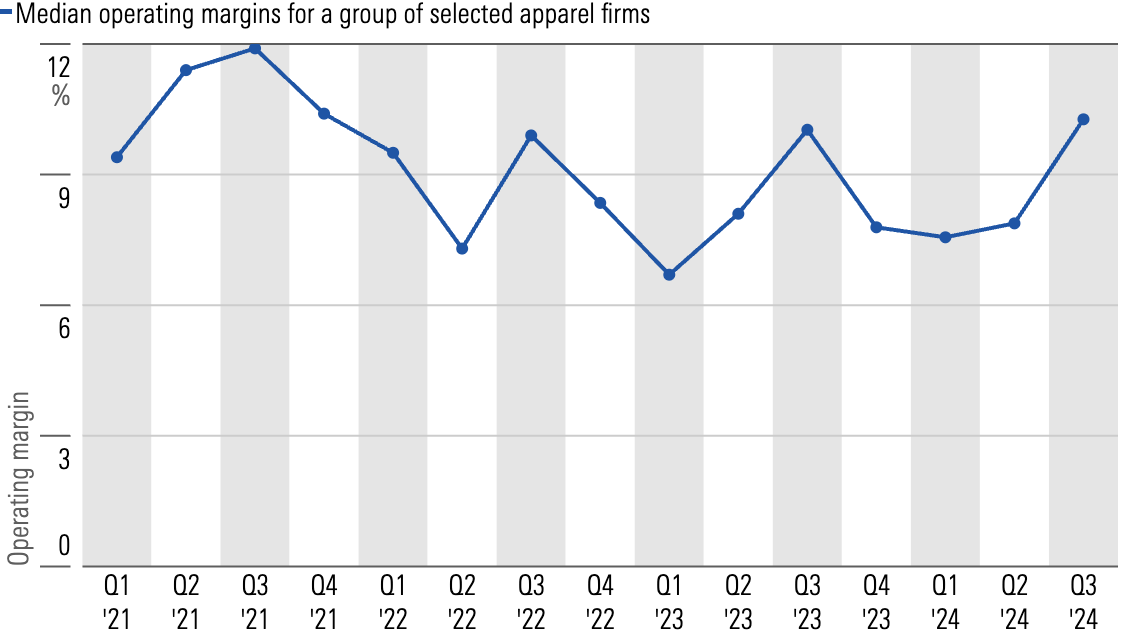
Apparel firms are looking for ways to boost profitability after a period of inflation and disappointing demand. Coming off strong results in 2021, it was almost inevitable that operating margins for many apparel firms would weaken in 2022 and 2023. As it happened, they dropped even more than expected in an environment of high inflation and slowing consumer spending. Also, the strength of the US dollar against the euro and other currencies has affected profitability for many multinationals.
Slowing inflation is benefiting apparel firms’ margins as they have sold through much of their higher-cost merchandise.
Operating Margins Have Declined From Lofty 2021 Levels, but Cooling Inflation and Cost Cuts Are Beneficial
Altman z-scores demonstrate risk for some apparel firms, but improvement is possible. The Altman z-score is a metric used to predict financial distress, based on profitability, balance sheet health, and market data. In general, a z-score below 3 suggests that a firm is in danger of falling into distress.
According to this score, about 36% of apparel firms currently have scores that show they’re in danger of distress. Most of these firms currently have Morningstar Economic Moat Ratings of none.
8 Stock Picks in the Apparel Industry
Although the share prices of most apparel companies under our coverage have rallied over the past year, about 40% of them are presently trading at 4 or 5 stars. This sizable percentage reflects investors’ concerns about the industry returning to typical patterns of excessive merchandise and discounting.
While we share investors’ view that the apparel industry has seen better days, we also believe that inventory levels are declining and that some participants are operating more efficiently than in the past.
Here are eight companies that we like:
- Nike NKE
- Hanesbrands HBI
- VF VFC
- Under Armour UA
- Macy’s
- Topsports International 06100
- Shenzhou International 02313
- Zalando ZAL
| Stock | Ticker | Morningstar Rating | Moat Rating | Fair Value Estimate (as of Jan. 27, 2025) | Price/Fair Value Estimate (as of Jan. 27, 2025) | Uncertainty Rating |
|---|---|---|---|---|---|---|
| Nike | NKE | 5 stars | Wide | USD 112.00 | 0.66 | Medium |
| Hanesbrands | HBI | 4 stars | Narrow | USD 16.30 | 0.51 | Very High |
| VF | VFC | 4 stars | None | USD 39.00 | 0.68 | Very High |
| Under Armour | UA | 5 stars | None | USD 14.50 | 0.52 | High |
| Macy’s | M | 4 stars | None | USD 25.00 | 0.61 | Very High |
| Topsports International | 06100 | 5 stars | Narrow | HKD 6.80 | 0.43 | Very High |
| Shenzhou International | 02313 | 5 stars | Narrow | HKD 110.00 | 0.53 | High |
| Zalando | ZAL | 4 stars | None | EUR 42.70 | 0.77 | High |
Editor’s Note: A previous version of this article appeared on May 20, 2024.
The author or authors do not own shares in any securities mentioned in this article. Find out about Morningstar’s editorial policies.

 United States