
After Earnings, Is Marvell Technology Stock a Buy, a Sell, or Fairly Valued?
With profit margins and AI revenue growing, here’s what we think of the semiconductor manufacturer’s stock.

Marvell Technology MRVL released its fiscal second-quarter earnings on Aug. 24, 2023, during trading hours. Here’s Morningstar’s take on Marvell’s earnings and stock.
Key Morningstar Metrics for Marvell Technology
- Fair Value Estimate: $61.00
- Morningstar Rating: 3 stars
- Morningstar Economic Moat Rating: Narrow
- Morningstar Uncertainty Rating: High
What We Thought of Marvell Technology’s Q2 Earnings
Marvell materially raised its outlook for artificial intelligence revenue growth this year. The firm pushed out its outlook for recoveries in its data center storage and enterprise networking businesses. We still view fiscal 2024 as a mixed bag, with promising strong growth out of AI partially offsetting downcycles in some of Marvell’s other customer end markets.
Fiscal second-quarter sales rose 1% sequentially to $1.34 billion, which was still down 12% year over year. Data centers are Marvell’s largest end-market exposure and have been suffering from steep inventory corrections, which limited sales and drove a year-over-year decline of 29%. Marvell’s optical portfolio has been gaining steam in fiscal 2024 as AI data centers require its market-leading optical modules for high-speed connectivity, helping to balance declines in storage. Marvell’s enterprise networking business is grappling with its own inventory corrections and fell 10% sequentially. The firm’s automotive business continues to benefit from increasing car connectivity and rose 32% year over year and 23% sequentially.
Profit margins improved sequentially but remain far below year-ago levels. Non-GAAP operating margin of 27% was down more than 900 basis points year over year. Still, we anticipate recovering margins through fiscal 2024 and into fiscal 2025 behind recovering volumes, cost controls, and product mix.
Marvell Technology Stock Price
Fair Value Estimate for Marvell Technology
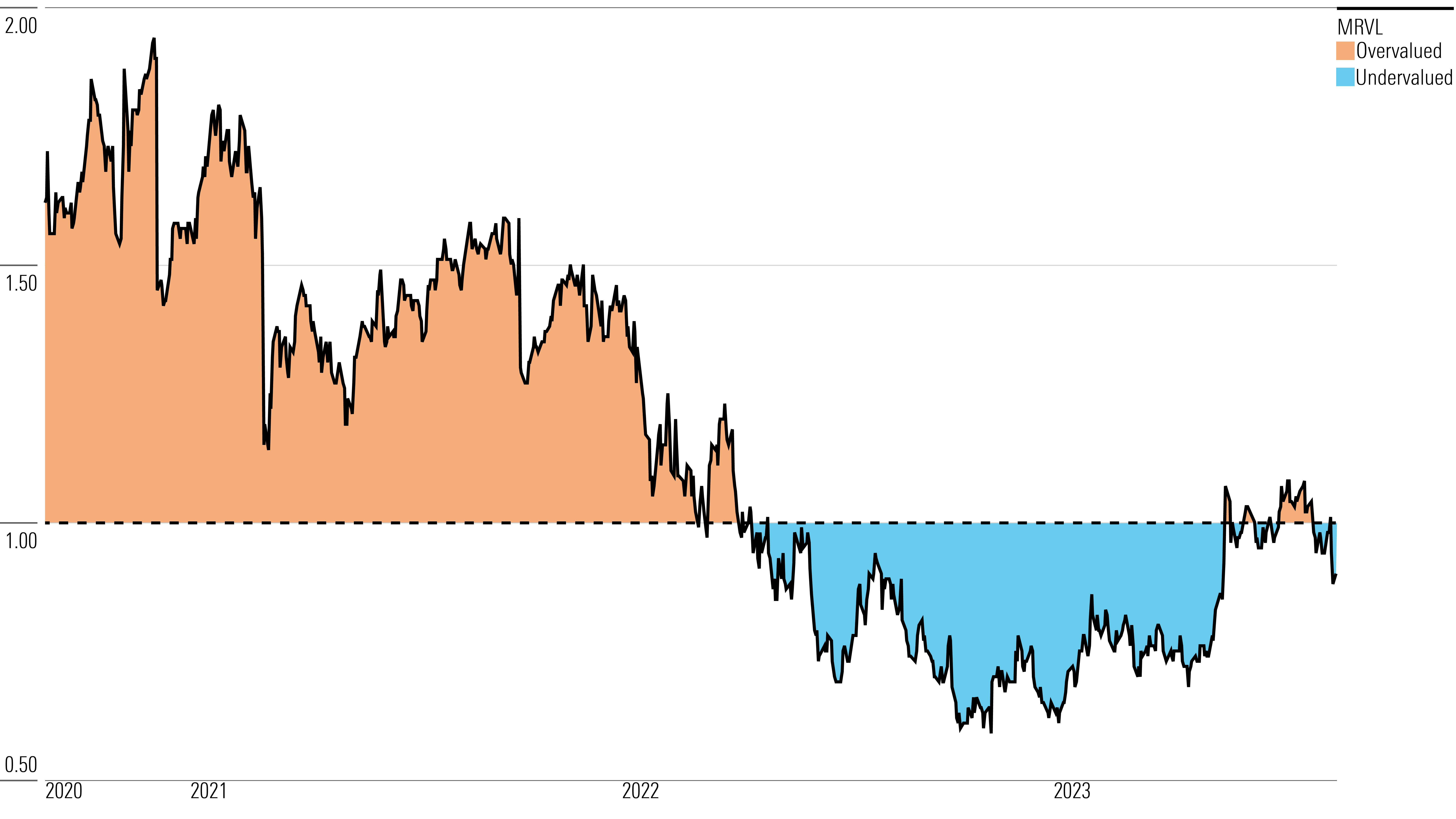
With its 3-star rating, we believe Marvell’s stock is fairly valued compared with our long-term fair value estimate.
Our fair value estimate for Marvell is $61 per share. Our valuation implies a fiscal 2024 price/adjusted earnings of 36 times and an enterprise value to sales of 10 times, along with a 4% free cash flow yield. The primary drivers of our valuation are growth in the data center, carrier, and automotive end markets.
We expect 14% sales growth for Marvell over the next five years, primarily from organic share gains as it flexes its portfolio for growing applications in public clouds, AI, 5G networks, and cars. We model a weak fiscal 2024 amid inventory digestion and slower spending from cloud and enterprise customers, but a fierce rebound in results in fiscal 2025 and growth tapering down thereafter. We expect it to take organic share across most of its end markets, but for its largest win rate to come in the data center business. We expect Marvell’s consumer portfolio to wind down gradually as part of the business over the long term.
We anticipate the data center will remain Marvell’s largest end market and is the primary driver of our forecast, with a 16% compound annual growth rate through fiscal 2028. We estimate Marvell will gain significant wallet share from customers as public clouds adopt more data processing units and optical content to efficiently advance to higher speeds. In carrier, we expect 17% compound annual growth through fiscal 2028, with the primary driver being the adoption of 5G networks with increasing network density that requires more processors.
Read more about Marvell Technology’s fair value estimate.
Marvell Historical Price/Fair Value Ratios
Economic Moat Rating
We assign Marvell a narrow economic moat rating. We believe the firm holds intangible assets in networking chip design that let it compete at the cutting edge and defend its competitive position from well-capitalized competition, and that it also benefits from switching costs. We expect Marvell to earn excess returns on invested capital over the next 10 years.
To us, intangible assets in networking chip design come in the form of engineering expertise, both in terms of silicon design and integration with complementary hardware and customer networking topologies. This comes from decades of development, R&D expense, and engraved customer relationships. In our view, Marvell’s billions of dollars of cumulative R&D over the past decade have created a portfolio of differentiated intellectual property from which it can draw to build custom and semi-custom designs for myriad applications and customers.
We contend that Marvell commands pricing power for its differentiated technology and design. We believe customers pay for performance and features in their networking chips, and the firm’s pricing power shows in its healthy gross margins as it aggressively adds new sockets. Marvell’s customers have shown a commitment to building greater portions of their networks on its chips, reflected in strong cross-selling and upselling activity. Marvell’s over-$100 million customer count has risen quickly, from 13 in 2020 to 19 today. Such customers include Microsoft MSFT, which sole-sources Marvell’s optical chips for its North American regional data centers.
Read more about Marvell Technology’s moat rating.
Risk and Uncertainty
We assign Marvell a High Morningstar Uncertainty Rating. We view the firm as prone to cyclicality in its end markets, arising from cloud capital expenditures, 5G buildouts, and the cyclical storage drive market. Though we believe Marvell’s moat and opportunity for content growth help it smooth over some cyclicality, it can be vulnerable to downturns in end-customer spending.
We foresee Marvell facing continued competition in its end markets. Our valuation assumes Marvell’s ability to defend its current share in data centers and 5G networks, as well as to win greater customer wallet share with its processors and optical chips. We also forecast increased investment to help Marvell win back shares in its enterprise end market against Broadcom. If Marvell struggles on any of these fronts, its performance could suffer. We also think new entrants pose a risk for Marvell, such as Cisco CSCO entering the networking chip arena with its Silicon One family.
Read more about Marvell Technology’s risk and uncertainty.
MRVL Bulls Say
- Marvell’s strong position in data processors and optical chips should offer high growth potential in future networking setups in public clouds and 5G networks.
- Marvell’s strong non-GAAP profitability reflects moaty pricing power, in our view.
- We believe Marvell’s wide portfolio of switches, processors, and optical chips gives it ample opportunity for cross-selling and share gains.
MRVL Bears Say
- Marvell remains a distant second to Broadcom AVGO in networking chip market share, and it will face an uphill battle in overcoming its customer relationships.
- Marvell could struggle to compete with the immense R&D budgets of Nvidia NVDA, Intel INTC, and Broadcom across rapid innovation cycles.
- Marvell still has a solid portion of sales going into storage drives, which opens the firm up to cyclicality.
This article was compiled by Monit Khandwala.
The author or authors do not own shares in any securities mentioned in this article. Find out about Morningstar’s editorial policies.

 United States