
Energy: Low Oil Prices May Challenge Capital Returns, but Geopolitical Tensions Provide Upside Risk
Exxon and SLB are some of our favorite names.

OPEC+ announced yet another 411,000 barrel/day increase in crude production for July from June. This follows a similar increase from prior months. OPEC+ has publicly claimed the increases stem from ensuring quota compliance from its members. But we think the group’s unspoken goal is taking global market share. This echoes a prior failed price war with US shale over a decade ago. Instead, the US increased its liquids production share to 22% over the past decade from 15%. By contrast, OPEC’s market share stalled and fell to 31.5% from 35% during the decade.
Oversupply and Middle-Eastern Risks Whipsaw Oil Markets
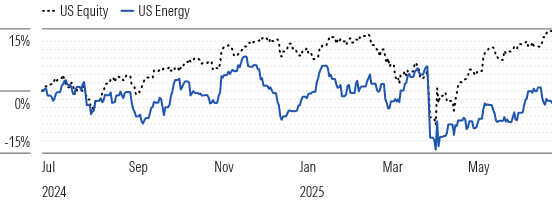
The shale revolution was in pro-growth mode a decade ago. The best producers adapted and matured, becoming far more capital-disciplined. Persistently lower oil prices, the end of enormous leaps in operating efficiency, and less remaining quality acreage in US shale will stress the capital returns model adopted by operators there. Non-Permian producers can’t pull back on activity without facing weaker unit economics. Still, most US independents we cover primarily operate in the Permian and fall at the low end of the cost curve. Additionally, geopolitical conflict from supply disruptions could quickly boost share prices.
We Expect Further Oil Rig Activity Declines in 2025
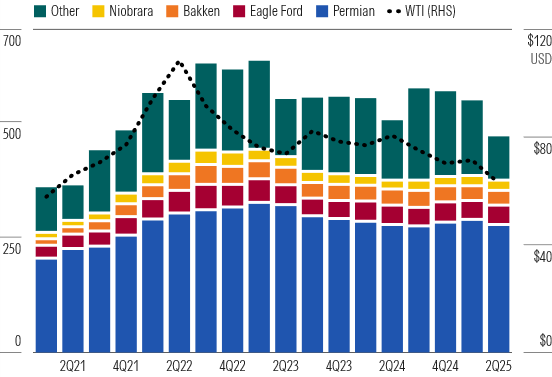
The US oil rig count sits at its lowest level since 2022, and we expect further drilling declines. Persistent factors pushing the WTI benchmark to the low 60s include OPEC+ supply increases weighing on oil prices and continued secondary economic impacts from uncertain trade policy. We think Permian drilling faces higher risks of decline at current pricing levels. Most US independents we cover focus development efforts in the Permian; this basin alone accounts for nearly half of total US production.
Gas Drilling Remains Muted in the Near Term, but Long-Term Drivers Intact
Top Energy Sector Picks
Schlumberger
- Fair Value Estimate: $51.00
- Morningstar Rating: ★★★★★
- Morningstar Economic Moat Rating: Narrow
- Morningstar Uncertainty Rating: Medium
Schlumberger SLB is among the cheapest stocks in our global energy coverage with a moat. Its multiple trades in line with peer services firms, but it deserves a premium, given its scale, suite of solutions, competitive position in some of the more attractive services markets, and technological advantage. These factors position SLB to outperform peers. The firm’s offshore segment outside North America boasts a growing project opportunity set that could exceed $100 billion annually over the medium term. SLB’s digital-related revenue is also highly accretive and more resilient against cyclical headwinds. We expect digital revenue to more than double by the end of 2025 to $3 billion and possibly reach $4 billion by the end of the decade.
HF Sinclair
- Fair Value Estimate: $51.00
- Morningstar Rating: ★★★★
- Morningstar Economic Moat Rating: Narrow
- Morningstar Uncertainty Rating: Very High
Sinclair DINO is the lone refiner trading below our fair value estimate. Following the acquisition of Sinclair Oil, HollyFrontier, now known as HF Sinclair, is a fully integrated, independent company that encompasses refining, marketing, renewables, specialty lubricants, and midstream businesses. Following weak fourth-quarter results, the company remains a turnaround story. However, management is showing progress in improving reliability and efficiency, as well as cutting costs across its portfolio to enhance competitiveness. Along with a focus on shareholder returns, we think this is the right playbook to improve valuations.
ExxonMobil
- Fair Value Estimate: $135.00
- Morningstar Rating: ★★★★
- Morningstar Economic Moat Rating: Narrow
- Morningstar Uncertainty Rating: High
ExxonMobil’s XOM strategy diverges from industry trends as it plans to increase its spending through 2030, aiming to raise production to roughly 5.4 million barrels of oil equivalent per day and boost earnings by over $20 billion. While this higher spending has raised concerns among investors, given the industry’s track record of prioritizing growth over returns, Exxon’s high-quality hydrocarbon portfolio should ensure attractive returns while maintaining capital discipline. Continued capital efficiency gains and structural cost reductions support the company’s ambition of generating $165 billion in surplus cash by 2030, with $20 billion in share repurchases projected for 2025 and 2026.
The author or authors do not own shares in any securities mentioned in this article. Find out about Morningstar’s editorial policies.

 United States