
Financial Services: Robust Expectations Limit Investor Upside
In this sector, we recommend T. Rowe Price, U.S. Bancorp, and Ally.

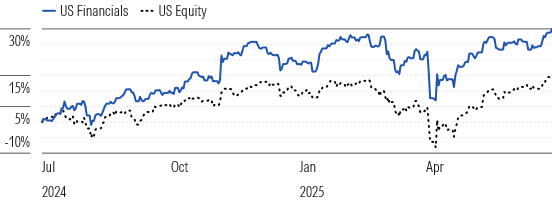
US financial services have been on a torrid run, returning 29.9% over the past year and outperforming broader US equity markets by a striking 14.9 percentage points. That outperformance narrowed over the past quarter, driven in large part by slowing transactions and at least temporarily lower asset levels attributable to trade policy uncertainty.
Financial Services Outperformance Leaves Limited Investable Opportunities
Looking forward, we believe the market has gotten ahead of itself in the sector, which is fundamentally driven by economic growth and risk appetite. Our house view is that real GDP clocks in 1% lower in 2029 than our April 2025 forecast, reflective of a long, slow drag from tariff policy, even as many of the most punitive levies have been eased. That’s not reflected in valuations, as the sector trades at an 8% market-cap-weighted premium to our bottom-up fair value estimates.
Battered Credit Services Provide Investors With Best Value for the Money
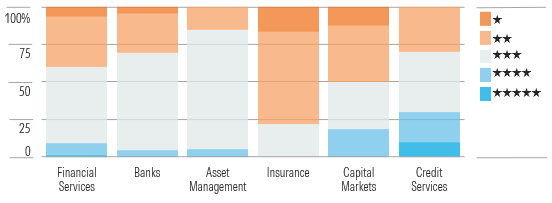
Considering performance at the industry group level, we see minimal pockets of value across the sector. For investors needing sector exposure, the best bet is credit services, which makes up around 30% of companies trading in 4- and 5-star territory. In our view, this is driven by cyclically higher credit costs for players like Capital One, Synchrony Financial, and Bread, which the market expects to persist. By contrast, we view improving delinquency data as a sign that the industry is turning the corner, barring significant macroeconomic deterioration, and expect improving charge-off rates over the next couple of years.
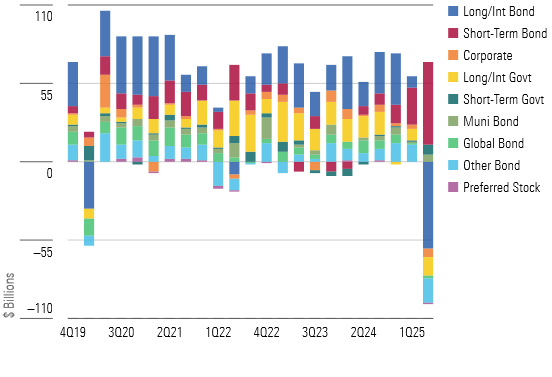
Money Market Fund AUM Has Exploded to $7 Trillion in the Year to Date
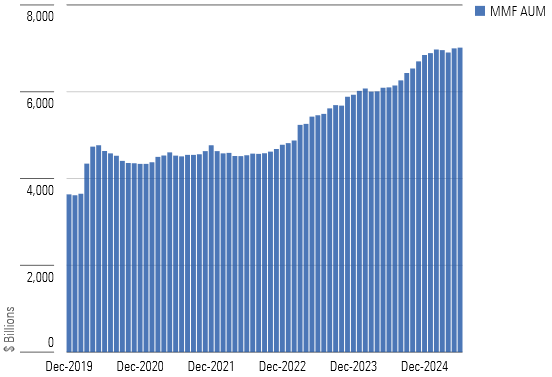
While asset prices have largely recovered from April declines, we’re following two interesting narratives. First, an increasing number of investors are parking capital in cash, suggesting some combination of waning risk appetite and stretched equity valuations. Large-cap US stocks currently see a trailing earnings yield of around 3.6%, roughly 100 basis points lower than historical averages and below the current fed-funds rate. Second, investors eschewed long-term government bonds during the past quarter. While this has partially reversed, fiscal discipline has become an increasingly hot topic, and one that we’re monitoring closely, given the importance of the 10-year Treasury yield on loan pricing.
Bond Market Wobbles Matter; Our Base Case Calls for 4.5% LT 10-Year UST Rates
Top Sector Picks
U.S. Bancorp
- Fair Value Estimate: $53.00
- Morningstar Rating: ★★★★
- Morningstar Economic Moat Rating: Wide
- Morningstar Uncertainty Rating: Medium
U.S. Bancorp’s USB current valuation does not reflect its true earnings power. While the firm’s payment franchise is not growing as quickly as some of the software-based players, it remains an asset-light business for the bank and generates high returns on equity. We also think the market is extrapolating USB’s recent high operating expenses and punishing it for a permanently higher operating cost base. We forecast the bank to achieve a normalized operating efficiency ratio in the high 50s, which is better than its current range of low 60s over the past several quarters. In 2024, USB achieved a positive operating leverage of 650 basis points, and we expect it to deliver another positive 150 basis points in 2025.
T. Rowe Price
- Fair Value Estimate: $113.00
- Morningstar Rating: ★★★★
- Morningstar Economic Moat Rating: Narrow
- Morningstar Uncertainty Rating: High
T. Rowe Price TROW has been facing more headwinds of late, with continued baby boomer rollovers and increased competition from low-cost passive target-date funds affecting organic AUM growth, while their growth-equity heavy book of business has been affected by higher short-term rates and volatility induced by tariffs and fiscal policy. The company has posted uncharacteristically poor investment returns the past several years, with both its equity and fixed-income platforms generating performance well outside the upper quartile, which has weighed on its multiple. We don’t expect the firm to recover until its organic AUM growth results improve, but it remains in decent long-term shape and is a strong capital allocator.
Ally Financial
- Fair Value Estimate: $45.00
- Morningstar Rating: ★★★★
- Morningstar Economic Moat Rating: None
- Morningstar Uncertainty Rating: High
Ally’s ALLY share price doesn’t reflect its improving fundamentals. We believe that recently elevated credit costs, pressure from falling used car prices, and compressed NIMs are temporary pressures. By contrast, the firm has tightened its underwriting, and consumer delinquencies are stabilizing. The company’s deposit base is now in great shape, with 80% retail funding, so Ally should benefit from falling interest rates. In the background, the firm is exiting lower-return businesses to focus on core retail auto lending. The market is discounting cyclical factors; the firm is structurally healthier than ever.
The author or authors do not own shares in any securities mentioned in this article. Find out about Morningstar’s editorial policies.

 United States