
The Top Investing Opportunities for Oil and Gas E&P Stocks
Cost advantage is key for exploration and production firms to achieve a moat.


Exploration and production firms, which produce oil and natural gas for energy and transport, are facing near-term uncertainty, but we think they have positioned themselves well for changes in the industry.
We expect three key themes to drive the E&P industry:
- The energy transition and global oil demand.
- Producer capital discipline.
- The global thirst for US natural gas.
We outline our expectations for the industry through the lens of these themes and how companies in this space are positioning themselves to succeed in lower-price environments.
3 Key Themes for the E&P Industry
Our outlook for the E&P industry is centered on three key industry themes:
- Global oil demand will peak in 2030 but decline slowly. We think the global energy transition will gradually affect oil demand. Electric vehicle adoption will accelerate quickly for private and commercial uses, but the vehicle stock will shift more slowly because internal combustion engines have long lives. For aviation, shipping, and petrochemicals, the substitutes are far from ideal, even with generous allowances for technological improvements. However, a gradual energy transition does not necessarily signal climate disaster; emissions will decline faster as the share of noncombustible uses rises.
- Producers exercise capital discipline now. Investors have long demonized E&Ps for overspending and growing recklessly. This continued after the 2015 collapse in crude prices; when prices recovered, activity bounced right back as well. Such behavior exacerbated commodity price booms and busts. But firms eventually realized that investors want disciplined investing, with surplus cash returned to shareholders rather than plowed back into drilling. So far, the evidence shows that firms are committed to this new philosophy: US rig activity decoupled from spiraling prices in 2021-22.
- The global thirst for US natural gas will accelerate. Natural gas is more climate-friendly than coal and a better complement for renewables in power generation. So, consumption is growing rapidly in Europe and Asia, spurring a surge in US exports. This benefits US producers to an extent, but infrastructure constraints cap the potential for growth. Despite rising energy costs, many politicians are reluctant to compromise their climate credentials by supporting pipeline or export terminal approvals.
Market Share of Key Players in the E&P Industry
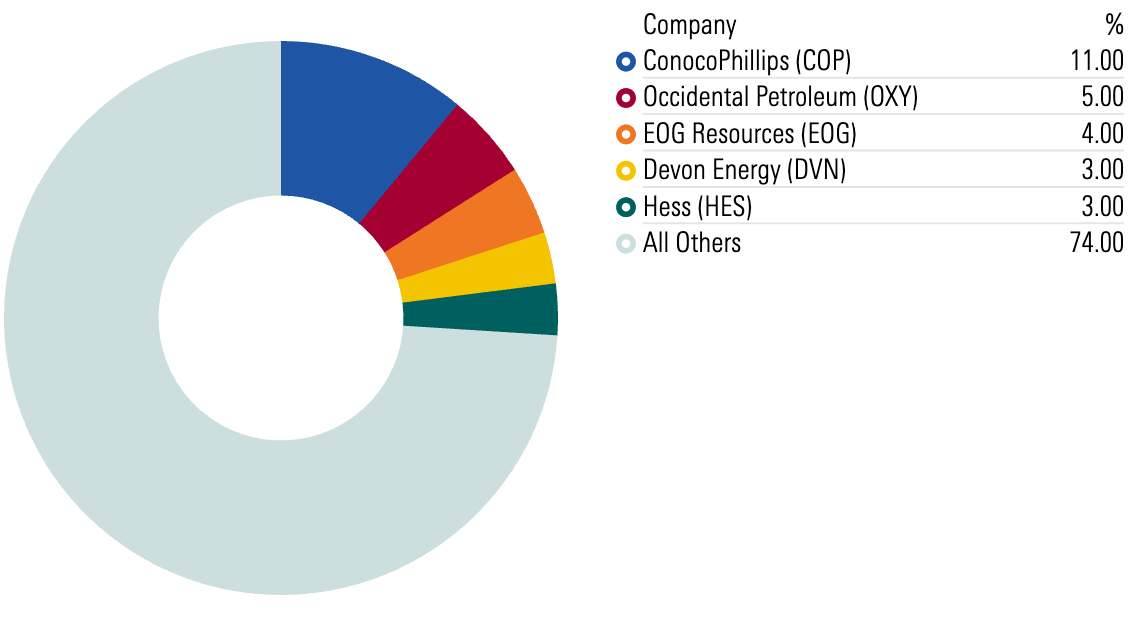
Though US shale players have undergone a consolidation wave, the oil and gas E&P industry remains fragmented.
The top five companies by revenue collectively accounted for 26% of total sales in 2023. ConocoPhillips COP is the largest player overall, with an 11% revenue share, while Occidental OXY and EOG Resources EOG are second and third, each with around a 5% share. Devon DVN and Hess HES close out the top five.
Key Industry Players and Revenue Market Share (2023)
Are There Any Moats to Be Found?
Moats are relatively rare in the oil and gas E&P industry. More than half of the companies in our E&P coverage—67%—have a Morningstar Economic Moat Rating of none, compared with the cross-sector average of 41%.
We assign no wide moat ratings in the E&P space, as the uncertainty regarding long-term oil and gas prices is simply too high. But low-cost producers can earn narrow moats. We assign narrow moat ratings to 33% of our coverage, compared with the cross-sector average of 40%.
The largest oil and gas E&P companies with narrow moats are:
- Devon Energy
- Diamondback Energy FANG
- EOG Resources
- Hess
- ConocoPhillips
| Stock | Ticker | Morningstar Rating | Fair Value Estimate (as of Feb. 20, 2025) | Price/Fair Value Estimate (as of Feb. 20, 2025) | Uncertainty Rating |
|---|---|---|---|---|---|
| Devon Energy | DVN | 4 stars | $52 | 0.74 | Medium |
| Diamondback Energy | FANG | 3 stars | $168 | 0.96 | High |
| EOG Resources | EOG | 3 stars | $126 | 1.08 | Medium |
| Hess | HES | 4 stars | $178 | 0.85 | High |
| ConocoPhillips | COP | 3 stars | $114 | 0.89 | High |
All E&P moats are predicated on the cost advantage moat source. Maintaining production costs well below the long-run industry marginal cost is the only real way we’re sufficiently confident these firms can generate excess returns and cumulative economic profit through the cycle. Oil and gas companies produce undifferentiated commodities, often widely fungible. Therefore, other moat sources—like switching costs, network effect, brands or patents, and efficient scale—aren’t available.
Disciplined capital allocation, efficient operations, and leading-edge technology do help lower unit costs, but these characteristics are theoretically replicable and do not guarantee a durable competitive advantage.
Instead, moats are determined by access to resources with intrinsically low extraction costs. This is determined by geological characteristics, such as product mix, reservoir quality, formation thickness, and depth. We also consider processing needs, transportation distances, infrastructure, and the runway of potential drilling opportunities (since geological deposits are finite and eventually deplete).
Industry Outlooks: Crude Oil and Natural Gas
We believe reports of oil demand’s death have been greatly exaggerated.
We expect oil demand to drop by 11% through 2050, down to 88 million barrels per day in 2050 from 99 mmb/d in 2019. That’s less of a decline than some may expect. We’re optimistic about EV adoption, which will slash road fuel demand, but not every component of oil demand can be electrified.
- Light-duty vehicles. Our bullish views on electric vehicles drag our gasoline consumption forecast below the consensus business-as-usual case. We think EVs will account for 57% of the vehicle fleet by 2050. We’re still above the consensus bear average because we’re more pessimistic about efficiency gains for internal combustion engines because real-world performance severely lags officially reported values.
- Road freight. Freight trucking (including, eventually, long haul) is an ideal candidate for electrification, though conventional wisdom is surprisingly pessimistic.
- Ships and planes. Even the consensus business-as-usual average incorporates rosy assumptions on efficiency gains as well as unduly pessimistic views on air travel and marine freight volume. For planes, substitute fuels are exorbitantly expensive. For ships, we think the displacement of oil by green ammonia will be modest.
- Petrochemical feedstock. We’re way above the business-as-usual average despite incorporating optimistic assumptions for recycling uptake (which will reduce demand for virgin plastics). The consensus forecasts seem to imply a plastics demand that is far below historical trends, along with unrealistic assumptions for recycling.
On the natural gas side, we believe that global liquefied natural gas demand is the most important growth driver for the US gas market.
Since 2010, global LNG demand has increased about 5% annually. We expect that pace to accelerate to 7% annually between 2023 and 2027.
We build our forecast on a country-by-country basis, considering gross domestic product growth rates, electricity growth and gas power sector demand, renewables growth, and domestic production, and we factor in GDP/electricity intensity changes over time, among other assumptions. China will be the main engine for this expansion.
While growth will be lower than historical levels, there’s still scope for further expansion, and that should drive up natural gas consumption in the industrial and power generation sectors. Natural gas is expected to be a larger slice of the electricity mix going forward.
The author or authors do not own shares in any securities mentioned in this article. Find out about Morningstar’s editorial policies.

 United States