
Our Take on Wireless Earnings
AT&T makes plans, Verizon adds customers, T-Mobile takes share, and Sprint brings up the rear.

AT&T Lays Out Optimistic Three-Year Plans AT&T's T announcement of three-year strategic and capital-allocation plans overshadowed third-quarter earnings that were broadly as we expected. Wireless results remained solid, with continued postpaid customer growth improvement and modest margin expansion, while the entertainment segment experienced sharp television customer losses but stable profitability. The general outline of AT&T's three-year plans lines up with our expectations, with one major exception: Management believes the EBITDA margin can expand about 2 percentage points through 2022, which we view as optimistic, given the pressures facing several parts of the business. AT&T also plans to repurchase $30 billion of shares over three years, equal to more than half of expected free cash flow after dividend payments, while continuing to reduce debt leverage gradually. We were happy to hear management express sensitivity to the stock price, with plans to front-load repurchases to capitalize on the current share price.
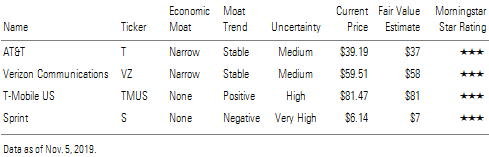
We like the progress AT&T has made thus far in 2019, but we’re hesitant to radically change our longer-term thinking on the company. The telecom and media landscapes are likely to change meaningfully in the coming years, forcing AT&T to adjust along the way. While we suspect the company is capable of expanding margins in the near term, we aren’t convinced that doing so will prove to be in its long-term best interest. While the company has incorporated HBO Max into its projections, maintaining solid competitive positions in wireless and media could require unplanned investments. In addition, future asset sales or restructurings are likely to complicate the picture over the next couple of years. Our $37 fair value estimate and narrow moat rating are unchanged.
AT&T added 101,000 net postpaid phone customers, its best third-quarter result in five years. The company held its own versus Verizon, which reduced unlimited pricing during the quarter, an indication that AT&T’s place in the market has solidified. Postpaid customer defections (churn) were roughly flat versus a year while gross new customer additions increased about 3%. Revenue per customer also continued to edge higher, up 0.6% year over year and 0.7% sequentially. Total wireless service revenue increased 0.7%, slower than recent quarters, reflecting significantly stronger wireless results in the second half of 2018 than in the first. A declining phone upgrade rate also continues to benefit the segment EBITDA margin, which expanded nearly 1 percentage point year over year to 43.8%.
In the entertainment segment, AT&T reported a loss of 1.2 million satellite and U-verse television subscribers during the quarter, a horrifically large number that was telegraphed earlier. In addition to losses resulting from content blackouts, the company continues to shed customers on promotional pricing plans and sharply curtail marketing to new customers, measures that drove a 6% increase in revenue per customer. Management believes television customer losses have peaked. Beyond television, the Internet access business was also weak, posting 119,000 net customer losses as cable competitors have accelerated their share gains. Total segment revenue declined 3.4% year over year, but EBITDA declined only 1.4%, likely reflecting the loss of low-margin television customers and lower customer acquisition costs.
WarnerMedia revenue declined 4.4%, reflecting a weaker movie slate than a year ago, soft ad sales, and lower licensing revenue. The lull in releases provided a lift to the EBITDA margin, however, which expanded more than 1 percentage point versus a year ago to 34.1%. AT&T is planning to invest about $1.0 billion-$1.5 billion, after tax, behind HBO Max in 2020, declining to $750 million in both 2021 and 2022. That amounts to around 4%-5% of annual Warner revenue and probably reflects a mix of startup costs and forgone licensing revenue.
On a consolidated basis, AT&T generated $6.2 billion of free cash flow during the quarter, with 60% of this amount paid in dividends. Remaining cash flow was used to reduce leverage, with net debt declining $3.6 billion to $159 billion during the quarter. Net leverage ended the quarter a bit below 2.7 times adjusted EBITDA, down from 2.9 times at the time of the Warner acquisition in the second quarter of 2018.
Lower Unlimited Pricing Drives Customer Growth for Verizon Verizon's VZ third quarter included strong postpaid phone customer growth, reflecting the ebb and flow of competitive intensity across the industry in recent quarters. The narrow-moat company cut pricing on its unlimited plans during the quarter, betting that improved competitiveness and the migration of more customers to unlimited will offset lost revenue from existing unlimited customers. This bet seems to have paid off, as wireless service revenue edged higher, a trend management expects to continue into the fourth quarter. We expect tactical maneuvering will affect Verizon and its rivals from quarter to quarter, but we believe Verizon's overall competitive position remains solid. We view the shares as fairly valued relative to our unchanged $58 fair value estimate.
Wireless customer growth has steadily accelerated during 2019 following a weak start to the year. Verizon added 444,000 net postpaid phone customers, its best third quarter in five years, thanks to relatively stable customer defections (churn) and a 10% increase in gross additions. Wireless service revenue increased 2.7% year over year, slower than earlier in the year, but this deceleration largely reflects weaker results during the first half of 2018. Importantly, average revenue per account continued to grow, increasing 1.8% versus a year ago and 0.9% sequentially.
The wireless EBITDA margin dropped about 1 percentage point versus a year ago to 46.8%, though Verizon claims the margin would have been flat absent accounting changes. This result is modestly disappointing, as margins have been expanding steadily in recent quarters. The cost to serve wireless customers is growing faster than we’d expected, increasing about 10% during the quarter. We aren’t yet concerned about this trend, though, as network differentiation is key to Verizon’s strategy and we expect rivals to face the same cost pressures.
Margins remain a larger concern for the fixed-line segment, which hasn’t been able to cut costs fast enough, despite a major employee buyout, to offset declining revenue. Segment revenue dropped 3.8%, with weakness across most business lines. Segment operating costs were basically flat year over year, producing a 17.8% drop in EBITDA. The segment EBITDA margin dropped to 17.4% from 20.4% a year ago. While Verizon is moving aggressively to reorganize the company by customer type rather than network type, making fixed-line margins less relevant, we remain concerned that the cost of maintaining the fixed-line network is becoming burdensome in areas where the company still operates legacy assets.
On a consolidated basis, Verizon reported 0.9% revenue growth year over year thanks to the wireless business and improved stability in the media segment. The consolidated adjusted EBITDA margin contracted nearly 1 percentage point to 36.6% (again roughly flat absent accounting changes). Free cash flow was solid during the quarter at $6.5 billion, enabling Verizon to reduce net debt by $4.8 billion during the quarter to $106.6 billion. Net leverage improved slightly to 2.2 times EBITDA. Management pegs unsecured debt at 2.1 times EBITDA, near its target range of 1.75-2.0 times.
T-Mobile's Negotiations With States Continue T-Mobile TMUS continued to steadily gain wireless market share during the third quarter thanks to strong customer loyalty, indicating that Verizon's decision to cut unlimited pricing had only a modest impact on the company. Regarding the Sprint merger, management announced that it will hold an event on Nov. 7 to announce its first planned move as a combined company, hinting that it could "add a little bit" to the conversation with the states' attorneys general that are suing to stop the deal. The company continues to hold discussions with the states with the goal of reaching a settlement before going to trial in early December. We continue to believe the merger is more likely than not to close, and we're sticking with our $80.50 fair value estimate, which assumes a 75% chance of approval, for T-Mobile.
T-Mobile added 754,000 postpaid wireless phone customers during the third quarter, likely equal to about half of the industry total. Customer defections (churn) did tick up a bit versus the prior quarter but remained well below a year-ago levels and roughly in line with Verizon and AT&T. The company is having a bit more trouble attracting new customers, with gross postpaid phone customer additions down about 4% versus a year ago. This modest drop is probably attributable to Verizon’s more aggressive pricing and AT&T’s ongoing marketing efforts. Importantly, average revenue per phone customer increased modestly year over year, the first gain in more than two years. Solid customer growth and stable pricing pushed postpaid revenue up 9.6%, with prepaid softness holding total wireless services revenue growth to 6.4%, still an industry-leading mark.
The reported EBITDA margin dipped 10 basis points versus a year ago to 28.3% but expanded about 80 basis points excluding merger-related costs. T-Mobile has struggled recently to turn the benefits of its increased scale into margin gains as the cost to serve customers increases with the investments made in the network. The cost to attract the marginal new customer also appears to be increasing, a dynamic we expect to continue as the company’s geographic expansion produces diminishing returns. Still, the dramatic improvements made in customer service over the past several years, and the resulting reduction in churn, should enable T-Mobile to pull back on marketing spending somewhat while still growing nicely.
On the other hand, T-Mobile also increased its planned network capital spending for 2019 to $5.9 billion-$6.0 billion from $5.4 billion-$5.7 billion, a sizable increase given this late stage. Management had previously said that network investments would be front-end loaded this year, but now claims efforts to more rapidly deploy 600 MHz spectrum and launch 5G service have pulled spending forward from 2020. We expect spending needs will continue to trend higher as the company pushes to maintain network quality and retain recent customer loyalty gains.
Weak Competitive Position, Self-Inflicted Wounds Hound Sprint Sprint S continued to limp along in its fiscal second quarter as it struggles to overcome a particularly weak competitive position. We don't expect to change our $7.20 fair value estimate, which reflects a 75% probability that the T-Mobile merger is completed. Sprint's shares have diverged sharply from T-Mobile's since the agreement with the Justice Department was announced in July, which we believe reflects a somewhat pessimistic view of the merger's odds of approval. Still, with the potentially catastrophic downside for Sprint absent T-Mobile, we would avoid the stock.
Net postpaid phone customer losses totaled 91,000, Sprint’s fifth consecutive quarter of net losses as customer defections remained stubbornly high. Monthly postpaid phone customer churn hit 1.91%, the worst mark since Sprint began disclosing this figure nearly five years ago and more than twice the pace of the closest major competitor (AT&T at 0.95%). Surprisingly, gross customer additions increased 5% year over year, indicating that Sprint can still attract new business. However, the industry had a fantastic quarter in terms of postpaid customer growth as migrations from prepaid services accelerated, and Sprint continues to fall behind overall. In addition, if it can’t keep new customers in the fold, improving profitability will be extremely difficult.
Sprint recently admitted that it had claimed government subsidies for ineligible customers, forcing the company to remove estimated reimbursements from revenue during the quarter. In addition, the prepaid business continues to struggle, losing 207,000 net customers and posting a sharp drop in revenue per customer. As a result, while postpaid revenue has held up fairly well, total wireless service revenue declined 8.2% year over year. The sharp drop in revenue and increasing costs of running the network more than offset modest cost-cutting elsewhere, pulling the wireless EBITDA margin down to 33.9% from 37.3% a year ago.
Sprint burned through about $330 million during the quarter, excluding asset sales, bringing the total burn through the first half of the fiscal year to about $800 million. This amount is roughly double a year ago despite a small drop in wireless network investment spending. We expect Sprint, as a stand-alone company, will continue to burn cash for the foreseeable future, exacerbating its already weak financial position.
AT&T Verizon Communications, T-Mobile US, Sprint

 United States