
Is Asset Growth an Appropriate Measure of Investment?
A new study challenges the foundation of popular asset pricing models.


The newer factor models of Hou, Xue, and Zhang and Fama and French, which include measures of asset growth to quantify investment, have been shown to add considerable explanatory power to asset pricing models.
But there is a problem.
Both models use growth in total assets to measure investment. Because asset growth can come from increases in cash, inventory, or accounts receivable, Michael Cooper, Huseyin Gulen, and Mihai Ion, authors of the July 2023 study “The Use of Asset Growth in Empirical Asset Pricing Models,” examined how the models would perform using more traditional measures of investment (capital expenditures; property, plant, and equipment—or PPE; and intangible capital).
In other words, they sought to answer the important question of whether asset growth is an appropriate measure of investment.
One problem they noted is that “asset growth confounds investment with the financing used.” For example, “if a firm uses cash to finance an investment in PPE, we would observe zero growth in total assets when an investment was clearly made.”
Other problems: Cash can grow because of lack of investments, and inventories can grow because of lack of sales.
To address these issues, they built investment factors using the percentage growth in PPE, capital expenditures, which the paper refers to as “CAPX,” divided by lagged total assets, and more complete measures of investments, which include investments in off-balance-sheet intangible assets.
The following is a summary of their key findings:
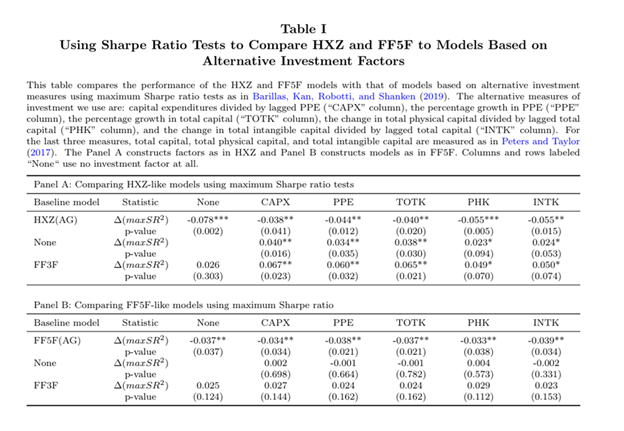
- The ability of the investment factor in both the Hou, Xue, and Zhang and Fama-French models to price the cross-section of returns decreased significantly when the investment factor was constructed using traditional investment measures (such as capital expenditures or PPE), or measures that also account for investment in intangibles.
- Factors based on growth in inventory and accounts receivable contained the bulk of the pricing information in the asset growth factor—not only did the inventory and accounts receivable factors span the returns of the asset growth factor, but also they themselves were not spanned by any other subcomponent of asset growth.
- Asset growth is not a better predictor of future investment, profitability, or book-equity growth than CAPX.
- The Hou, Xue, and Zhang and Fama-French models are no more powerful than the prior models they are purported to replace when conventional measures of investment are employed.
Their findings led Cooper, Gulen, and Ion to conclude: “The AG factor likely captures an aggregate source of comovement in returns that, given the results described above, is not captured by other measures of investment, but is captured by the INVT [growth in inventory] and AREC [accounts receivable] factors.”
They added that the superior performance of the asset growth factor seems to be attributable to its ability to capture aggregate shocks to equity financing costs.
Sharpe Ratio Tests
Conclusion
Cooper, Gulen, and Ion examined the link between the empirical specification and theoretical motivation of the investment factors and found a problem—the success of the Hou, Xue, and Zhang and Fama-French models critically depends on how they constructed the investment factor, using asset growth (the year-on-year percentage change in the book value total asset) instead of traditional measures of investment.
The bottom line is that the empirical success of the models is not linked to financial theory, which should motivate asset pricing models, as their success is related to growth in assets (inventory and accounts receivable), not investment.
Thus, as the authors noted: “Their relevance to asset pricing is potentially limited by their (lack of) theoretical justification, as is the case with many other firm characteristics associated with anomalous returns.”
Correction: Feb. 27, 2025: A previous version of this article misspelled the name of researcher Mihai Ion.
The author or authors do not own shares in any securities mentioned in this article. Find out about Morningstar’s editorial policies.
Larry Swedroe is a freelance writer. The opinions expressed here are the author’s. Morningstar values diversity of thought and publishes a broad range of viewpoints.

 United States