
Going Into Earnings, Is Microsoft Stock a Buy, a Sell, or Fairly Valued?
Investors should keep an eye on Azure and artificial intelligence in the first-quarter earnings report.

Microsoft MSFT is scheduled to release its first-quarter earnings report on April 27 after the close of trading. Here’s Morningstar’s take on what to watch for in earnings and Microsoft’s stock.
Key Morningstar Metrics for Microsoft
- Fair Value Estimate: $310
- Morningstar Rating: 3 stars
- Morningstar Economic Moat Rating: Wide
- Morningstar Uncertainty Rating: Medium
What to Watch for in Microsoft’s Quarterly Earnings
- Azure growth. It has been decelerating meaningfully for the past several quarters as customers are taking the time to make sure they are maximizing their contracts during macro uncertainty. Azure is the key growth driver for the company.
- Any discussion around OpenAI and Copilot-powered solutions. This has been a hot topic lately with clients and in headlines.
- Commentary on macro pressures and the demand environment as this sets the tone for other enterprise software vendors.
- Commentary or financial performance within consumer facing areas like Bing, advertising, Windows, gaming, and LinkedIn as these underperformed our expectations last quarter.

Fair Value Estimate for Microsoft
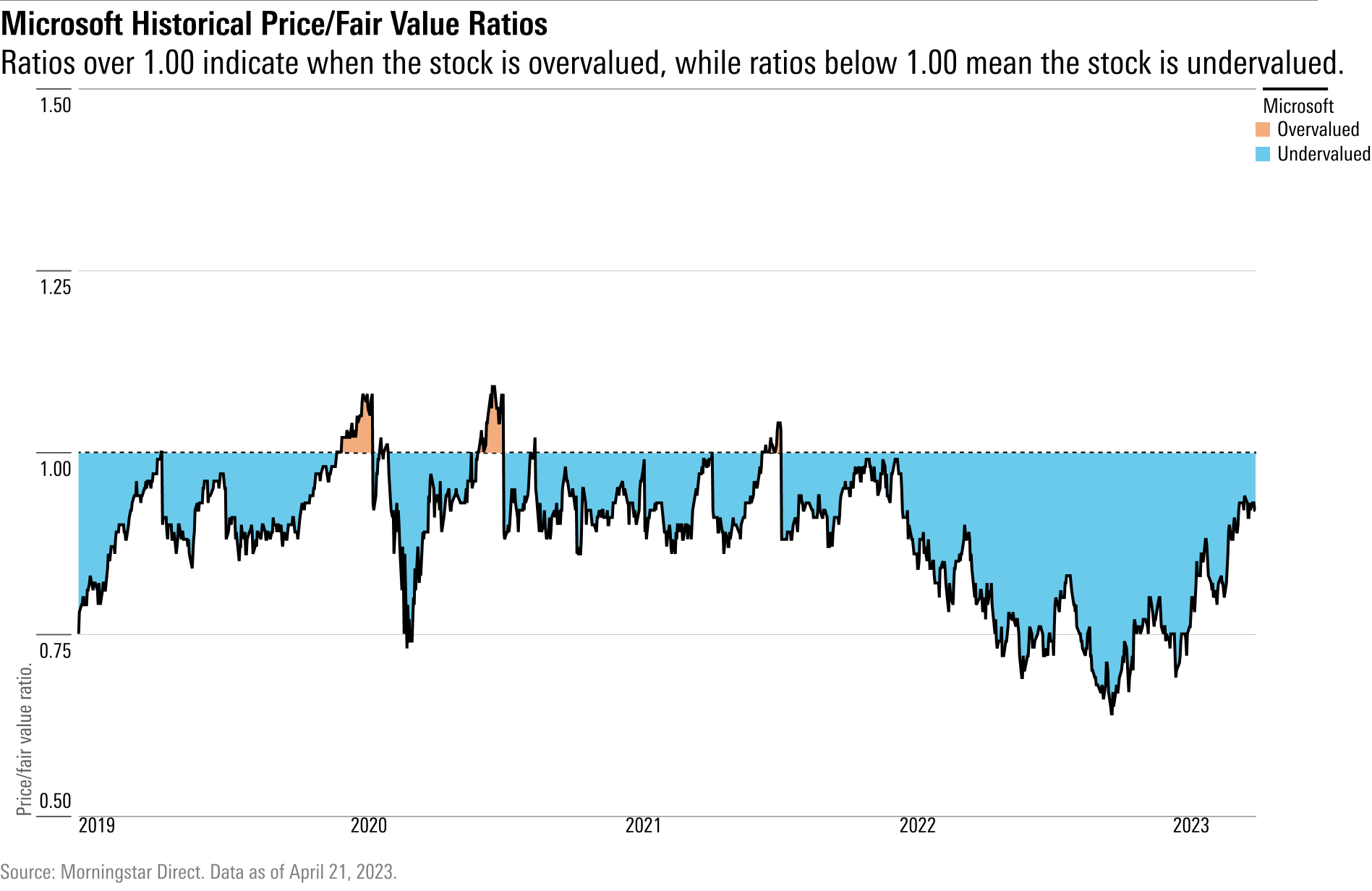
At a 3-star rating, we believe Microsoft stock is fairly valued when compared with our fair value estimate.
Our fair value estimate for Microsoft is $310 per share, which implies a fiscal 2023 enterprise value/sales multiple of 11 times, adjusted P/E multiple of 33 times, and a 3% free cash flow yield. We model a five-year compound annual growth rate, or CAGR, for revenue of approximately 9%. We foresee stronger revenue growth ahead as Microsoft’s prior decade was bogged down by the downturn in 2008, the complete evaporation of mobile handset revenue from the disposal of the Nokia handset business, as well as the onset of the model transition to subscriptions (which initially results in slower revenue growth). However, we believe macro and currency factors will pressure revenue in the near term. We also model operating margins increasing modestly from 42% in fiscal 2021 (actual) to 43% in fiscal 2026, driven by improvements in gross margin as Azure continues to scale as well as some operating leverage.
Read more about Microsoft’s fair value estimate.
Economic Moat Rating
For Microsoft overall, we assign a wide Morningstar Economic Moat Rating arising from switching costs, network effects, and cost advantages. We believe that Microsoft’s different segments and products benefit from different moat sources. Microsoft’s Productivity and Business Processes segment includes Office, Dynamics, and LinkedIn. We assign the segment a wide moat rating based on high switching costs and network effects. We believe that Microsoft Office, including both 365 and the perpetual license version, is protected by a wide moat driven by high switching costs and network effects. Microsoft Office also benefits from high switching costs. Because of the significant installed base, and the fact that critical business processes are often centered around Microsoft Excel, we believe it would be highly disruptive for a company to pivot to an office suite other than Office 365. Microsoft’s Intelligent Cloud segment includes Windows Server, SQL database management systems, Azure, enterprise services, and Visual Studio. We assign the segment a wide moat rating based on high switching costs, network effects, and cost advantages. Critically, we believe that Microsoft’s unique ability to move clients from an on-premises Microsoft environment to a cloud Microsoft environment via Azure is a structural advantage. We believe high switching costs and cost advantages drive a wide moat for Azure. Azure is clearly the growth engine for the Intelligent Cloud segment, and one of the critical products the “new” Microsoft will be built around. Microsoft’s More Personal Computing segment includes Windows, gaming, devices, and search. We assign the segment a narrow moat rating based on high switching costs and network effects.
Read more about Microsoft’s moat rating.
Risk and Uncertainty
Microsoft faces risks that vary among the products and segments. High market share in the client-server architecture over the past 30 years means significant high-margin revenue is at risk, particularly in OS, Office, and Server. Microsoft has thus far been successful in growing revenue in a constantly evolving technology landscape and is enjoying success in both moving existing workloads to the cloud for current customers and attracting new clients directly to Azure. Microsoft is acquisitive, and while many small acquisitions are completed that fly under the radar, the company has had several high-profile flops, including Nokia and aQuantive. The public cloud buildout remains in its early phases. Amazon Web Services has taken the market by storm, with Azure trailing, but the two are seen as clear leaders. While we do not see significant environmental, social, and governance risks, we note that Microsoft faces strong competition for software engineers on the hiring front, and it also faces risks arising from a potential data breach within its data centers.
Read more about Microsoft’s risk and uncertainty.
MSFT Bulls Say
- The public cloud is widely considered to be the future of enterprise computing, and Azure is a leading service that benefits the evolution first to hybrid environments and then ultimately to public cloud environments.
- The shift to subscriptions accelerates growth after the initial pressure, and the company has passed the margin inflection point such that margins are increasing again and have returned to levels from before Nokia and the cloud.
- Microsoft has monopolylike positions in various areas (OS, Office) that serve as cash cows to help drive Azure growth.
MSFT Bears Say
- Momentum is slowing in the ongoing shift to subscriptions, particularly in Office, which is generally considered a mature product.
- Microsoft lacks a meaningful mobile presence.
- Microsoft is not the top player in its key sources of growth, notably Azure and Dynamics.
Get access to full Morningstar stock analyst reports, along with data and tools to manage your portfolio through Morningstar Investor. Learn more and start a seven-day free trial today.
The author or authors do not own shares in any securities mentioned in this article. Find out about Morningstar’s editorial policies.

 United States