
Who Will Buy TikTok? And Why it Matters
The five stocks we’re watching and the companies we think are most likely to benefit.

Key Takeaways
- The deal for TikTok’s US business expected to be north of $50 billion.
- Microsoft and Amazon are among the many well-capitalized potential suitors.
- Top bidder Oracle would most likely be a consortium bid.
TikTok’s future in the United States remains uncertain. The firm’s unresolved status—it currently depends on US government action to remain operational—has implications across Morningstar’s social media coverage. The company’s owner, ByteDance, is facing a Sept. 17 deadline to divest the social media company’s US assets.
TikTok’s Impressive Rise
TikTok has achieved significant scale, it operates in a fiercely competitive US short-form video market where core user-facing features have largely converged among social media players. As features are largely the same, we believe that the key competitive battlegrounds for retaining or capturing user engagement—and billions in US ad sales—are algorithmic content recommendation, content personalization, and ad monetization.
One of the key battlegrounds in social media is content recommendation and personalization. TikTok’s primary differentiator is its highly effective content recommendation algorithm, often cited as its crown jewel.
The firm’s ability to deliver hyperpersonalized content based on nuanced interest signals, rather than primarily relying on a user’s social connections, has helped spearhead its user engagement. The “For You” page suggests content based on watch time, interactions, and even small cues like rewinds and pauses, making every scroll important for data collection.
This hyperpersonalized content recommendation is an area where, despite investments in content recommendation algorithms by well-capitalized players such as Meta and Alphabet, time spent on TikTok continues to rank among the top social media platforms.
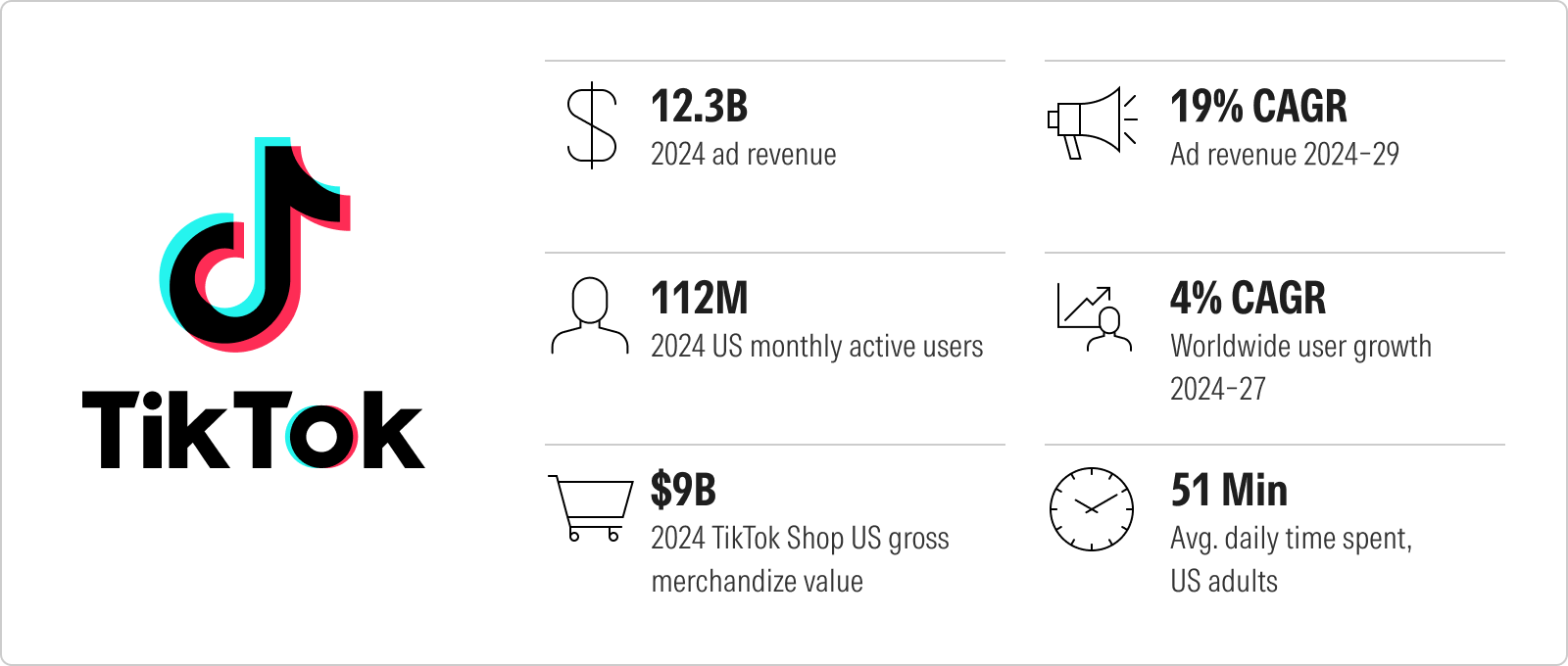
Against this backdrop, the company has amassed a formidable share of the social media advertising market. With more than 110 million monthly active users and more than $12 billion in 2024 US ad revenue, it has rapidly evolved from a small upstart into a top competitor for social media firms under our coverage.
Could There be a Forced Sale of US TikTok?
The US government’s concerns about data security and potential Chinese influence have escalated over time. These concerns and active government efforts to curb TikTok’s presence culminated in federal legislation, signed in April 2024, mandating that ByteDance divest TikTok’s US operations or face a blanket national ban. After a series of legal challenges, the courts upheld the ban, and the divestiture deadline was ultimately extended to Sept. 17, 2025, following an executive order by Trump.
Our base case is for TikTok to change ownership sometime in 2025, with a majority stake being sold to a non-Chinese entity to be in compliance with US law. We anticipate that this extended period of uncertainty will modestly benefit competitors as some ad dollars and user attention shift, with a reorganized TikTok under new (presumably US) ownership emerging thereafter. We think it is highly unlikely that a deal will be reached before the Sept. 17 deadline, and believe US President Donald Trump will offer another extension after already providing two.
TikTok’s US business has more than 110 million monthly active users and reported over $12 billion in ad sales in 2024. We expect any deal to be north of $50 billion. We arrived at this number by looking at price/sales multiples across our social media coverage and using our 2026 sales estimate of $18 billion and an above-average multiple (to account for its strong growth prospects).
Due to Chinese export controls, we don’t think TikTok’s original “secret sauce” algorithm will be included in any sale. We applied a discount to our valuation to account for this. It also means a new owner would likely need to rebuild or significantly adapt a US-based algorithm, which is a major challenge.
Nature of the Buyer Critical for Investors
TikTok has amassed a formidable share of the social media advertising market, rapidly evolving from a small upstart into a top competitor for social media firms under our coverage. The app’s hyperpersonalized algorithm, creator ecosystem, and shop (with a US GMV of more than $9 billion) have captured significant user engagement and advertiser budgets, with the firm growing its ad sales at a 100% CAGR from 2020 to 2024.
We expect the firm to gain further ad market share, with ad revenues projected to grow at a 19% CAGR over the next five years, materially ahead of the broader 10%-12% for the digital advertising industry.
A strategic acquirer with existing advertising technology or e-commerce strengths (Amazon AMZN or AppLovin APP, for example) could intensify competition, turbocharging TikTok’s US growth and potentially muting upside for incumbents like Meta Platforms META and YouTube. Conversely, a financial buyer or one lacking deep adtech expertise may lead to a more significant digital ad wallet share shift toward these established players.
Here’s a closer look at the companies that could buy Tik Tok, our take on the most-likely winners and the implications of any such deal.
Could Microsoft or Amazon Buy TikTok?
While there are many potential suitors, we see well-capitalized players including Microsoft MSFT and Amazon as strongly positioned to acquire TikTok’s US operations.
Oracle ORCL has emerged as a top bidder, mostly due to Larry Ellison’s close personal ties with Trump. However, we think any potential Oracle offer would be a consortium bid, as the company doesn’t have enough financial firepower to close an approximately $50 billion deal on its own.
Microsoft
- Strength of bid: High
Microsoft showed interest in pursuing TikTok at the start of 2025. Trump confirmed the company’s involvement, but specific deal terms were not publicly disclosed.
Microsoft’s first bid for TikTok was in 2020; it was rumored to be $20 billion-$30 billion for control of operations as well as TikTok’s core algorithm. This bid was rejected. The firm is reportedly again in talks with TikTok and will likely be a strong contender, given that it’s the best-positioned financially to absorb a deal of this scale. Additionally, Microsoft has the adtech base ready through Xbox, Bing, and LinkedIn.
Amazon
- Strength of bid: High
Amazon submitted a last-minute bid to acquire TikTok’s US operations in April. The proposed structure of the bid has not been disclosed.
Amazon has plenty of financial resources and consumer expertise from its large ecommerce platform as well as Twitch. The two businesses already have some ties, as they partnered in 2024 to enable TikTok users to purchase Amazon products directly from the app. The strong strategic compatibility would benefit both platforms, although the firm may have to overcome some regulatory hurdles.
Oracle
- Strength of Bid: Mixed
The aim of the deal, called Project Texas 2.0, is to relocate American user data servers in Texas, with Oracle overseeing security. Oracle would take a minority stake in the US operations while ByteDance retains some ownership.
The market currently ranks Oracle as the best-positioned bidder, based on reports that the company is already in advanced talks versus the other bidders, as well as its stronger political connections with the Trump administration. However, Oracle’s financial position is at a meaningful disadvantage to those of Microsoft and Amazon. It has a net debt position and much less free cash flow to work with. We believe that any potential Oracle offer will have to be a consortium bid.
AppLovin
- Strength of bid: Low
AppLovin has submitted a preliminary bid to acquire TikTok’s operations outside China, proposing a merger rather than a full-scale buyout. The structure involves ByteDance retaining a minority stake and AppLovin taking operational control to address US security concerns.
AppLovin’s CEO acknowledged the deal as a “long shot,” and we believe the merger would face regulatory hurdles. The financial backing and size of the bid are also uncertain.
Could TikTok Face a Ban?
While we believe a full TikTok ban in the US is a low-probability event, it presents the most significant potential upside for our social media coverage. If the app is banned, we see YouTube (Alphabet GOOG) and Instagram (Meta) as key beneficiaries from the standpoint of ad dollar migration, garnering 75% of its residual ad dollars.
From a valuation standpoint, we view the additional TikTok ad dollars as less meaningful, given these firms’ large advertising businesses. We see a 1% fair value estimate upside for Alphabet and a 5% upside for Meta in the case of a ban. Snap SNAP stands to gain the most significant relative valuation uplift, with approximately 20% upside to our fair value estimate in the case of a TikTok ban.
We see around 5% valuation upside for Reddit RDDT and Pinterest PINS, as their products aren’t well aligned with TikTok’s short-form video platform. We also would expect advertiser migration toward these platforms.
A State of Limbo
The third potential scenario is prolonged uncertainty, without a sale by the end of the year. This would likely result in a gradual erosion of TikTok’s US advertiser base and an increase in user churn. This would marginally benefit competitors (0%-5% fair value estimate uplift), with Snap again seeing the most relative upside.
Editor’s Note: On June 19, President Trump signed another executive order again extending the deadline for the TikTok sale, this time to Sept. 17. This article has been updated to reflect this change.
The author or authors do not own shares in any securities mentioned in this article. Find out about Morningstar’s editorial policies.

 United States