
The Biggest Investment Risks May Be Outlined by the Companies You Own
Lessons from reading 70 million words of regulatory filings.


The biggest risks for your portfolio are the ones that companies and investors deem to be material—meaning they can affect a company’s financials or stock price.
These risks can make you change your mind about buying a company’s stock. They can include litigation, trade risk, credit risk, climate risk, among others. Yet finding them in an alarmingly vast information ecosystem is tough.
Finding Low-Risk Investments
How to recognize the most pertinent ones? Well, companies often disclose them. You can find them in offering documents, regular reporting, and other statements required by regulators—in the US, these might be documents with names like the 10-k annual report or the 8-K “current report” that companies must file with the SEC to announce major events that shareholders should know about.
In fact, computing power allows you to compare companies by the risks they disclose. One effort is led by John Streur of Boston Common Asset Management, whose team of analysts trawled through seven years of boilerplate and other risk data from the 1,400 largest US companies. “There are 70 million words within that set of regulatory information,” Streur says.
Investment Risk Rises
The group identified 200,000 specific risks disclosed by companies. Over the past five years, they found, the world also grew riskier: Risks grew by a cumulative 30%. They then categorized that information into risk categories, which the analysts ranked for severity on a scale of 1 to 5, with 5 representing the most severe. These update at least monthly. The data is standardized, regulated, and, equally importantly, “has been through company legal review, with the quality control around that,” says Streur.
Make no mistake, these have repercussions for returns. While 80% of material risks are already reflected in stock prices, the remainder aren’t, Streur says. Based on data from hundreds of thousands of test portfolios, the team was able to identify which pieces of information explained something about a stock price.
These filings are a stream of public data that is, “by definition, material for disclosing risk,” according to Boston Common.
Finding Environmental, Social and Governance Risk
About 20% of these risks are considered traditional environmental, social, and governance risks, such as those related to climate, carbon, or water, says Streur. And it includes risks not traditionally regarded as ESG risks, including hazards related to artificial intelligence or cybersecurity. Thus, even though some critics censure ESG approaches as misplaced examples of progressive politics or “woke capitalism,” ESG risks are also in a class that companies themselves identify as material.
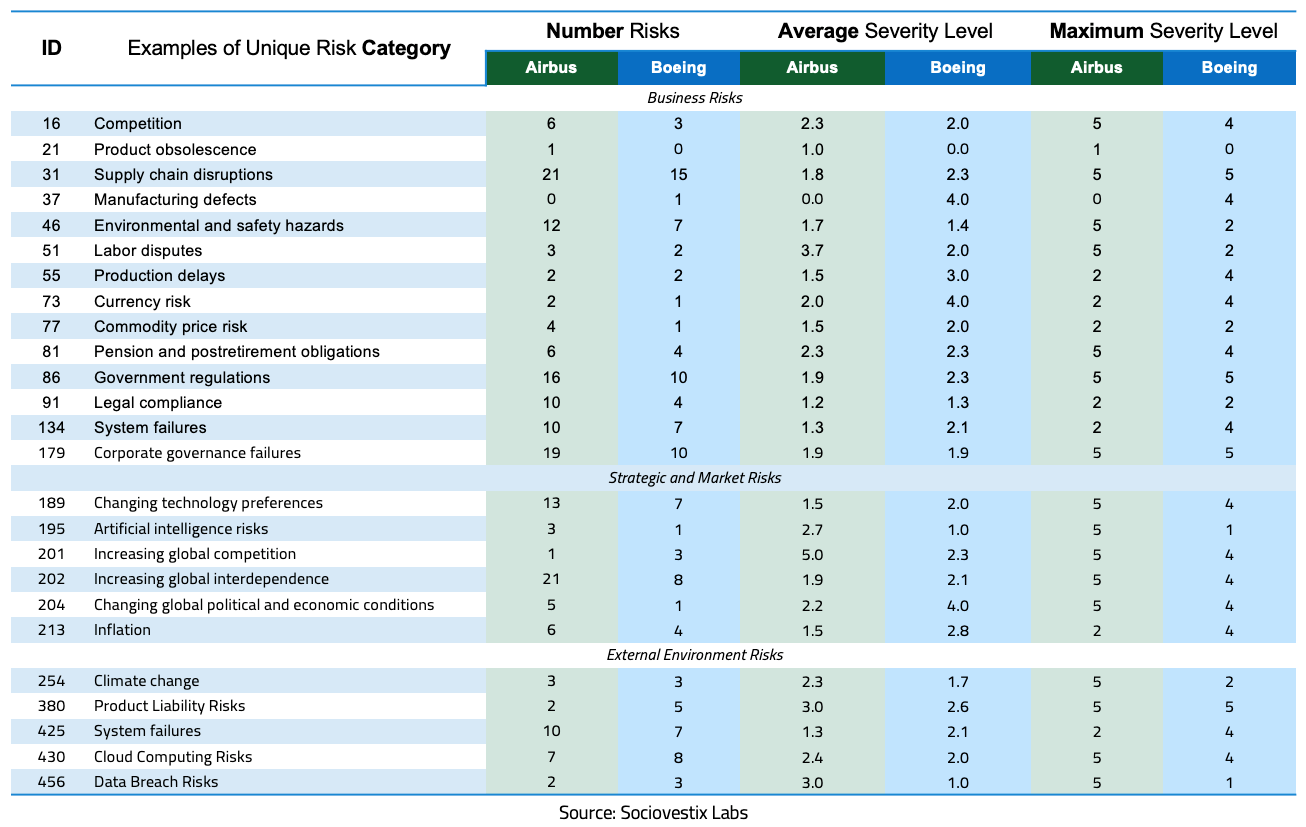
Here’s how it works. This table, from Boston Common, compares risks over time at Airbus EADSF and Boeing BA. The columns in the middle and to the right show severity levels, with 5 being the highest.
Comparing Boeing and Airbus on Risk
Until last year, Streur led Calvert Research & Management, a prominent sustainable-investment firm owned by Morgan Stanley MS. You can read more about Streur here and here. At Boston Common, his title is Chief Investment Officer, All Material Risk Investment Strategies.
Boston Common is led by Geeta Aiyer, a sustainable-investing pioneer. (You can read about Aiyer here.) The data is available to Boston Common analysts and portfolio managers to add to their bottom-up research. The first impact, Streur says, “will be to indicate areas the team may want to conduct additional research.” Ultimately, it may affect how managers weight various stocks. Mutual funds that will use the data include Boston Common ESG Impact US Equity BCAMX, Boston Common ESG Impact Emerging Markets BCEMX, and Boston Common ESG Impact International BCAIX. “This allows us to hold any risk in relation to all other risk and understand how the market has been dealing with that,” says Streur. It has obvious implications for how investment managers spend their time, he says.
The team is also trawling through data for a similar number of publicly traded large companies outside the US and has done the same for 200 or so emerging-markets companies.
To be sure, many companies may fail to disclose material risks, including ESG risk. ESG risk disclosure is still voluntary. Companies report it partly because investors, through regular meetings with companies, have asked for them to disclose ESG risks according to guidance from the Sustainability Accounting Standards Board as part of a larger reporting framework. But it’s not mandatory.
“Investors could still be missing out on risks that companies don’t identify as material, as could be the case with ESG-related information given the political climate,” says Hortense Bioy, head of sustainable-investing research for Morningstar.
Nevertheless, that creates opportunities for good analysts. And misrepresenting risks can create legal liabilities for a company and its executives.
Ultimately, the aim is to beat the market. “The whole point is to see if there’s an opportunity to reduce the exposure to unattractive ESG and other risks and have a set of products that could outperform the benchmarks with similar or lower risk,” says Streur.
The author or authors do not own shares in any securities mentioned in this article. Find out about Morningstar’s editorial policies.

 United States