
What’s Ahead for Clean Energy Stocks After the Election?
How prices could be affected by AI, interest rates and federal policy.

The near-term prospects for renewable energy were uncertain this year, amid high interest rates and the forthcoming US presidential election. Former President Trump has said he wants to repeal the Inflation Reduction Act of 2022 and its wide-ranging measures to boost clean energy.
But interest rates are now on the way down, helping those wanting to adopt solar and other clean energy technologies. Renewable energy, primarily wind and solar, accounted for 20% of generation in the second quarter of 2024, up from 8% in 2018. And the energy transition will continue regardless of whether Vice President Harris or Trump wins, says Brett Castelli, who follows the sector for Morningstar. Castelli talked about what parts of the IRA are at risk in a Trump victory. Keep reading for more.
Leslie Norton: What are the key differences for renewable energy between a potential Trump scenario and a Harris scenario?
Brett Castelli: For long-term investors, it’s important to not get too caught up in the outcome of one election or another as it relates to the energy transition and the adoption of clean energy. History has shown that that transition will continue regardless of who wins this election. Now the pace may change depending on who wins.
Norton: Fair enough. For now, the focus is on the Inflation Reduction Act.
Castelli: The IRA is the largest clean energy law ever passed in the US and includes a bevy of incentives across the clean energy space. Under a Harris win, the short answer is we’ll keep the status quo, nothing changes, they continue to implement the act.
Under a Trump win, he has said publicly he would want to repeal the IRA. In reality, we think that’s highly unlikely in its entirety. He could do a partial repeal, putting bits and pieces on the chopping block. You’d expect the pace of investment to slow under Trump, but it’s not a draconian slowing on the margin.
Norton: What stays safe, and what doesn’t?
Castelli: Most safe would be the portion of the IRA that sought to reshore manufacturing of clean energy technologies, EV batteries, solar panels, wind turbines, back to the US from largely Southeast Asia. It plays to his economic policy as well his anti-China policy. He’s not going to do anything that’s going to harm US manufacturing and ship jobs to China, right? So that’s why we think those domestic manufacturing credits are safe.
More at risk is the demand side. The IRA included a long-term extension of the solar, wind, and battery storage tax credits. Could Trump look to either reduce the amount or maybe have those expire sooner than currently proposed? That’s potential. Could things like a government loan program to fund earlier-stage technologies be at risk? Yes.
A company like a First Solar FSLR is largely reliant on those domestic manufacturing incentives, because it’s the made-in-the-USA solar company. The reshoring of manufacturing, tariffs on imports, are a positive. It’s probably the most immune solar stock to either outcome, potentially even benefiting from a Trump win. First Solar is very policy-sensitive and in general, the policies of both parties right now in terms of reshoring and stimulating domestic manufacturing have been very beneficial for First Solar’s moat relative to five years ago.
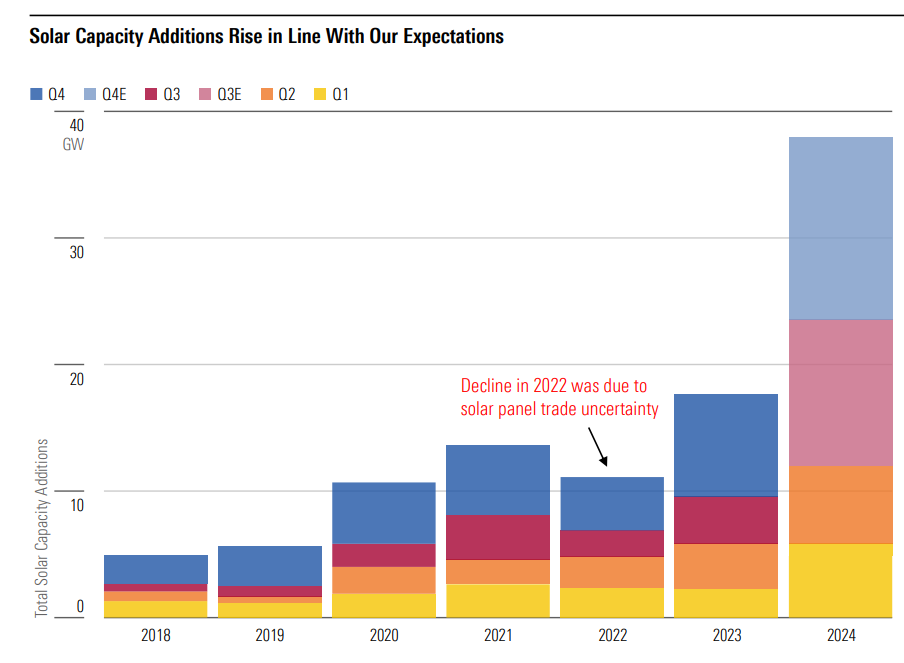
Solar Capacity Additions Rise in Line With Our Expectations
Norton: Last time around, Trump withdrew the US from the Paris Agreement. Do you expect him to do it again, and what would that mean?
Castelli: Withdrawing from Paris is a headline. For these companies, what people care about is hard commitments under The Inflation Reduction Act. The Paris Agreement, the 2050 long-term targets, are somebody else’s problem, and are more in the background.
Norton: Let’s talk more about tariffs and trade policy.
Castelli: They’ll be watched closely. In general, the vast majority of the clean energy value chain—whether you’re talking solar panels, batteries for things like EVs, to a lesser extent wind turbines, or solar batteries, which are critical to the energy transition—are manufactured in China and broader Southeast Asia. These tariffs can create short-term disruption and potentially delay investment in solar projects, battery storage projects, or EV battery manufacturing because of the uncertainty. Should I build a factory in the US? Or can I rely on imports? The end customer building the solar project has a lot of uncertainty, so does nothing. In 2022, the solar buildout paused because of uncertainty around importation of solar panels. As a result of the IRA, we’re in the midst of building out a lot of domestic manufacturing so that we’re not as reliant on imports, but we’re not fully there.
Norton: You expect the status quo from Harris. What challenges do you foresee?
Castelli: There’s no lack of incentives out there for renewables. The challenge is that when you build a large solar project, wind farm, battery storage facility, that’s physical infrastructure. So you’re running into bottlenecks in terms of permitting, with a lot of NIMBYism and getting projects connected to the grid. We’re past the stage of asking whether projects make sense economically, but running into bottlenecks in terms of just getting them built. So people need to watch for permitting reform, stuff to make construction more readily available, and how to accelerate things further.
There isn’t a silver bullet. The easy thing is just to throw money at it and say, hey, if you put up a solar farm, you get 30% tax credit, which the IRA does. The harder thing is that permitting reform involves state and local levels, and it’s not clear that the federal level can necessarily control that issue.
Norton: Absent the election, what are the prospects for clean energy?
Castelli: Interest rates have been a headwind for a couple of years and are now easing. So there are signs of optimism. Solar, utility-scale solar, and battery storage are doing well right now. What’s doing less well? Onshore wind, offshore wind, and rooftop solar. But for those areas, the supply chain is showing signs of easing for the first time in a couple of years since coming out of covid. Now you’re getting to a more normal level of demand and you’re seeing capacity expansions for some areas. Some has to do with electrical equipment that’s also needed for a wind and solar farm. Maybe you can get the panels, but can you get a transformer that connects that project to the grid? Transformers, for instance, have been extraordinarily tight. We’re in a severe shortage there. So, it varies by end market.
The number-one topic in this space is the rising power demands from data centers and AI that consume a lot of electricity. Exposure here varies.
Norton: Generally, how do prices look after the bear market in this space?
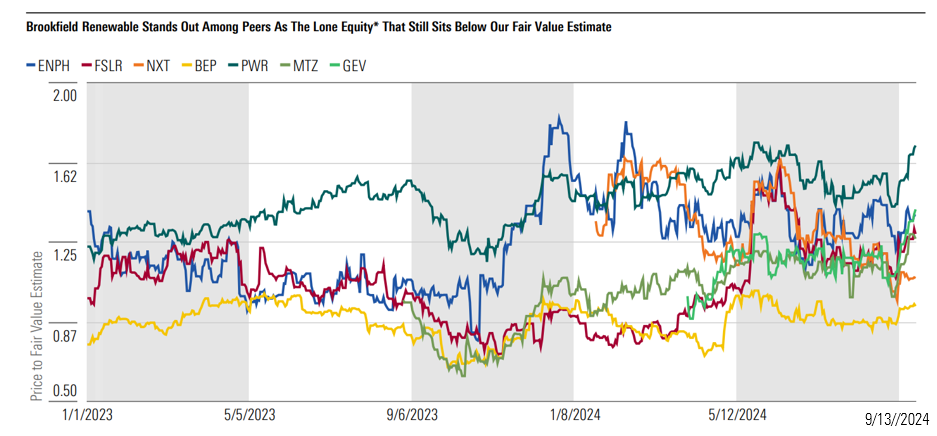
Castelli: On average, they’re still above fair value. Some stocks, like GE Vernova GEV, have done phenomenally well. It’s not because of their wind turbine business on the renewable side. It’s because data centers and the expectation for the electricity use required are giving a second life to older technologies that people once thought dead, such as natural gas and nuclear. Twelve months ago, people said they weren’t building new nuclear or natural gas projects. Now, nuclear plants are coming back from retirement for the first time ever. And 2024 is slated to be the strongest year in the past decade-plus for new natural gas turbine orders. If you have exposure to data centers, your stock has done well. The market is very optimistic—in some cases too optimistic. If you’re not as directly benefiting from data centers, much of the space has lagged.
Brookfield Renewable Stands Out Among Peers As The Lone Equity* That Still Sits Below Our Fair Value Estimate
Norton: Let’s talk about what you like. First Solar was a favorite of yours earlier this year.
Castelli: First Solar is the most immune from the election and potentially even benefits under a Trump victory, more so than a Harris win. It’s the only solar stock you can say that about. I just think the market is overly optimistic on the pricing that First Solar might get for solar panels over the immediate term. It’s still going to produce a ton of cash. The stock price has run up.
I like Brookfield BEP. It’s a stable cash flow business, not a high-risk stock. You get a 5% dividend yield. They’re going to grow the dividend 5%. It’s a nice income play. They own wind, solar, and hydroelectric projects globally. And so, they should benefit from the rising electricity demand from AI and data centers. This year, they signed a large agreement with Microsoft MSFT to build out renewable energy projects globally. So Brookfield, because of their large capability set across technologies and across geography, is uniquely positioned to partner with some of these electricity-hungry tech companies.
Norton: Generac GNRC has an economic moat. Is it attractive?
Castelli: It’s obviously topical here with Hurricane Helene and the significant power outages because they’re the home generator company. Generac’s business is dependent on power outage activity. It’s at the lower end of my list in terms of election sensitivity because it’s transitioning. They have a legacy generator business and are investing in clean energy. It’s currently about 10% above fair value, so we’d like it if the stock fell.
Norton: What would you avoid?
Castelli: Areas that ran up on excessive optimism about data centers. For example, Quanta Services PWR. We like the growth potential. We simply think it’s overvalued.
Norton: Thanks, Brett.
The author or authors do not own shares in any securities mentioned in this article. Find out about Morningstar’s editorial policies.

 United States