
Should You Invest in Semiliquid Funds? It Depends on Your ‘Why’
Here’s what investors should consider before adding private market strategies to their portfolios.


Semiliquid funds sit at the intersection of public and private markets. They offer access to illiquid assets that are hard to buy and sell (think private credit or private equity), which requires the fund to also provide less-than-daily liquidity to its investors. To properly manage illiquid assets, these funds offer infrequent and limited opportunities to sell—most commonly, quarterly repurchases of up to 5% of the fund’s value.
As access to illiquid assets improves, a key question emerges: Should investors incorporate semiliquid funds into their portfolios?
The role that semiliquid funds play should be grounded in clear objectives rather than headline appeal. For most investors, they are best used to complement—not replace—traditional asset class exposures, with careful consideration of liquidity, risk, and the true sources of return.
The Rise of Semiliquid Funds
Semiliquid funds are geared toward retail investors who don’t have access to private funds. As distributions from traditional private markets have slowed, asset managers have increasingly turned to retail investors as a new growth engine. Combined with ongoing fee pressure from passive strategies, these dynamics have accelerated the industry’s shift toward private markets and drawn investors’ attention toward private assets, which are now rapidly entering the mainstream. This backdrop is fueling a growing fear among investors of missing out on value creation as private credit grows to a $2 trillion market and companies like OpenAI and SpaceX stay private for longer.
This has given rise to semiliquid funds. These structures offer periodic liquidity without a fixed end date, effectively bridging the gap between daily liquid vehicles such as mutual funds and exchange-traded funds, and traditional drawdown private market funds with long, up-to-10-year lockup periods and capital calls.
Should Investors Incorporate Semiliquid Funds Into Their Portfolios?
The answer begins with understanding the investor’s objective. A Morningstar survey highlights a divergence in motivations: Individual investors are typically drawn to private assets for higher returns and potential tax advantages, while advisors emphasize their diversification and risk management benefits.
The potential for higher returns is the primary appeal. Semiliquid funds can provide access to private equity and venture-style investments, offering exposure to companies and growth opportunities not available in public markets. Similarly, income-oriented investors may benefit from strategies such as private credit, infrastructure debt, or real estate income funds, which can deliver attractive yields compared with public options.
Other objectives also matter. Real assets—such as infrastructure and real estate—can offer inflation protection through Consumer Price Index-linked revenue or contractual rent escalations, alongside relatively stable cash flows.
2 Cautionary Tales From Private Equity and Private Credit Markets
The Role of Semiliquid Funds in a Portfolio: A Functional Approach
Incorporating semiliquid funds in a portfolio requires careful alignment between an investor’s liquidity needs, risk tolerance, and overall objectives. Rather than grouping investments strictly by asset class, it is often more useful to categorize them by function—what role they play within the portfolio.
This distinction is critical because many private market strategies exhibit similar underlying risk exposures to traditional assets. For example, private equity tends to expand the equity opportunity set by accessing companies not listed on public exchanges, but it does not necessarily introduce new, uncorrelated risk factors. As shown in the chart below, private equity returns often show meaningful correlation with public equities, particularly during periods of market stress. The absence of daily pricing can obscure this relationship, potentially overstating the diversification benefits of private assets.
Private Capital Indexes Rolling Five-Year Correlation With S&P 500 Quarterly Returns
As a result, private equity and venture capital are best viewed as part of a portfolio’s equity allocation. Similarly, private debt strategies largely replicate credit risk exposures found in traditional fixed-income markets and should be considered alongside broader bond allocations. The Morningstar Alternative Investing Wheel typically characterizes these assets as risk modifiers, rather than true diversifiers.
Morningstar Alternative Investing Wheel
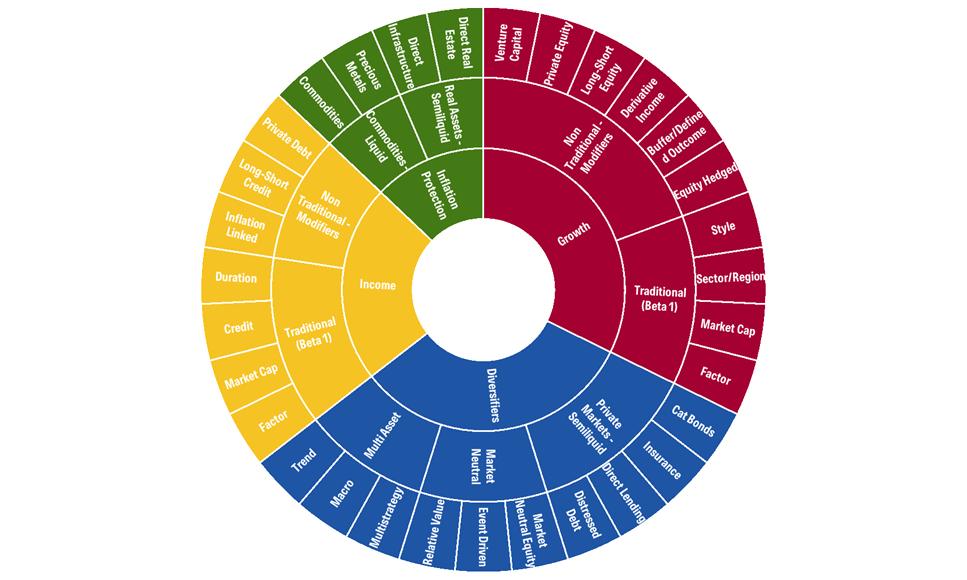
One area that does offer more defensive characteristics is real assets—particularly core infrastructure and prime real estate. These sectors benefit from structural features such as scarcity, essentiality, long-term cash flow visibility, and inflation-linked revenue, making them well suited for a protective role within portfolios. However, as recent real estate performance has shown, they are not immune to broader macroeconomic and public market influences.
In subsequent articles, we’ll explore what investors should prioritize when choosing semiliquid strategies—including the importance of patience, demanding an illiquidity premium, and manager selection—as well as how to construct portfolios that effectively integrate both public and private market exposures.
The author or authors do not own shares in any securities mentioned in this article. Find out about Morningstar’s editorial policies.

 United States