
What the Academy's Best Picture Voting Tells About Investing
Opportunities exist to be exploited, but they don't remain constant.

Not-So-Total Recall Initially, the Academy of Motion Picture Arts and Sciences honored films that had been released over portions of the previous two years. That decision weakened the awards' rhetorical power. For example, the Best Picture winner of the dinner held in March 1934, which was hosted by Will Rogers, could neither be called the best film of 1932 nor of 1933. It was instead...the recipient of the 6th Academy Award. Much better to boast "named the year's best film" than "we won a trophy that was given away at a dinner."
Thus, for its 1935 dinner, the Academy switched to using calendar years. All nominated films had been released during 1934.
This permits a nifty test on recency bias. Behavioral researchers have documented how people tend to employ near-term memories while responding to questions. Ask them to list potentially dangerous accidents, and they'll mention automobiles if they dented a fender last month, or showers if they slipped in the stall last week. Did that same principle apply to the Academy's early voters? Were they likelier to support films that were closer to mind, being released later in the calendar year?
Easy enough to check. Below are the release dates for the Best Picture nominees, sorted by release-date quarter, for the first five years in which the Academy used its new approach. (Five years might not seem like much, but in the 1930s the Academy nominated a boatload of Best Pictures.) Presumably, with the Academy Awards being a relatively new event, the change to evaluating films over a calendar year having just occurred, and no behavioral scientists lecturing about recency bias, the studios released their films naively, without regard to how the timing might affect their Academy Award prospects.
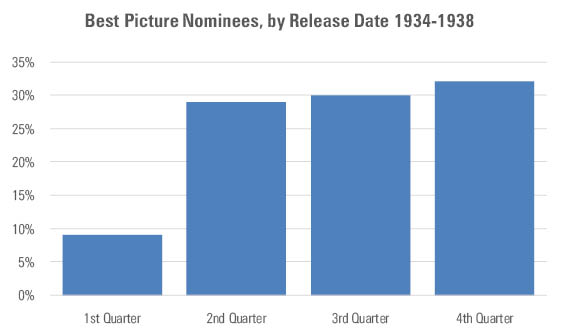
Woe betide those films that debuted in a year's first quarter! Only 9% of them, as opposed to the 25% that would be suggested by chance, earned the nod. That equates to five selections out of 56 nominees. (See what I mean about a boatload?) The remaining 51 films were spread almost evenly among the other three quarters. We can't know for certain that movies released in January, February, and March were of roughly similar overall quality to those that debuted later in the year, but that seems like a reasonable proposition. If so, then this particular test of recency bias suggests that voter memories linger for nine months, then faded quickly.
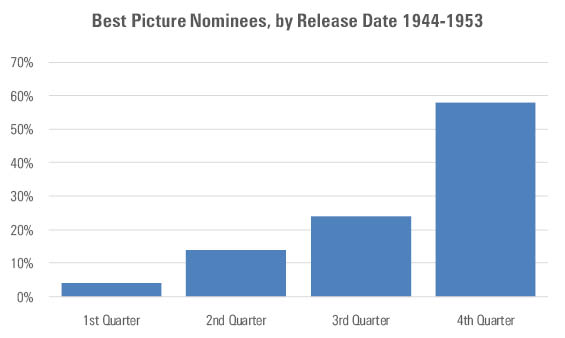
Respond and React A decade later, the picture was much different. From 1944 through 1953, release-date timing was overwhelmingly important. Only 4% of first-quarter films received recognition; the percentage more than tripled during the second quarter, to 14%; it jumped again in the third quarter, to 24%; and it was a dominant 54% in the fourth quarter. Indeed, more nominees debuted after the calendar year ended (qualifying for the Academy nomination because of a limited release in December) than were released during the years' first five months.
The voters didn't get stupider--the studios got smarter. Studio chiefs realized that Academy Award nominations increased profits; that Academy members tended to like certain types of movies; and that if a studio had made such a film and launched it early in the year, there was a danger that the voters would overlook it for more recent fare. Better to push back the release date. Aim for the summer, not early spring. Summer launches could wait until October. And never mind autumn, make it December.
The studios' actions, in turn, influenced the voters' decisions. Because the films that Academy members favored got bumped to later dates, Academy voters paid less attention to movies that arrived earlier in the year. Those pictures were unlikely to be the sort of serious fare that the voters appreciated. The studios trained Academy members to change their viewing behavior; the voters trained the studios to change their launch dates.
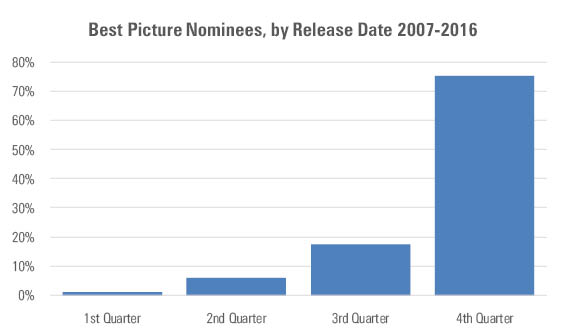
Which has led to today's extremity, when for award purposes October counts as the New Year and Dec. 1 as the summer solstice. More than half of 2016's Best Picture nominees--Fences, Hidden Figures, La La Land, Lion, and Manchester by the Sea--were released in the second half of December. Moonlight, Arrival, and Hacksaw Ridge arrived in November. That leaves only Come Hell or High Water for the first 10 months of the year. And even that picture opened in August.
The figures for the Best Picture nominees in the past 10 years look like this.
Implications for Stock Investors Broadly speaking, the Academy's experience is akin to the U.S. stock market's evolution.
In the 1930s, the U.S. stock market resembled the Academy's initial voting pattern: Largely efficient, but with certain flaws caused by behavioral biases. For the Academy Best Picture voting, the anomaly occurred with films released during the year's first quarter. The stock market's Depression-era quirks can't be so easily summarized, but one major example would be underpricing the market's cheapest, most-disliked stocks. In the 1930s, Ben Graham famously found many "net-net" companies, which could be purchased in the open market for less than the value of their assets (minus debt) even while operating profitable businesses.
Over time, participants in both arenas became aware of the inefficiencies and adjusted their behavior accordingly. Realizing that Academy members were unlikely to appreciate February films, the studios altered their release schedules. In the stock market, as the stories of highly successful investors were told, other buyers changed their habits accordingly. If net-net stocks meant easy money, then they would buy net-net stocks. The result was dramatically fewer net-net opportunities. (Good luck finding them today.)
As knowledge of the release-date factor for Academy nominations has grown, so has the interactivity between the subject of Academy members and the object of studio releases. Hollywood producers tinker with their release dates more than ever, while Academy voters have become even less likely to recall--or even view--films that debut early in a year. The original findings of the recency bias study, the data from the 1930s, no longer hold, because those who learned about the pattern's existence ended up transforming it. They were no longer the same actors as before.
The same holds true for the stock market's anomalies. The parallel isn't perfect, as companies can't alter their stocks' characteristics as readily as studio executives can shift release dates, but nonetheless companies do exert some control over how their stocks appear to the investment community. In addition, the interaction of each investor's decision causes a ripple effect on securities prices that is more complex than what occurs with Academy Best Picture voting. So, while the comparison isn't point for point, the conclusion applies equally to the Academy Awards and to the stock market: Knowledge of what has occurred affects the path of what will occur.
The lesson: A strong knowledge of history is a necessary but insufficient condition. The successful studio chief, and the successful investor, is the person who understands how others are interpreting that history, and how that will lead them to change what they had been doing.
John Rekenthaler has been researching the fund industry since 1988. He is now a columnist for Morningstar.com and a member of Morningstar's investment research department. John is quick to point out that while Morningstar typically agrees with the views of the Rekenthaler Report, his views are his own.
The opinions expressed here are the author’s. Morningstar values diversity of thought and publishes a broad range of viewpoints.

 United States