
The Stocks That Could Benefit From Falling Interest Rates
Research shows small-value stocks have outperformed the market.


Citing that although economic activity continued to expand at a solid pace, job gains have slowed, the unemployment rate has moved up, and further progress has been made toward its 2% inflation objective, the Federal Reserve lowered the target range for the federal-funds rate by one half of a percentage point to 4.75% to 5%. The market expects future rate cuts.
Given the forecast, a logical question for investors is: How have stocks performed during periods of falling interest rates? To answer that question, the research team at Avantis examined the performance of small-value stocks relative to that of the total US market from January 1976 through August 2024. Over this period, the CRSP 1-10 Index (representing the total US market) returned 11.99% annually versus a return of 16% for the Fama-French US Small-Value Research Index, an outperformance of 4.01%. As to performance during periods of both rising and falling interest rates, Avantis found:
- The number of six-month periods when rates rose was 303, and when rates fell, it was 248.
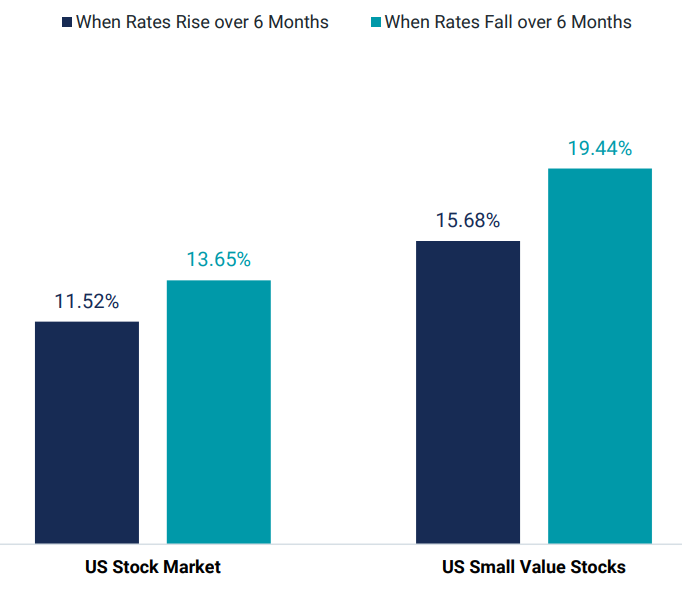
- Both the total market and small-value stocks performed better during periods of falling interest rates than during periods of rising rates.
- Small-value stocks, on average, outperformed during six-month periods of either rising or falling rates.
- When interest rates rose over six-month periods, US stocks returned 11.52% annually compared with the return of 15.68% for small-value stocks, an outperformance of 4.16%.
- When interest rates fell over six-month periods, US stocks returned 13.65% compared with the return of 19.44% for small-value stocks, an outperformance of 5.79%.
Lower-Priced Stocks Have Historically Fared Well in Falling-Rate Environments (Annualized Average Returns)
Investor Takeaways
One of my favorite expressions is what you don’t know about investing is the investment history you don’t know. While past performance is no guarantee of future results, the historical evidence suggests that if in fact rates do continue to fall (and that is not guaranteed) as the market expects, small-value stocks are likely (but not certain) to outperform.
Because there are no clear crystal balls, investing is always about putting the odds in your favor.
The takeaway then is that investors should not allow the twin-headed demon of biases (relativity bias and recency bias) to cause them to stray from a belief that small-value stocks are likely, but not certain, to outperform.
The author or authors do not own shares in any securities mentioned in this article. Find out about Morningstar’s editorial policies.
Larry Swedroe is a freelance writer. The opinions expressed here are the author’s. Morningstar values diversity of thought and publishes a broad range of viewpoints.

 United States