
How Value Stocks Can Strengthen Your Portfolio
Amid high US equity valuations, value stocks offer diversification and potential resilience if market leadership evolves.


Three is the smallest number needed to establish a pattern. A notable pattern seems to be emerging in the increasing number of influential voices expressing concerns about the outlook for US stocks.
In recent weeks, this includes:
- A recent quarterly report revealed that Warren Buffett’s cash pile has grown to over $305 billion, more than doubling Berkshire Hathaway’s BRK.B cash holdings from just a year ago.
- Hedge fund manager David Einhorn mentioned that this was the most expensive stock market that we have seen since founding his firm in 1996.
- Vanguard’s capital market assumptions project 10-year annualized returns of just 0%-2% for US growth stocks.
What’s driving the somber mood? Elevated valuations, as prices for many US stocks remain historically high.
One key indicator, the cyclically adjusted price/earnings ratio, shows US equity valuations at their highest level since the late 1990s, currently sitting at 38.1—placing it in the 98th percentile of historical readings.
The CAPE Ratio (January 1945 - November 2024)
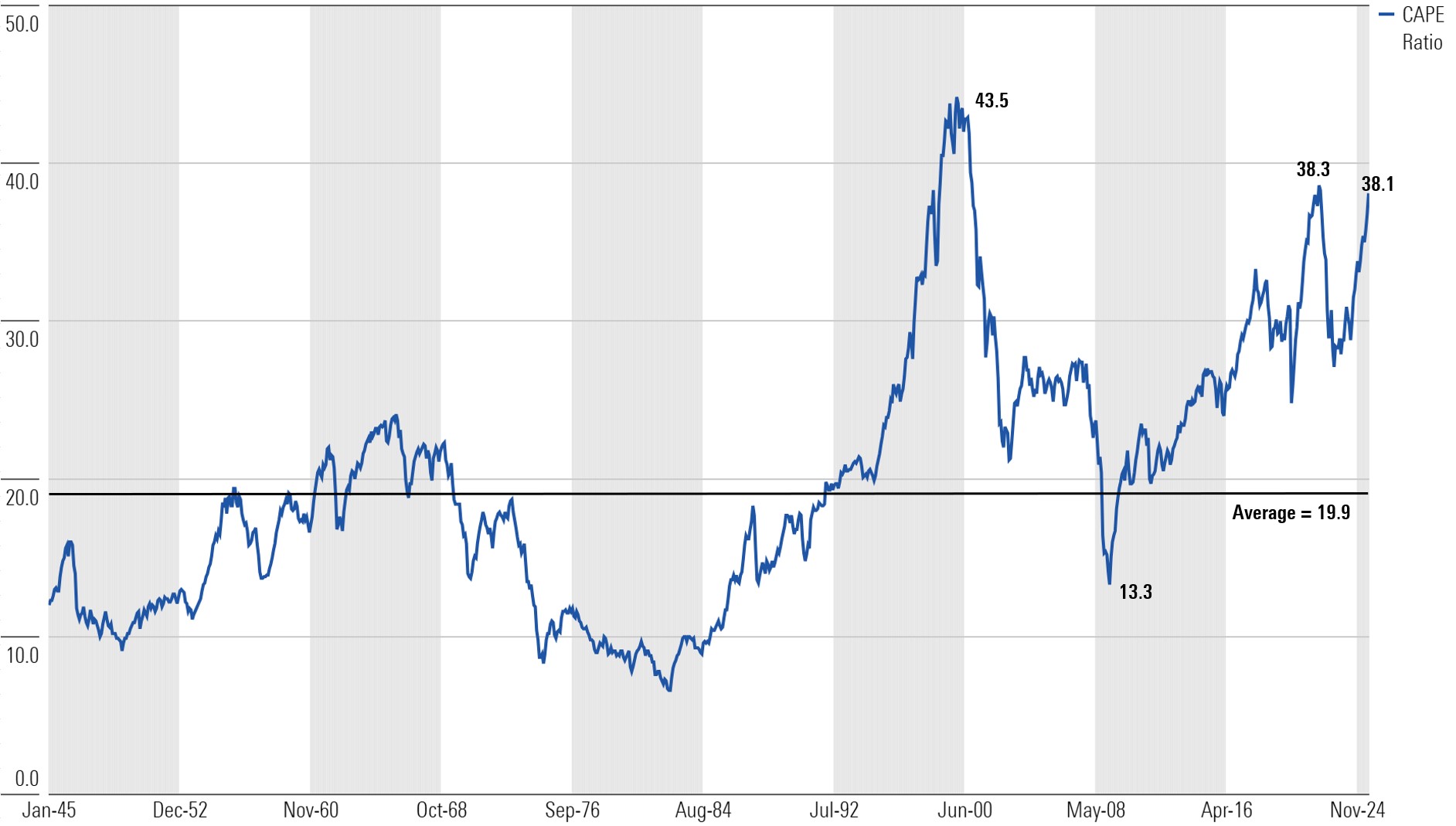
How should investors interpret this? The simplest statement is that long-term investment opportunities in the US are becoming increasingly scarce. While last week we highlighted the appeal of opportunities outside the US, it’s important to remember that “harder to find” doesn’t mean “impossible to find” within the US market.
3 Top Value Stocks to Buy and Hold for 2025
A Tale of 2 Markets
US large-cap valuations tell a story of two distinct markets:
- The high-valuation (expensive) segment, which is responsible for most of the recent performance and media attention.
- The low-valuation (cheaper) segment, which has been largely overlooked.
To illustrate, consider underlying data from Morningstar indexes: The top 10 holdings in the large-cap growth index trade at an average price/earnings ratio of 41.9, while the top 10 holdings in the large-cap value index trade at a much lower 18.4.
Morningstar Index Comparison (Growth vs. Value)
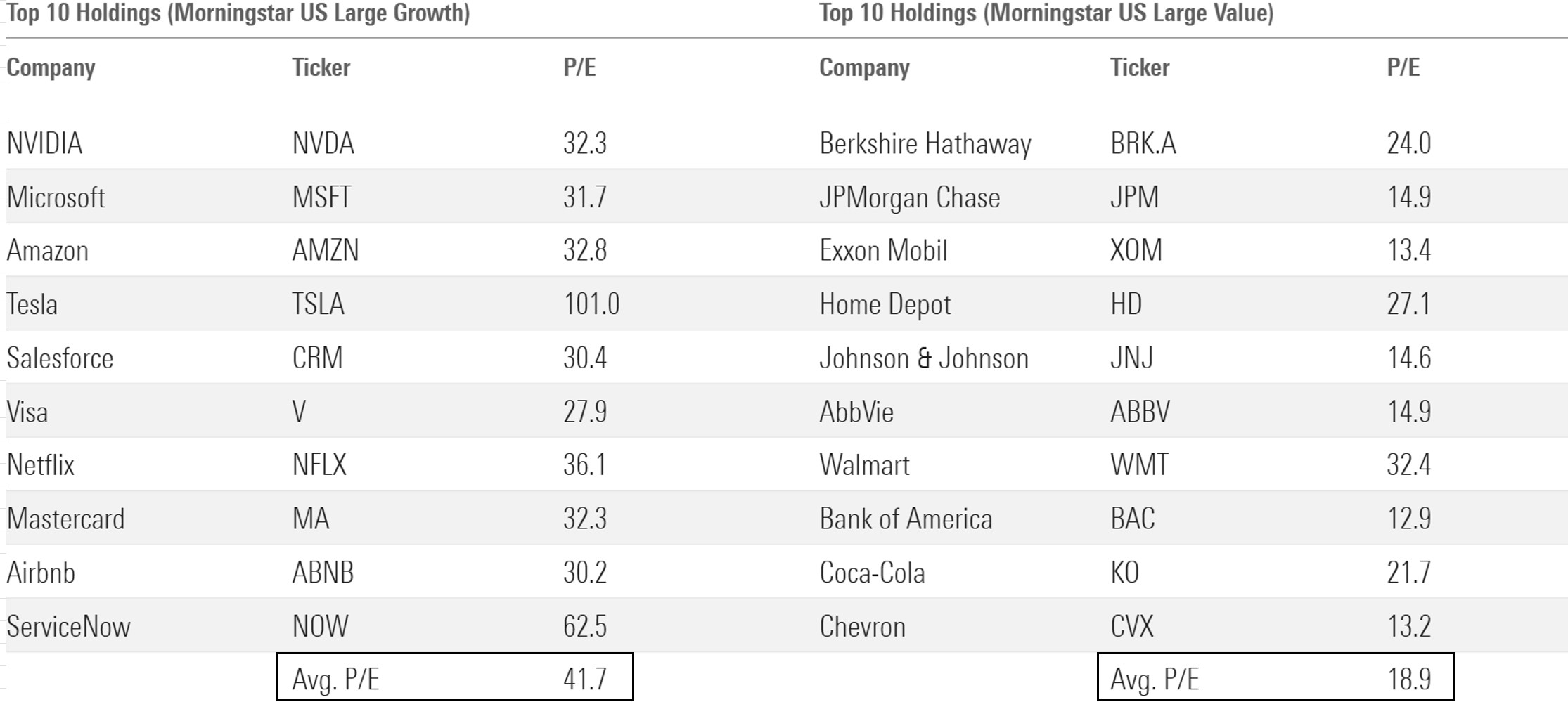
It’s common for many investors to focus solely on index-level valuations, relying on headline numbers. A closer examination, however, reveals that the value segment offers significantly lower valuations—and expectations.
Highlighting valuations in the growth segment, meanwhile, is not intended to spark fear. Valuations are not a market-timing tool. While many growth companies appear expensive, this says nothing about how they will perform over the next three to six months. In fact, Morningstar’s equity research highlights two growth companies on the above list as undervalued, with several others trading near their fair value estimates.
The key takeaway shouldn’t be “all these growth companies are overvalued.” Instead, it’s recognizing that many growth companies will be carrying more weight on their journey forward, stemming from higher expectations.
Stan Druckenmiller recently advised to never invest in the present—invest how things will be in 18-24 months. While this is easier said than done, it invites an important question: Will the investment landscape look different two years from now? While the future is unpredictable, diversification remains the best protection against shifts in market leadership. If the dominance of US growth stocks wanes, other segments such as value stocks could take the lead.
Incorporating more “value” into portfolios could not only protect against a shift in market dynamics, but also position investors to benefit from the evolving investment landscape.
The author or authors do not own shares in any securities mentioned in this article. Find out about Morningstar’s editorial policies.

 United States