
Should You Buy An Active Bond ETF?
What to consider with an active bond ETF.


The active bond exchange-traded fund market has grown exponentially over the past few years, pulling in over $270 billion in net inflows over just the past two years. Total assets under management reached $490 billion by the end of January 2026, and active ETFs now account for one-fifth of total bond ETF assets. Asset managers have met this growing demand by launching over 270 strategies in the past two years, with those new entrants making up one-fourth of all active bond ETFs.
Against this dizzying pace of development, you might be wondering if an active bond ETF has a place in your portfolio. While the investment merits for each ETF vary, there are a few important considerations that should steer you in the right direction.
The Price of Active Management
Active bond ETFs command a premium compared with passive bond ETFs. Their 0.45% average annual fee might seem low, but it pales in comparison to the average passive bond ETF’s 0.24% average. Active managers tend to charge more in riskier categories, too. Median fees for active emerging-market or multisector bond ETFs are nearly double those for corporate or ultrashort bond ETFs. While these complex corners of the market carry higher potential upside, they can also expose investors to more volatility and deeper drawdowns. A higher price does not always translate to more managerial skill.
Median Annual Fee for Active Versus Passive Bond ETFs
The good news is that the fee gap between active and passive ETFs is uneven across categories, as shown in Exhibit 1. Managing a bond fund is a costly affair in riskier and nuanced categories like emerging-market or high-yield bonds. The chart shows that investors do not suffer a huge step-up here should they choose to go active. On the other hand, cost compression among passive ETFs in safer and simpler categories like intermediate core and intermediate core-plus bond makes it difficult for active managers to compete on fees. Active ETFs in these categories must offer even more of an advantage for the investment to be worthwhile.
More Risk, More Reward?
Active bond managers have a better chance of beating their passive peers than active equity managers, according to Morningstar’s Active/Passive Barometer. While their success rate only hovers around 50% for longer periods, active bond managers have more tools at their disposal to deliver excess returns. Recent research from Morningstar’s Eric Jacobson and Maciej Kowara points out why active bond managers find it easier to outperform. They note that index funds face limitations active managers don’t, and they can gain an edge by simply including subasset classes off limits to indexes or can lean into certain risks when it’s prudent.
To keep an index investable, most providers limit the lineup to the most liquid, or highly traded, portion of the bond market and exclude more complex securities like floating-rate notes or convertibles. Market-value weighting also tilts index portfolios toward higher-quality corners of the market—usually Treasuries or higher-rated corporate bonds.
In many categories, active managers’ ability to outperform lies in their flexibility to take on more risk than an index portfolio typically allows. While they can squeeze more upside when riskier bonds rally, this can also leave many active portfolios trailing their index counterparts in stressed markets. Exhibit 2 displays the rolling one-year return of the average active bond ETF relative to its respective category index. This does not reflect the full universe of bond fund managers, but it does give a glimpse of how active bond ETF investors have fared so far.
Rolling 1-Year Average Excess Return of Active Bond ETFs Versus Category Index
The average active corporate bond ETF has stayed close to its category index so far because managers have limited wiggle room in this primarily investment-grade category. But in categories where managers have a wider range of subasset classes to choose from, like intermediate core and short-term bond, and more leeway on credit risk, such as in intermediate core-plus, the story is slightly different. The big drop during March 2020 and subsequent spikes during the 2021 recovery point to the greater risk levels that these managers embrace to outpace their benchmarks.
For a conservative portfolio using bonds as ballast, these wild swings are likely too risky to be worth their potential returns. Investors can use a well-constructed active portfolio to earn more upside in these categories, but investors should know that these returns come with extra risk. As such, bond ETFs require more frequent reviews and extensive due diligence compared with many passive bond ETFs.
3 Promising Bond ETFs to Keep an Eye On
The Manager Selection Edge
Some corners of the bond market are better suited for active management. High-yield and emerging-market bonds are two of these areas, given their relatively lower liquidity and greater credit risk. Choosing an active ETF in either of these categories does not guarantee success, however. While the bar is higher for passive ETFs, the wider margin for error also makes it challenging for active managers to avoid pitfalls.
Exhibit 3 displays the dispersion of excess returns for active bond ETFs over their respective category index for the trailing three years. The range is narrow for relatively safer categories such as ultrashort or short-term bond, but it widens dramatically for emerging-market or multisector bond ETFs. While the values themselves only represent a snapshot in time, they still reflect the wider range of outcomes investors could experience across these riskier territories.
Dispersion of Excess Returns for Active Bond ETFs Versus Category Index
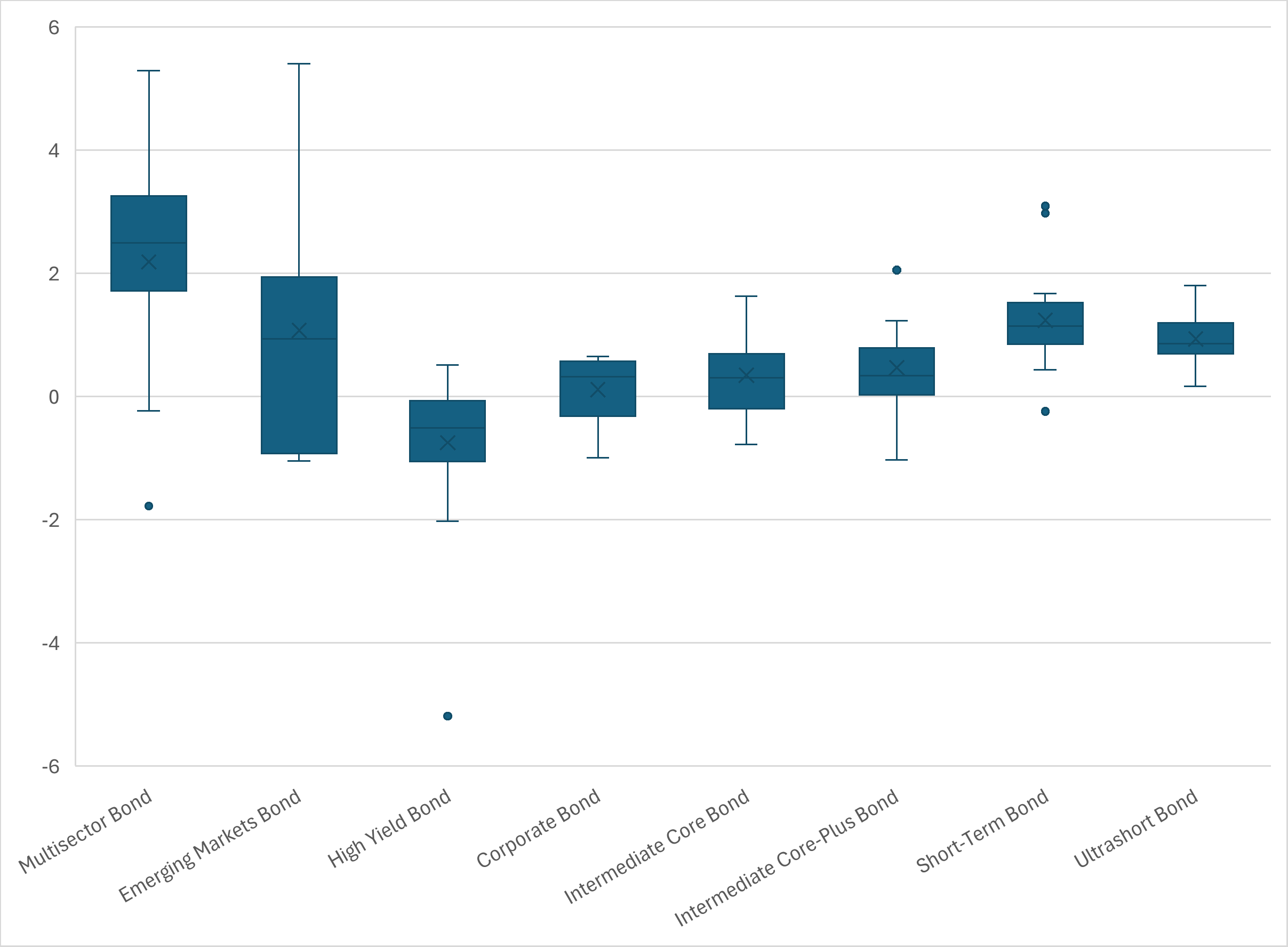
Good manager selection pays in categories with a wide range of outcomes.
Consider Bronze-rated Franklin High Yield Corporate ETF FLHY and Neutral-rated First Trust Tactical High Yield ETF HYLS. The Medalist offering outpaced both First Trust Tactical High Yield ETF and the ICE BofA US High Yield, the category index, between its 2018 inception and January 2026 by 1.8 and 0.6 percentage points annualized, respectively. It managed this with lower volatility than the category index and comparable volatility to First Trust Tactical High Yield ETF, resulting in better risk-adjusted returns than both. Beyond capturing more of the market’s upside, the managers’ ability to steer Franklin High Yield Corporate ETF through two major market crises during its life helped preserve this ETF’s edge.
Medalist-Rated Bond ETFs at Your Service
Active bond ETF outperformance typically comes with higher risk. A good active manager can make sure investors are well compensated for it. Choosing an experienced management team with a consistent track record, especially through market stress, should serve investors well.
Exhibit 4 showcases our highest-conviction Medalist-rated active bond ETFs. All charge competitive fees in their respective categories, which should only bolster the advantage earned from a sound investment process and capable management team.
Medalist Active Bond ETFs
The author or authors do not own shares in any securities mentioned in this article. Find out about Morningstar’s editorial policies.

 United States