
At Vanguard, a Tale of Two Volatilities
These two Vanguard bond funds dramatize the trade-off between income and price stability.


Charles Dickens’ A Tale of Two Cities famously begins, “It was the best of times, it was the worst of times.” Fixed-income investors have lived their own version of this paradox over the past five years. The pandemic ushered in an era of unprecedentedly low interest rates, driving bond-fund net asset values to historic highs but slashing income to unprecedented lows. As inflation pressures mounted, the Federal Reserve reversed course with aggressive rate hikes, flipping the narrative: NAVs sank while income recovered. For bond investors, these years have highlighted the delicate balance between income and price stability.
To illustrate this, we compare two Vanguard bond funds: Vanguard Short-Term Investment-Grade VFSUX and Vanguard Intermediate-Term Investment-Grade VFIDX. These funds, similar in asset-class and credit exposures but differing in duration profiles, showcase the trade-offs that investors face when selecting a bond strategy.
Income Volatility: Navigating Rate Swings
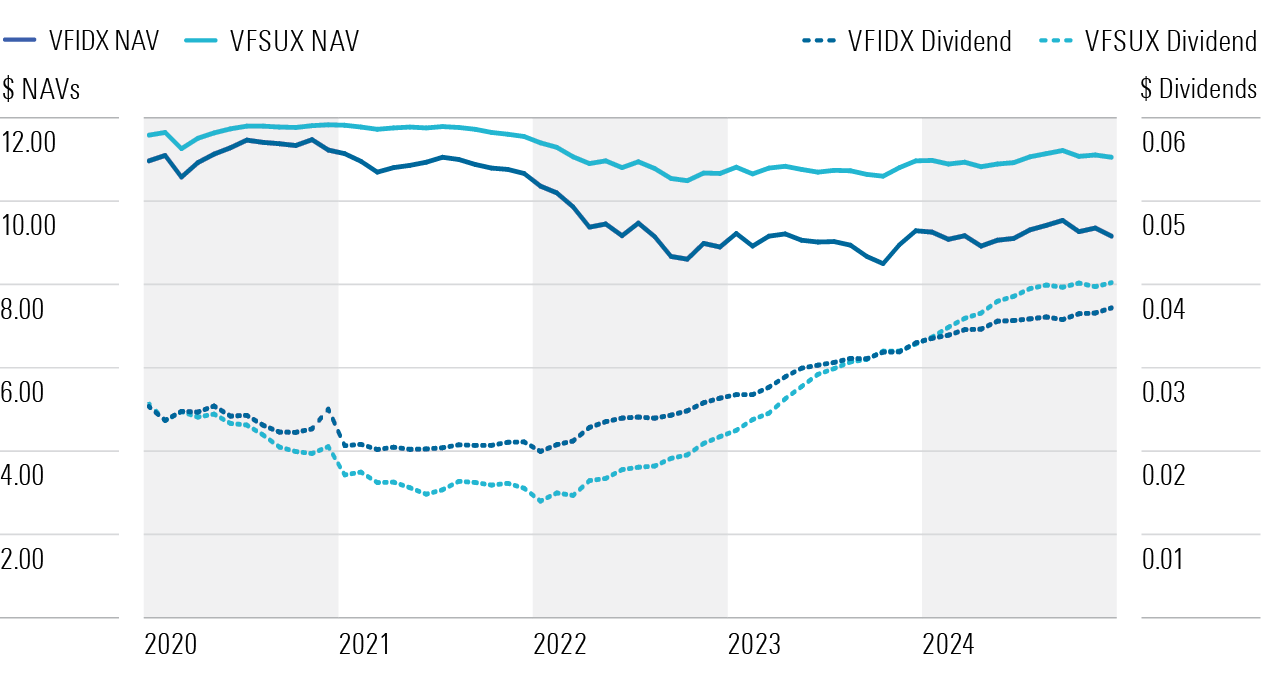
Bond-fund income reflects the interest earned on holdings. Vanguard Short-Term Investment-Grade, with a typical duration of 2.0 to 3.0 years, is highly sensitive to rate movements. In 2020–21, as interest rates hit rock bottom, the fund’s monthly income dropped some 45% as bonds maturing in this period were replaced with lower-yielding securities.
Vanguard Intermediate-Term Investment-Grade, with a longer duration of 5.0 to 7.0 years, displayed more income stability. The longer maturities meant it was less affected by reinvestment at lower rates, resulting in a smaller decline (20%) in monthly income.
When rates began to rise in 2022, Vanguard Short Term Investment-Grade was quick to respond, with its income nearly tripling by the end of 2024. Vanguard Intermediate-Term Investment-Grade also experienced a recovery, though at a more measured pace. By November 2024, both funds were generating income above their January 2020 levels, with the short-term fund benefiting more from the rising-rate environment.
Price Volatility: The Cost of Stability
NAVs tell the other side of the story. Vanguard Short Term Investment-Grade, with its short duration, experienced relatively mild price movements during these periods of volatility, with a maximum decline of 9%. Vanguard Intermediate-Term Investment-Grade, more sensitive to rate changes because of its intermediate duration, saw a more significant NAV drop of 22%. These contrasting trends highlight the inverse relationship between income stability and price sensitivity.
Visualizing the Trade-Offs
The exhibit consolidates NAV and income data, plotting NAV on the left axis and income on the right. This visualization highlights the differing behaviors of the two funds. Vanguard Short-Term Investment-Grade showcases greater agility in adapting to rate changes, while Vanguard Intermediate-Term Investment-Grade strikes a middle ground, offering higher income potential at the cost of greater price volatility.
Vanguard Short-Term Investment-Grade VFSUX and Vanguard Intermediate-Term Investment-Grade VFIDX
Key Takeaway
Choosing the right bond fund ultimately depends on goals and risk tolerance. Investors prioritizing stability may prefer shorter-duration funds like Vanguard Short-Term Investment-Grade, which recover income quickly and avoid sharp NAV declines. Those tolerant of price volatility may find higher income potential with options like Vanguard Intermediate-Term Investment-Grade.
This article first appeared in the February 2025 issue of Morningstar FundInvestor. Download a complimentary copy of FundInvestor by visiting this website.
The author or authors do not own shares in any securities mentioned in this article. Find out about Morningstar’s editorial policies.

 United States