
ETF quote page
Learn how to locate and gain insights from Morningstar.com’s exchange-traded fund (ETF) quote pages.
Morningstar’s ETF quote pages feature key performance and operations information on individual exchange-traded funds, including portfolio allocations, risk metrics, management insights, and more. To find an ETF’s quote page, type a ticker or fund name into the search bar on any page of Morningstar.com. Morningstar Investor subscribers get unlimited access to our analysis and opinions on the fund along with expanded performance information.
Below is an overview of key metrics contained in each area of the page that can help you assess that ETF’s potential strengths and long-term value.
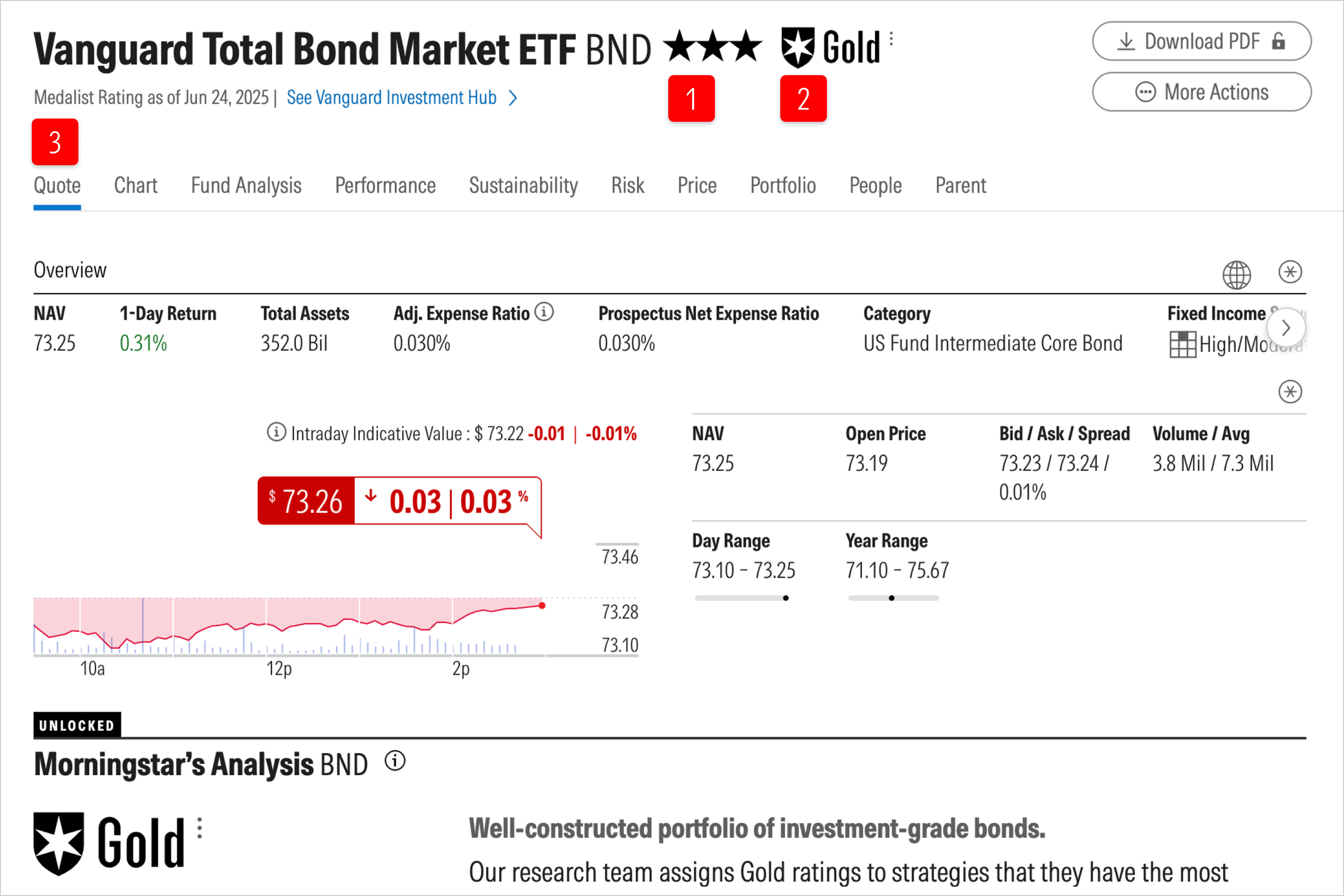
1. What is Morningstar’s overall opinion of the ETF?
The Morningstar Medalist Rating is the forward-looking assessment of an investment strategy. The rating is on a five-tier scale running from Gold to Negative. For actively managed funds and ETFs, Morningstar assigns Gold, Silver, and Bronze ratings to vehicles expected to add value over the long term when compared with a relevant Morningstar Category index after accounting for fees and risk. For passive strategies, funds and ETFs with the top ratings are expected to deliver alpha that exceeds the lesser of the category median net alpha, or zero, over the long term.
The following pillars are used to designate an appropriate Morningstar Medalist Rating for each respective ETF:
- Parent: This pillar analyzes the parent organization in charge of managing the ETF.
- People: This pillar evaluates the managers who are responsible for making key decisions regarding the fund.
- Process: This pillar determines whether the strategies a parent organization applies to the ETF is both effective and repeatable.
2. How has the ETF performed against its peers?
The Morningstar Rating for funds and ETFs (commonly called the “star rating”) is a backward-looking assessment of an ETF’s risk-adjusted performance compared with its category peers. Its peer group, or Morningstar Category, is located in the data table below the ETF’s name.
3. Quote tab
The Quote tab provides a high-level overview of the ETF’s trading information, operations and Morningstar's overall take.
- The top data table provides trading information, current category, dividend yield, overall size, and fees.
- The Morningstar Analysis provides a preview of the Pillar assessments for the ETF. This analyst-curated insight is a key benefit of the Morningstar Investor membership (along with investment research tools such as an investment Screener, Watchlist, and Portfolio application). Learn more here.
- Performance and Portfolio sections offer insight into the ETF’s performance history compared with peers and a snapshot of top holdings, respectively.
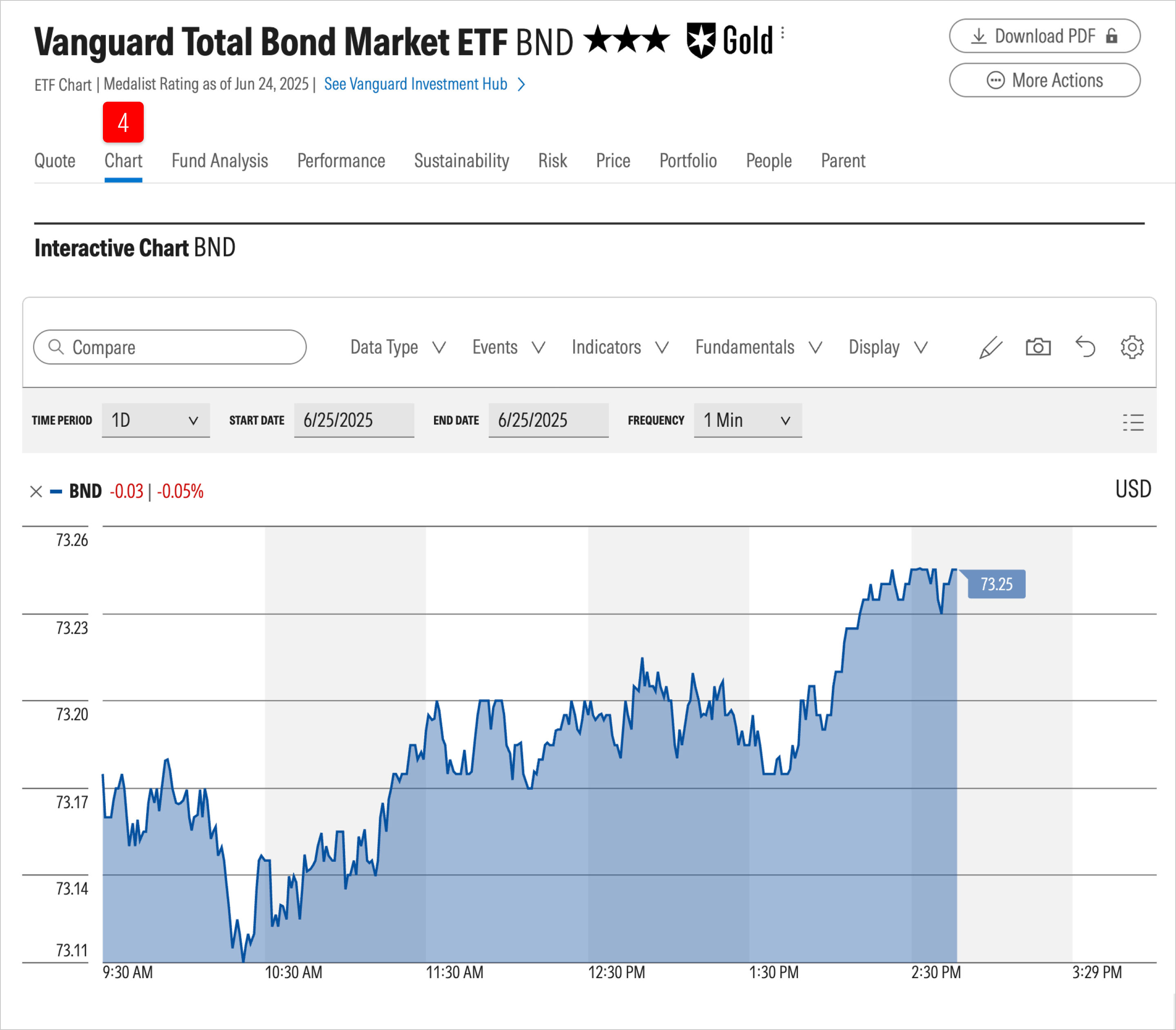
4. Chart tab
Users can view the historical performance of the ETF alongside other investments such as stocks, mutual funds, and market indices. Various technical tools, such as moving averages and dividends, are also available.
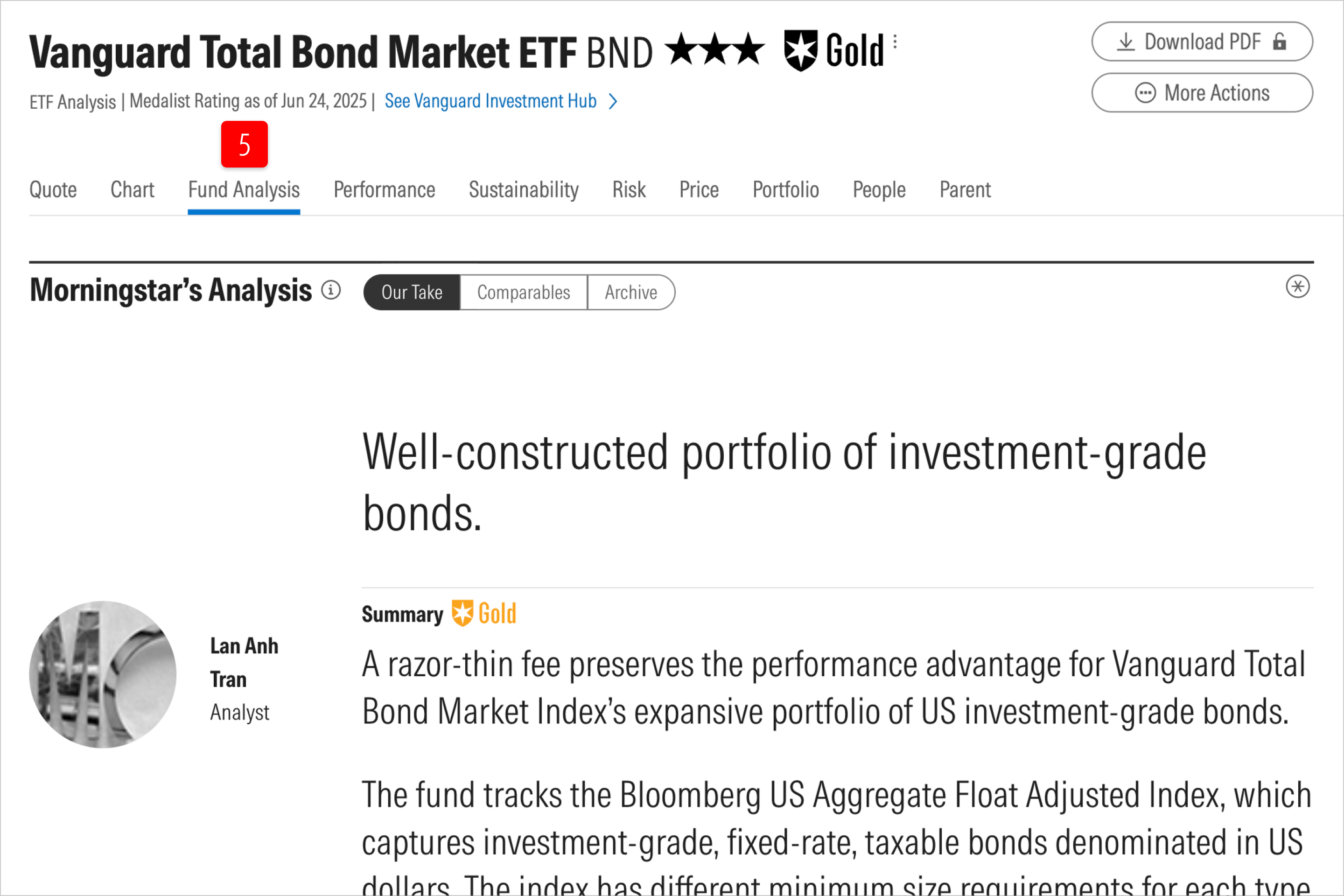
5. Fund Analysis tab
As mentioned above, this section provides the text and rationale for Morningstar Medalist Rating assigned to the ETF.
The rating is on a five-tier scale running from Gold to Negative. For actively managed funds and ETFs, Morningstar assigns Gold, Silver, and Bronze ratings to vehicles expected to add value over the long term when compared with a relevant Morningstar Category index after accounting for fees and risk. For passive strategies, funds and ETFs with the top ratings are expected to deliver alpha that exceeds the lesser of the category median net alpha, or zero, over the long term.
The following pillars are used to designate an appropriate Morningstar Medalist Rating for each respective ETF:
- Parent: This pillar analyzes the parent organization in charge of managing the fund.
- People: This pillar evaluates the managers who are responsible for making key decisions regarding the fund.
- Process: This pillar determines whether the strategies a parent organization applies to a fund is both effective and repeatable.
The analysis also includes an assessment of the ETF’s performance, fee level, and information on its sustainability profile.
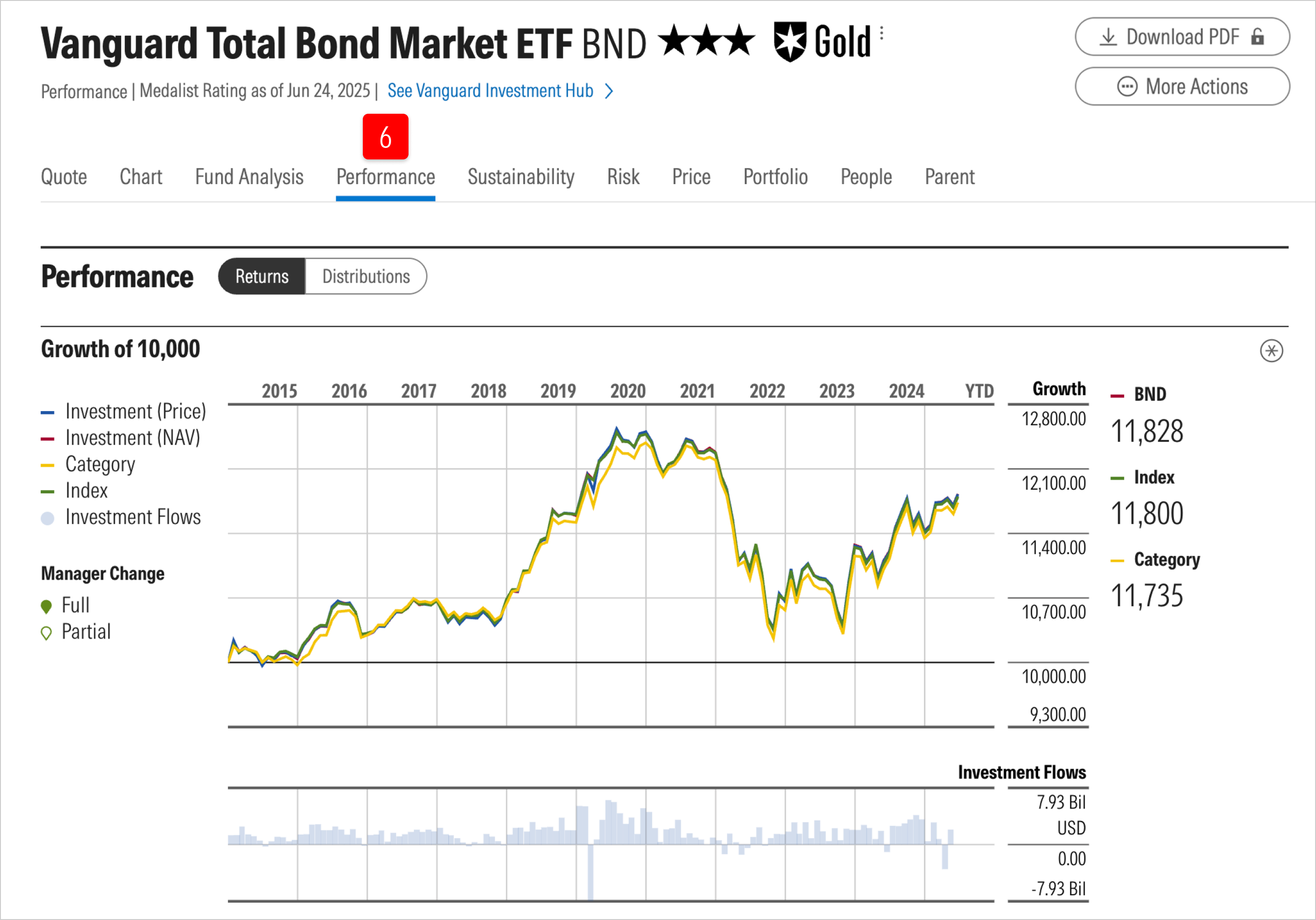
6. Performance tab
A fund’s performance tables allow for a quick comparison between the ETF, its category peers, and a relevant market index over multiple time periods. The top graph also overlays any partial or total management changes to assess the relevancy of the past performance compared with the current portfolio managers. (More information about management changes is available on the People tab.)
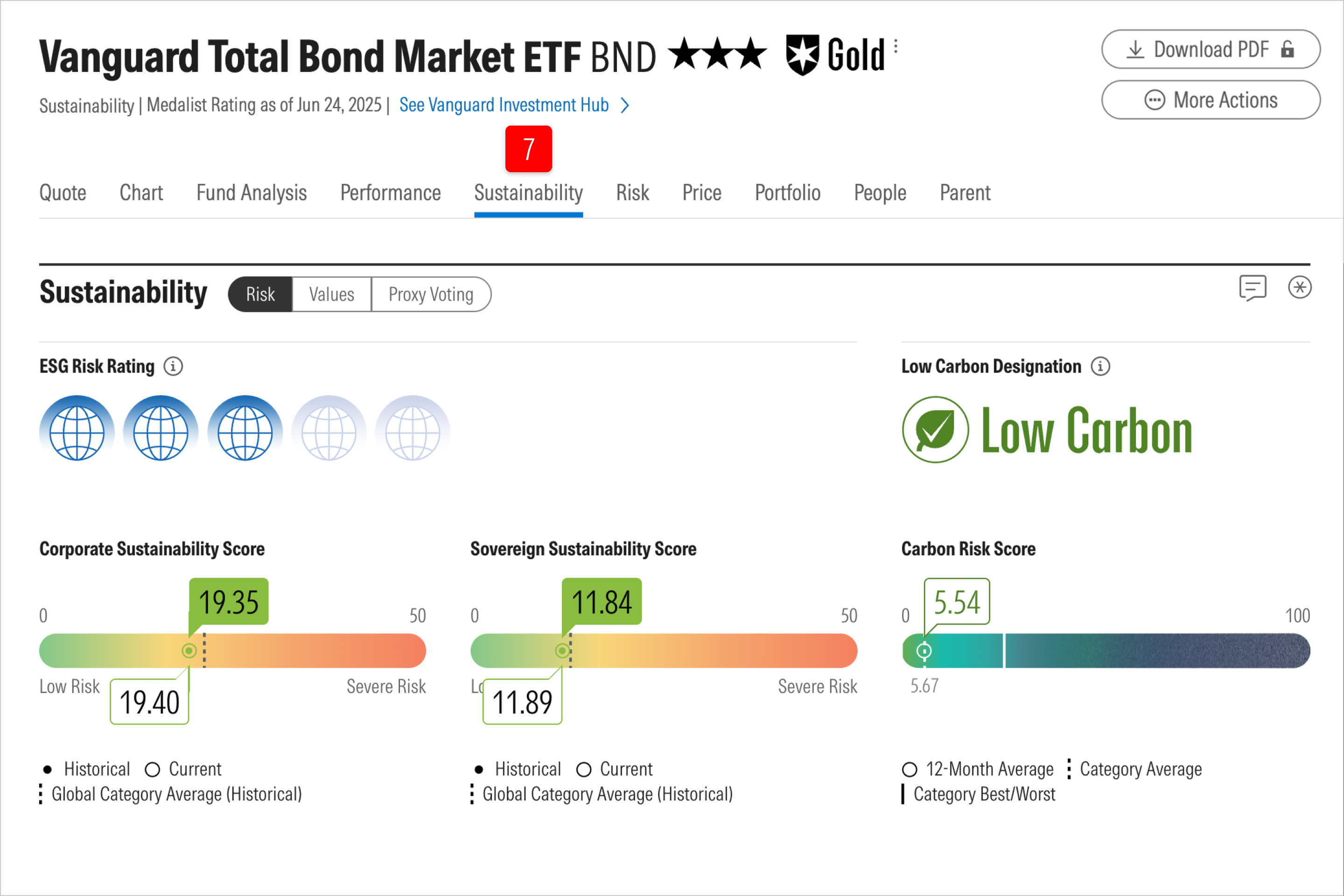
7. Sustainability tab
This section provides aggregated data on the ETF’s underlying holdings, culminating in an overall Sustainability Rating. The rating is a measure of how well a portfolio's holdings are managing their environmental, social, and governance (ESG) risks relative to the portfolio’s Global Category peer group. ESG risk considers how material ESG issues (such as resource management and labor relations) could influence a company's economic value. If available, this section also contains commentary from the research team on how ESG components factor into the fund’s security selection process.
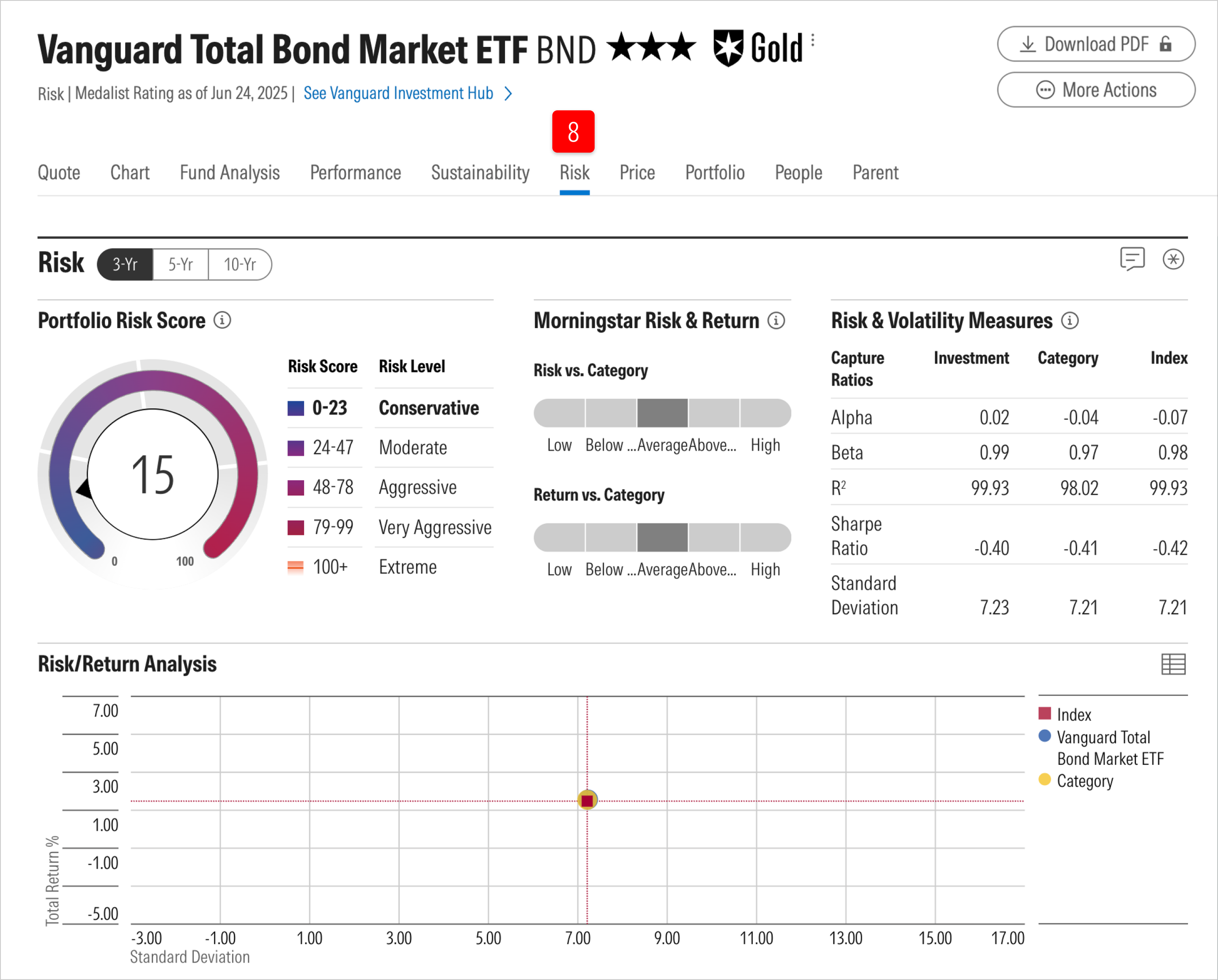
8. Risk tab
Return matters little if you do not understand how much risk was taken to generate said return. In the Risk tab, we lay out the standard risk metrics (Alpha, Beta, Volatility, etc.) of an ETF, along with capture and drawdown ratios. Morningstar’s proprietary Portfolio Risk Score also gives users a holdings-based assessment of the investment portfolio, ideal for comparison against other potential investments.
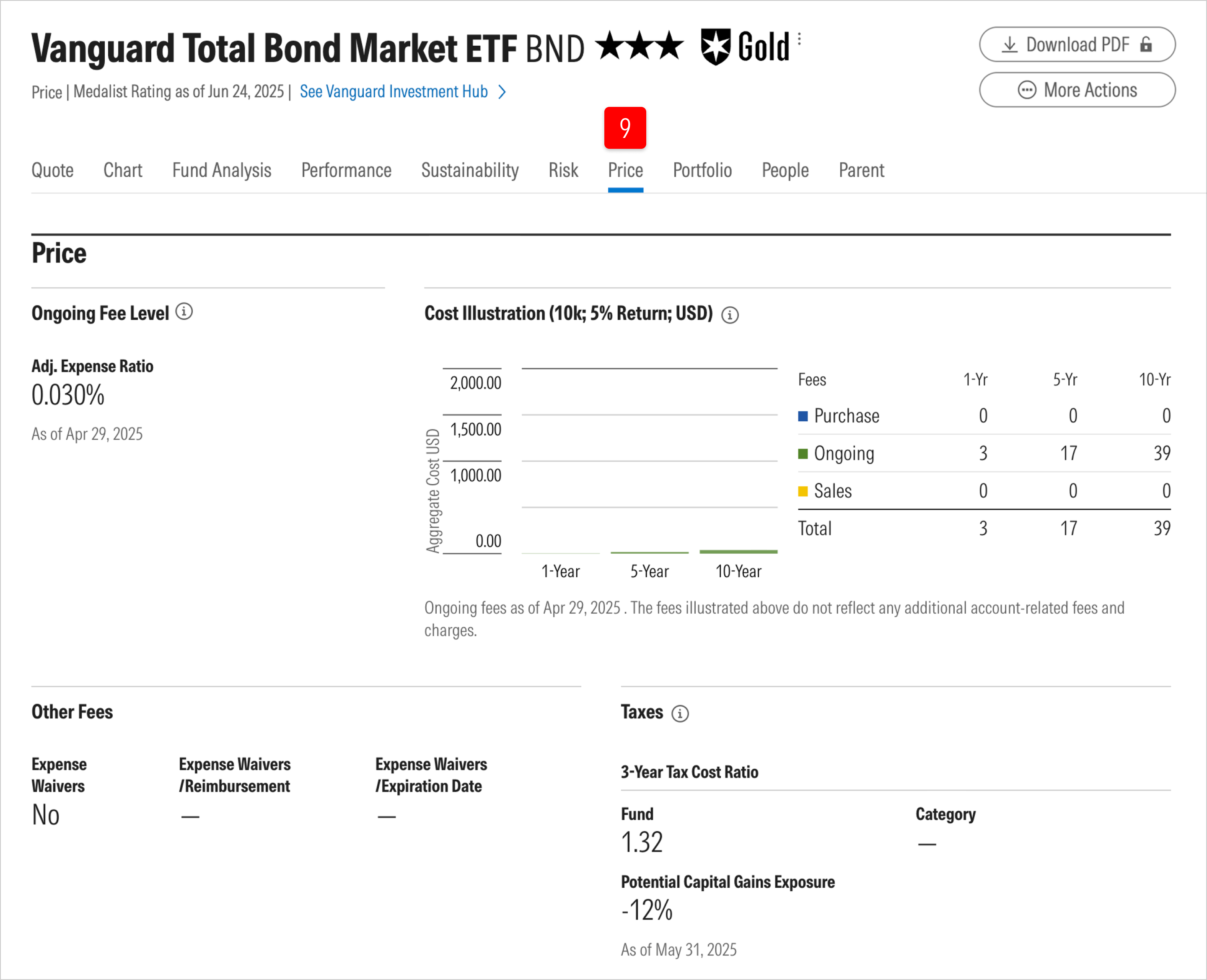
9. Price tab
As mentioned above, fees directly reduce the return available to investors. As such, an ETF’s relative fee level can have a material impact on its ability to outperform peers. The section provides information on both fees and estimated taxes. Generally speaking, ETFs tend to have lower relative fees compared with mutual funds. This is due in part to lower internal operating costs and management. A large majority of assets in the ETF space are in funds that simply track a market index, rather than a more active strategy where managers actively buy and sell securities to outperform an index or benchmark.
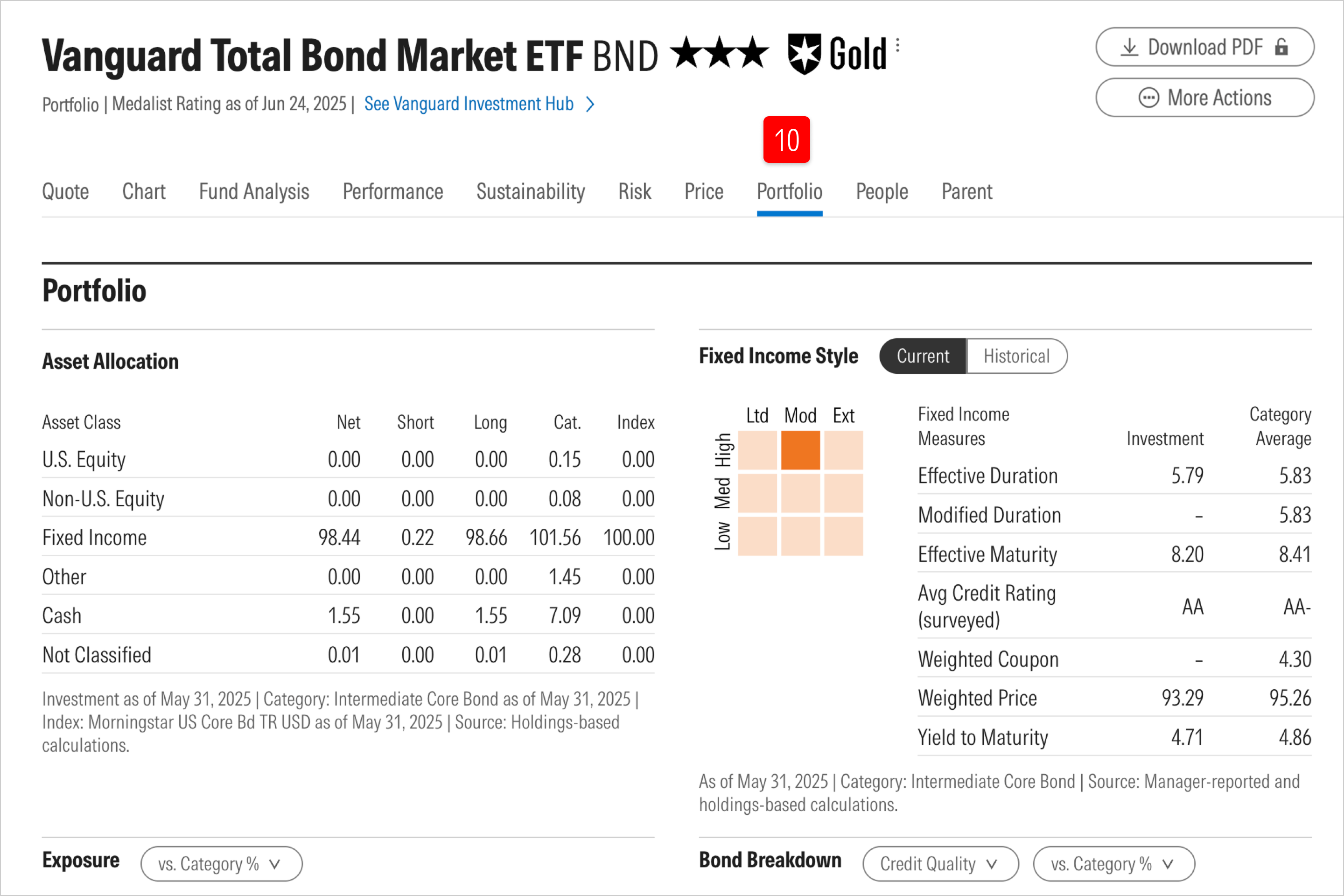
10. Portfolio tab
Morningstar’s Portfolio tab is enhanced with insights into investment factors such as growth, value, and momentum, among other metrics, that can help you understand the characteristics of the stocks held by equity portfolios, if applicable. In the Financial Metrics section of this tab, you’ll find a breakdown of exposure to stocks with varying economic moats. An economic moat is a durable, material competitive advantage that allows a company to earn excess returns on capital for an extended period of time and keep competitors at bay. Our analysts assign every company they cover an economic moat rating of wide, narrow, or none. In the Holdings section at the bottom of this tab, you can check out what a manager has recently bought or sold and see how long a holding has been in the portfolio.
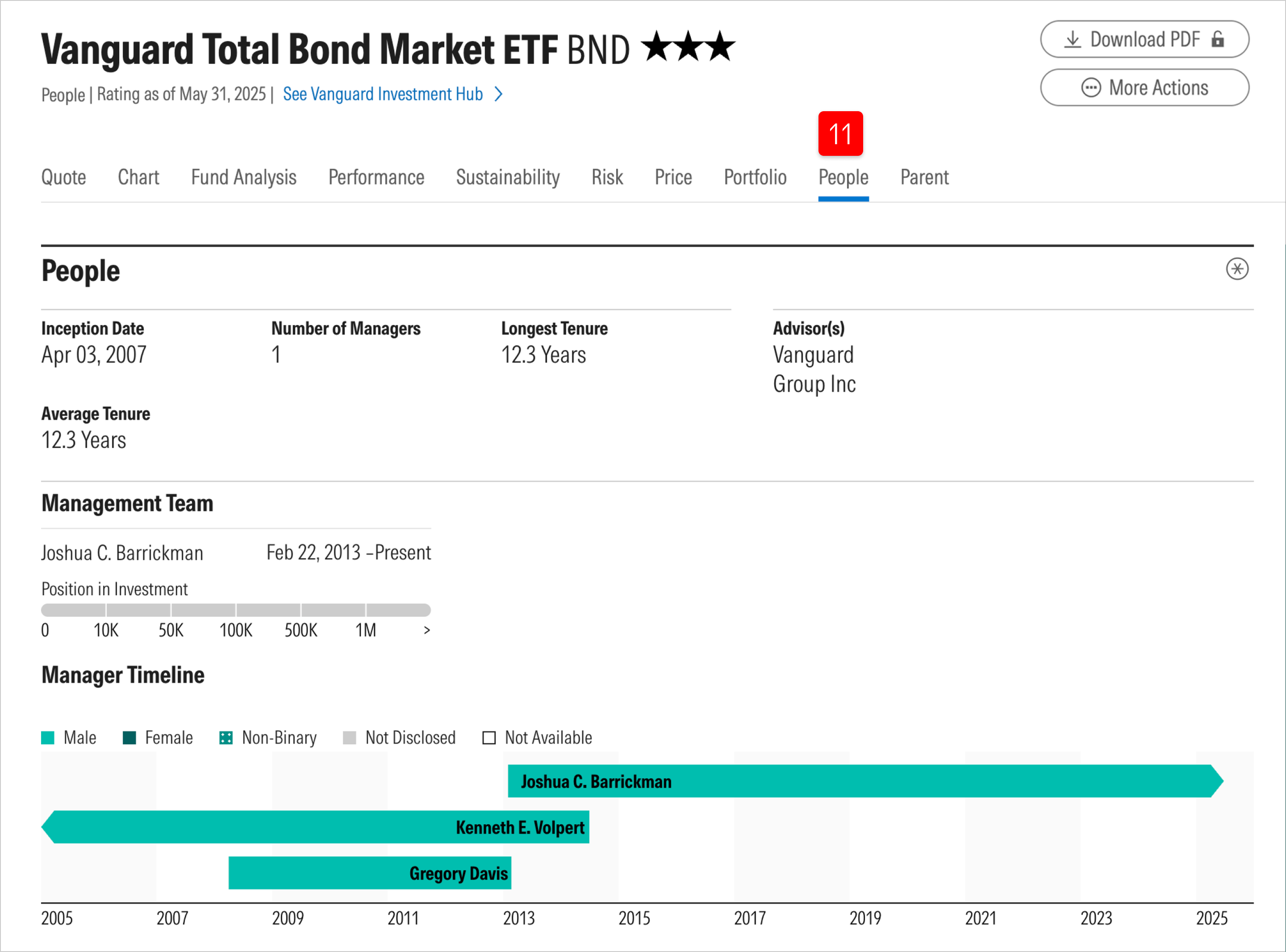
11. People tab The people referenced here are the portfolio managers on the ETF. A portfolio manager has day-to-day responsibility for monitoring the holdings and executing changes, and on this tab, you can examine managers’ tenure lengths and investments in the ETF. Investment in a fund helps align a manager’s financial outcomes with that of the fund investors. At the bottom of the tab, you’ll find a summary of the team’s record of voting on management and shareholder resolutions of the portfolio holdings.
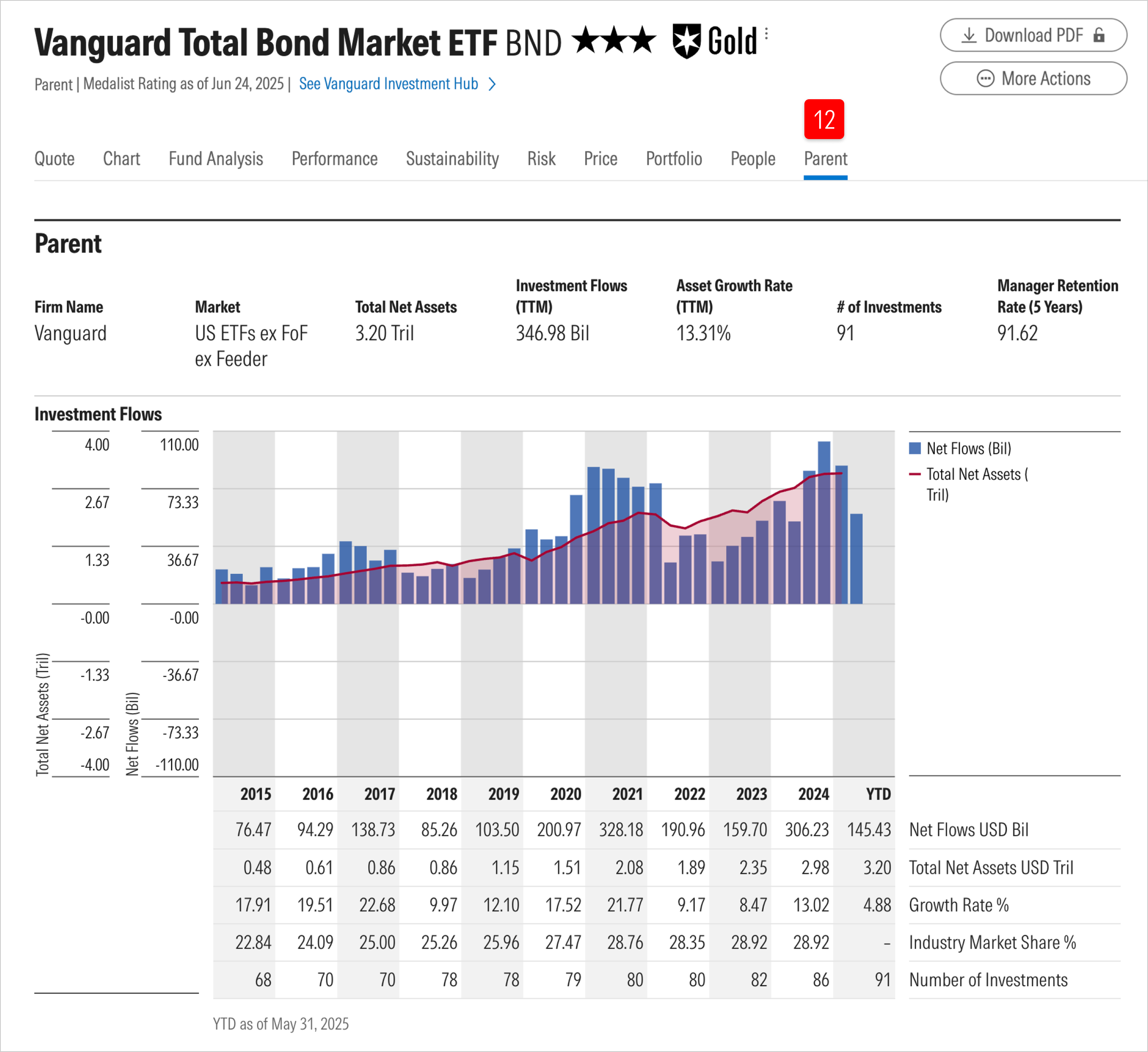
12. Parent tab
The parent overview provides a holistic picture of the ETF’s management company. Included here are the number of funds, asset flows across the company, and a breakdown of funds and ETFs by Morningstar Medalist and Star Rating. This tab features a concise, visual summation of how the firm manages money across style, market cap, and asset classes. For additional parent information, click on the “See (firm name) Investment Hub” link right below the ETF’s name at the top of the page.

 United States