
13 Charts on Q4’s Tech Sector Market Jitters
Investors questioned the AI trade, and the Fed cut rates as the job market cooled.

Key Takeaways
- Stocks climbed 2.4% in the fourth quarter, with broader gains tempered by selloffs and volatility in the tech sector.
- Value stocks rallied as growth stocks faltered.
- Bonds mostly posted gains as the Federal Reserve cut rates and data showed a weakening jobs market.
US stocks pushed to record highs in the fourth quarter of 2025, but the upward momentum cooled as some investors began to doubt the durability of the artificial intelligence trade, which had led the market higher. Other sectors like healthcare pulled ahead, as did value stocks, leading some to begin positioning for another market rotation.
All told, stocks finished the quarter in the green, gaining 2.43% and ending 2025 up 17%.
As the Federal Reserve cut interest rates and economic data suggested a softening jobs market, bonds edged higher in the quarter, with the Morningstar US Core Bond Index returning 0.97%. Amid gains in stocks and bonds, it was a brutal quarter for cryptocurrencies, with bitcoin at one point losing 30% of its value in a leverage-fueled plunge.
Key Stats: Q4 Stock and Bond Market Performance
- Stocks ended the quarter 2.4% higher as measured by the Morningstar US Market Index, even after multiple selloffs in the tech sector sent the overall market into the red in October and November.
- Value stocks pulled ahead of growth stocks as mega-cap tech firms struggled, with the Morningstar US Value Index returning 4.15%, compared with a 1.61% loss for the Morningstar US Growth Index.
- Dividend stocks kept up with the broader market, with the Morningstar Dividend Composite Index returning 2.37%.
- The US Core Bond Index returned 0.97% for the quarter. An unusually fractured Fed cut interest rates in October and December, and is widely expected to pause on addition rate cuts at its upcoming meeting in January.
- Gold climbed 12% as investors continued to flock to the safe haven asset.
- Bitcoin prices plunged 24% amid a dramatic “mini winter” selloff in cryptocurrencies.
Q4 Stock Market Performance
Gains in the equity market were more muted in the fourth quarter as the tech rally stalled. The US Market Index rose 2.4% in the last three months of the year, following an 8.09% rally in the third quarter.
The Morningstar Wide Moat Composite Index, which includes stocks Morningstar analysts believe have the largest and most durable competitive advantages, gained 3.47% for the quarter, compared with a 8.7% return in the previous period.
Losses in tech stocks weighed heavily on the market overall, sparked by renewed worries that AI-related companies like Nvidia NVDA and Oracle ORCL, which led the market rally for months, would not be able to deliver on Wall Street’s expectations for powerful profit and share price growth.
Also weighing on tech stocks were concerns about the enormous borrowing the so-called “hyperscaler” firms are undertaking to fund the development of AI infrastructure. Analysts say that with more debt and less cash on hand, these companies have little margin for error to meet investor expectations.
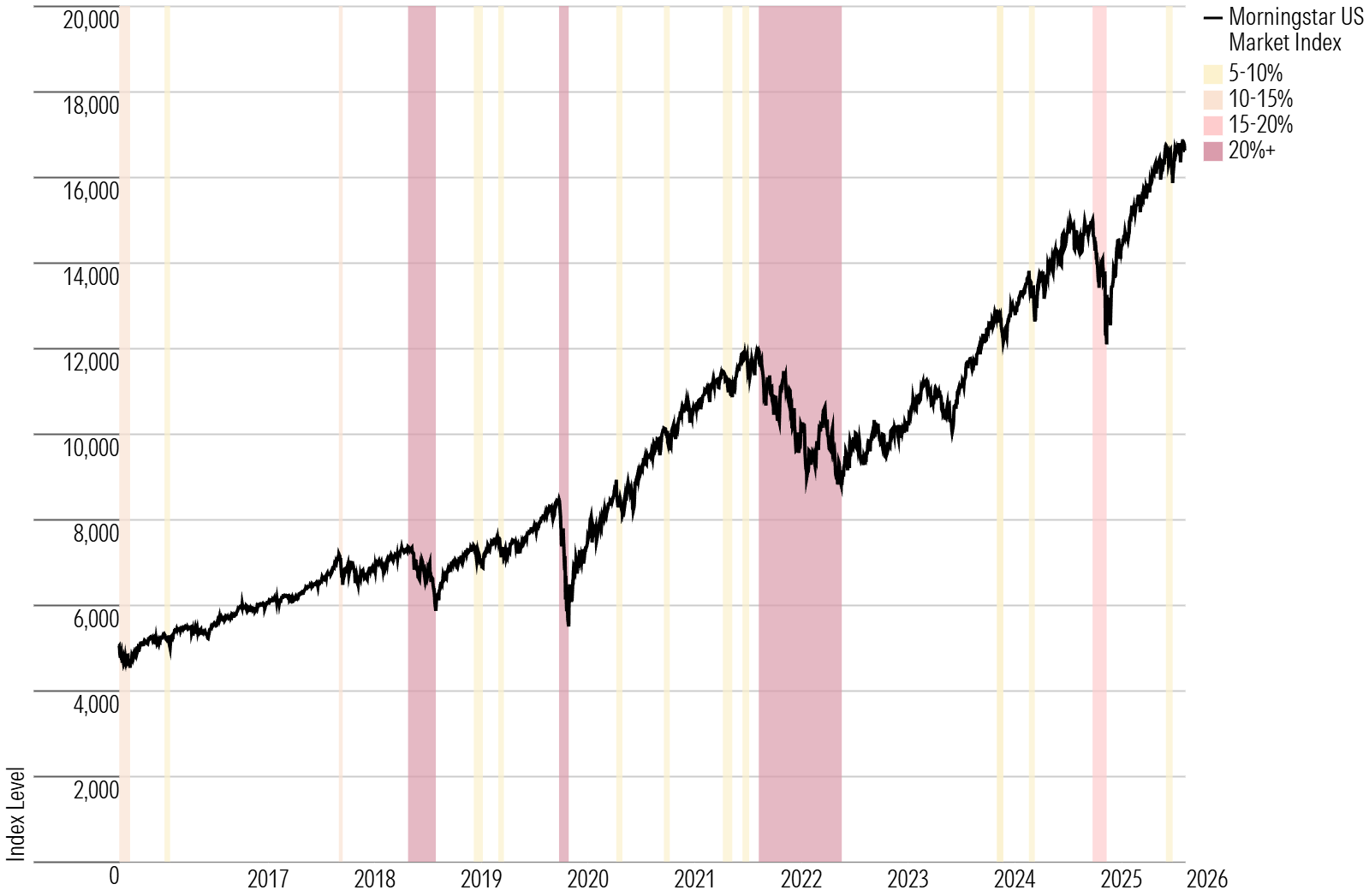
US Stock Market Pullbacks
Value vs. Growth Performance
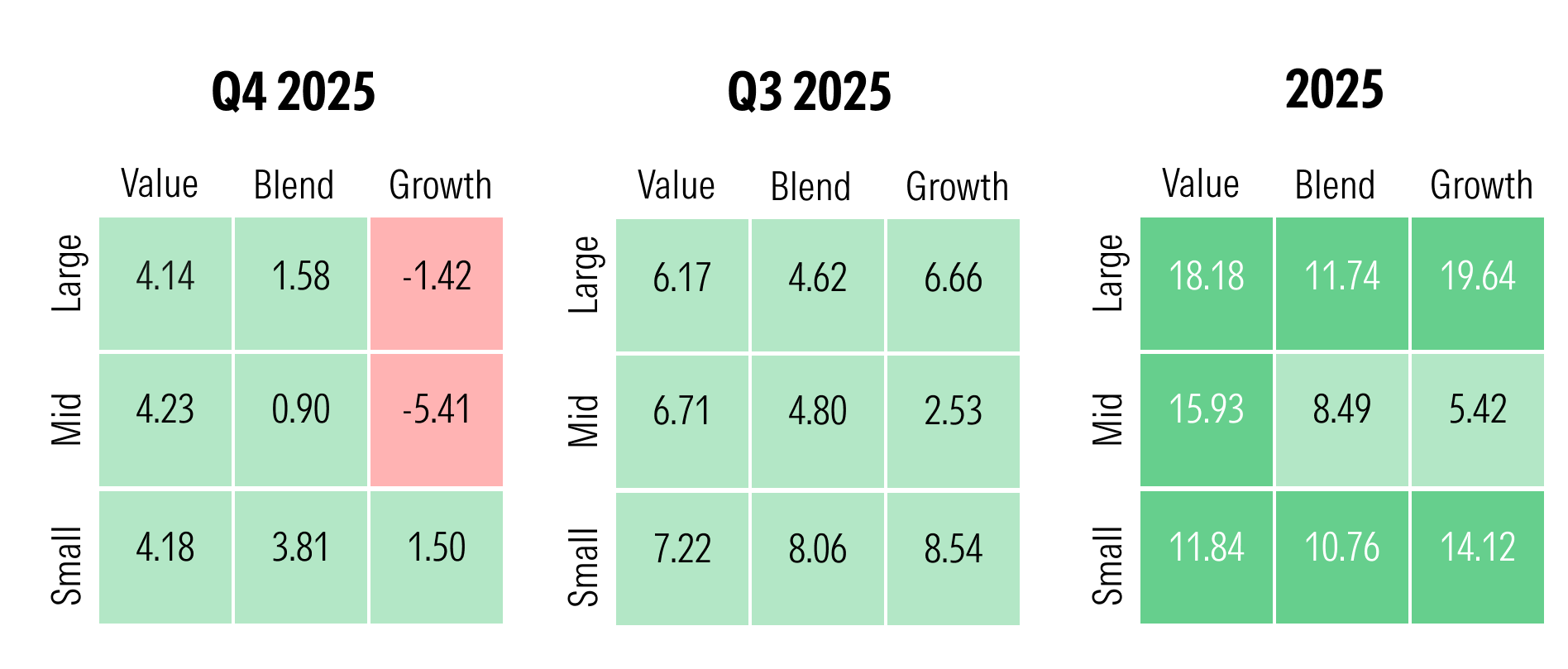
Within the Morningstar Style Box, value stocks surged ahead of growth. Mid-cap value stocks saw the best returns, climbing 4.23% over the fourth quarter. The small-cap value category returned 4.18%, while small-cap growth stocks gained 1.50%. Large-cap value stocks returned 4.14%, compared with losses of 1.42% for the large-cap growth category. Large-cap growth stocks were the best performers in 2025 despite those losses, gaining 19.64% overall. Mid-cap growth stocks performed worst in the fourth quarter, falling 5.41%.
US Equity Style Box Performance
Stock Sector Performance
As tech stocks faltered, some of the market’s previous laggards surged ahead. After trailing the broader market all year, healthcare was the best-performing sector in the quarter, rising 11.27%—more than double its 4.5% return in the third quarter.
Financial services stocks returned 2.50%, more muted than their third-quarter performance, while industrials returned 2.09%. Utilities stocks—which have seen their fortunes increasingly intertwined with the tech industry, thanks to ballooning demand for data centers—fell 1.35%. Real estate performed worst in the quarter with losses of 1.95%.
Q4 Dividend Stock Performance
Dividend stocks performed in line with the broader market in the fourth quarter, with the Dividend Composite Index returning 2.4%. The Morningstar US Dividend Growth Index rose 2.6% while the Morningstar Dividend Leaders Index, which includes the 100 stocks from the Composite Index with the highest yields, gained 3.5%.
Global Market Performance
As was the case for much of the year, US equity markets lagged their global counterparts in the fourth quarter as the tech selloff weighed on US returns. Canadian stocks outperformed with a rally of 7.95%, while the Morningstar UK Index rose 6.51%. The biggest reversal among major markets came in Chinese stocks, which fell 6.8% after surging more than 20.0% in the third quarter.
Fed Continues Cutting Interest Rates
The Fed cut interest rates twice in the quarter after cutting once in the previous quarter. This took the federal-funds rate target to a target range of 3.50%-3.75%, down from 4.25%-4.50% at the start of 2025.
These cuts came amid a rare lack of consensus among central bankers, and all were accompanied by at least one dissenting vote within the policy-setting Federal Open Market Committee. Some officials have advocated for further cuts to support a cooling labor market and provide insurance against a possible economic slowdown, while others have opposed cuts to protect against upside risk from inflation, which has fallen dramatically since 2022 but remains above the Fed’s 2% target.
Wall Street is still waiting for the Trump administration to announce Jerome Powell’s successor as chair of the central bank. They expect whoever it is to favor further easing. Still, analysts anticipate that the Fed will pause at its first meeting of 2026, with bond futures markets pricing in just 15% odds of a cut then, according to the CME FedWatch Tool.
Q3 Bond Market Performance
The bond market notched another solid quarter and closed out the year on a high note, with the US Core Bond Index returning 0.97% in the fourth quarter and 7.12% for the year.
The yield on the 10-year Treasury note ended the quarter at 4.18%, slightly higher compared with the beginning of October. The 30-year Treasury bond ended the quarter at 4.84%, down from a peak above 5.0% over the summer. Overall, the US Treasury Bond Index returned 0.77% in the quarter and 6.17% in 2025.
The strongest returns among major bond market benchmarks came on US mortgage-based securities, which gained 1.59%. High-yield bonds returned 1.40%, municipal bonds returned 1.48%, and intermediate maturity bonds gained 1.35%.
The Yield Curve Steepens
Short-term yields fell over the fourth quarter as the Fed cut rates, setting the stage for further steepening in the yield curve—a graphical representation of government bond yields across different maturities, most commonly between two- and 10-year bonds. It measures how much extra compensation bond investors demand for the extra risk of having money locked up with the federal government for longer periods. A steeper curve means investors are demanding more yield in exchange for that risk.
At the end of the fourth quarter, the spread between the 10-year and the two-year Treasury yield was 0.71 percentage points, wider than the 0.56-point gap at the end of the third quarter.
Stock and Bond Volatility
Volatility in the US, developed, and emerging markets increased in the quarter as tech stocks whipsawed. On the other hand, volatility in the bond market fell even further below its five-year average than in recent quarters.
Cryptocurrency Performance
After climbing for much of the year on optimism surrounding crypto-friendly regulatory developments in Washington and momentum from a surging tech sector, bitcoin saw a major reversal in the fourth quarter. The price of the most popular cryptocurrency plunged more than 23% in a selloff that rattled Wall Street, with investors pulling money from digital asset funds at a record pace. Analysts said the plunge was driven by massive selling from players who had bought cryptocurrencies using borrowed money.
Bitcoin finished 2025 below $89,000 per coin, down from a high above $123,000 in early October. Ether, the second-most-popular cryptocurrency, suffered even steeper losses.
Commodity Market Performance
As bitcoin and other risk assets plunged, gold prices continued to soar to one record high after another. The precious metal gained more than 12% in the fourth quarter as a monthslong rally continued, spurred by a combination of equity market jitters and trade and geopolitical uncertainty. Investors often view gold as a safe haven, and it tends to be more attractive during economic upheaval. Copper prices soared too, with gains of 17%.
On the other side of the equation were crude oil prices, which extended a slump as the United States and OPEC+ member countries ramped up production, increasing supply and driving prices lower.
The author or authors do not own shares in any securities mentioned in this article. Find out about Morningstar’s editorial policies.

 United States