
June CPI Report Forecast to Show Slowing Overall Inflation, but Not Slow Enough for the Fed
Core CPI still seen as sticky, elevated by the CPI’s reading on rental costs.

Forecasts call for the June Consumer Price Index report to offer some good news on the overall rate of inflation, with help from lower prices on gasoline and used cars.
Despite that good news, inflation excluding food and energy costs—a key measure for the Federal Reserve—is seen staying high, which is expected to mean another rate hike is on its way from the central bank later this month.
With the June report from the Bureau of Labor Statistics due out Wednesday morning, economists are calling for inflation to clock in at just over a 3% annual rate, which would be the slowest year-over-year increase in the CPI since March 2021 and down significantly from the 9.1% rate in July 2022, when inflation was running at a four-decade high. It would also make a meaningful drop from the 4.0% increase in the CPI that was reported for May.
For June, economists forecast a 0.3% rise in the CPI from May, which would be a faster pace than recorded in last month’s report, but still below 2023′s trend so far.
CPI vs. Core CPI
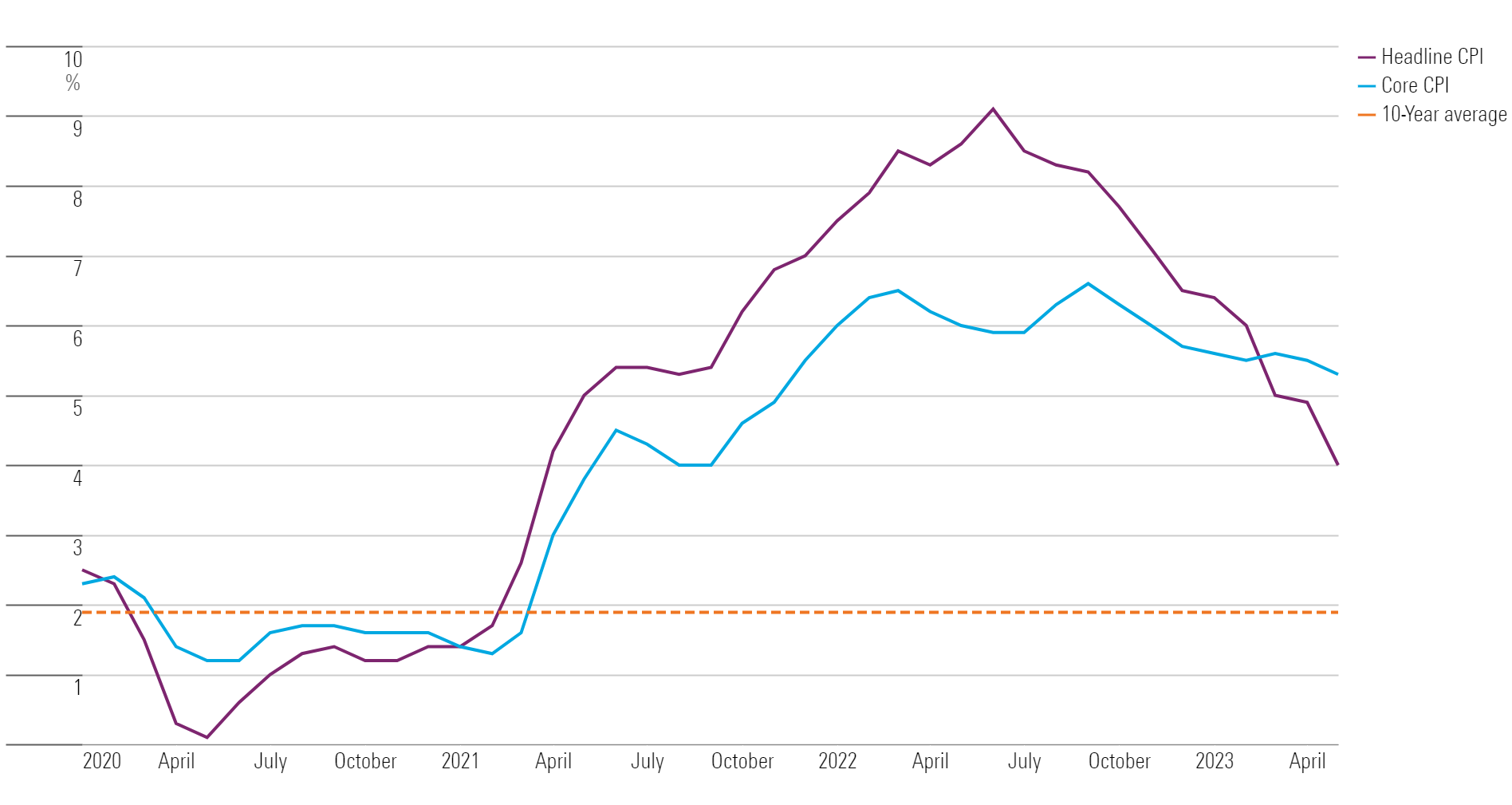
Overall CPI Falling Fast
“Headline inflation is falling very rapidly and right in line with what history suggests, which is that steep increases in inflation are followed by similarly large decreases in headline inflation,” says Joseph LaVorgna, chief economist at SMBC Nikko Securities. “So we’re going to have a headline number that would be somewhere in the low threes come from Wednesday, and that’s of some importance because that’s going impact inflation expectations.”
However, under the hood, forecasts call for a more mixed picture from the CPI. When volatile food and energy costs are excluded from the picture, the underlying rate of inflation is expected to remain more than double what the Fed is targeting. With that backdrop, the regulator is seen as on track to raise interest rates by another quarter-point when officials meet later this month to set monetary policy.
“Unless there’s a downward surprise in the core CPI, it’s flat, or there’s a 0.1% increase, I think the Fed is going to look past it,” says LaVorgna.
June CPI Report Forecasts
Forecasts for the June CPI report predict that headline inflation will slow but core prices will keep rising, according to FactSet.
- The CPI is forecast to rise 0.3% in June after rising 0.1% in May.
- Core CPI is forecast to rise 0.3% for the month versus 0.4% in May.
- The CPI year over year is forecast to rise 3.1% in June after rising 4.0% in May.
- Core CPI year over year is forecast to rise 5.0% versus 5.3% in May.
Watching Rent Costs Impact CPI
One of the key factors keeping inflation elevated has been housing costs, thanks to owners’ equivalent rent and tenants’ rent. Economists note that the CPI’s reading on rental costs has been moving lower at a significantly slower pace than what real-world costs appear to suggest should be the case.
The BLS data on rents “has a lot of inertia,” says LaVorgna. Pointing to statistics from Zillow and Reis, he explains: “We know from industry data that rents have already started moving down the way the BLS says shelter isn’t … there’s a lot more improvement there than the Fed is willing to admit.”
As a result, looking at core inflation excluding shelter costs, inflation “has come down quite significantly as well. It’s also likely to be somewhere in the low threes,” LaVorgna says.
Preston Caldwell, chief U.S. economist at Morningstar, is keeping watch on used car prices—another item in the CPI that has helped keep inflation readings high.
“We should see a substantial fall in used car prices—which have increased by 9% the past two months—over the next few months, as wholesale prices, which had increased in January and February, have dropped by 10% since March,” says Caldwell.
More broadly, Caldwell says, “I’m also looking to see whether the dramatic loosening of supply chain conditions will start to have broader deflationary effects on durable goods prices.”
Caldwell is expecting price pressures in the U.S. economy to go from inflationary to deflationary as this year progresses, allowing the Fed to start lowering rates in 2024.
CPI Not Seen Averting July Fed Rate Hike
For now, however, bond traders are seeing a Fed rate hike at the conclusion of the Fed’s July 25-26 meeting.
According to the CME FedWatch Tool, which tracks bets in the futures market on the direction of interest rates, there’s a 92% chance the Fed will raise the federal-funds rate by a quarter of a percentage point from its current target of 5% to 5.25%.
UBS economist Alan Demteister thinks the June CPI data should be welcome news for members of the policy-making Federal Open Market Committee. “However, we interpret recent FOMC communications as a strong bias toward another hike in their meeting later this month,” he says “One moderate CPI release will likely not be enough to deter the FOMC from this path (unless paired with an employment situation that comes in substantially weaker than our expectations). However, if this slowing is confirmed with another couple of moderate core CPI increases, as we expect, the FOMC is unlikely to have a second interest rate hike later this year.”
The author or authors do not own shares in any securities mentioned in this article. Find out about Morningstar’s editorial policies.

 United States